You can’t force a teenager or young adult to follow your script. Not really. Not for long. And that’s not a loss—it’s an invitation.
Your power was never in control. It was in influence. Not in volume. In trust. Not in orders. In example.
You can’t make them choose your path. But you can be the kind of person they come to when the path gets dark.
You can’t force them to listen. But you can speak with so much love and respect that your words are worth carrying.
You can’t protect them from every mistake. But you can make sure they never have to face the fallout alone.
So trade the commander’s chair for the lighthouse. A lighthouse doesn’t chase the ship. It doesn’t shout at the waves. It stands steady, shines bright, and lets the sailor choose.
Be steady. Be safe. Be honest. Be humble enough to apologize and brave enough to let go.
The young people in your life don’t need another person telling them who to be. They need someone who believes in who they’re becoming.
That’s how you lead. That’s how you love. That’s how you leave a legacy that doesn’t demand obedience—it earns respect.
Ask yourself today: Am I trying to control them, or am I trying to connect with them?
Living an Authentic Life: Swimming Through the Waves.
For years, I felt as though living my life meant swimming underneath the waves.
Submerged.
Holding my breath.
Aware that there was a storm above me, but protected from it by being beneath the surface.
It wasn’t drowning.
But it wasn’t really living either.
It was survival dressed up as safety.
I could imagine almost anything down there. I could rehearse conversations before they happened, replay conversations that already had, anticipate problems that might never arrive, and construct entire futures inside my head.
My imagination gave me somewhere to go when reality felt uncomfortable.
It also gave me somewhere to hide.
Now I’m beginning to feel as though I’m swimming through the waves.
It’s messier.
The water pushes me around. Sometimes it knocks me off balance. Sometimes I swallow water.
It’s more tiring than hiding underneath.
But I’m moving with life rather than beneath it.
I’m participating rather than watching.
And perhaps, in time, I’ll learn to surf.
Not fight the water.
Not hide from it.
Use its energy.
Balance. Skill. Trust.
I’ll fall sometimes.
But falling is part of the sport.
The Illusion of the Submerged Life
There is something strangely seductive about living beneath the surface.
You are protected from some of the turbulence.
But you are also separated from the light.
Imagination can become both refuge and prison.
We fantasise. We catastrophise. We rehearse conversations that will never happen. We regret conversations that already did.
We construct explanations.
We construct futures.
Sometimes we even construct versions of ourselves that are easier to live with than the person standing in front of the mirror.
None of this means imagination is the enemy.
Far from it.
Imagination is one of the things that makes us human.
It allows us to create, explore, understand and connect things that aren’t immediately visible.
But the same imagination that can help us create a better future can also keep us permanently rehearsing one.
There is a difference between using imagination to explore life and using it to avoid experiencing life.
I’ve become increasingly interested in what happens before a thought becomes a thought.
Before the explanation.
Before the story.
Before we find words for what we’re experiencing, there can be something much simpler:
A sensation.
A feeling.
A shift in the body.
A sense that something is happening before we quite know what it is.
Perhaps this is why feelings can be such powerful fuel for imagination.
The same raw feeling that becomes anxiety in one moment might become art, insight or connection in another.
The feeling itself may simply be information.
What we do with it is another matter.
That distinction matters.
Because being responsible for our experience doesn’t mean being responsible for everything that happens to us.
Life will continue to throw waves at us.
Other people will disappoint us.
Things will happen that we didn’t choose.
We don’t control the ocean.
But we can become more curious about how we respond to the waves.
And perhaps that is where some of our freedom lives.
We Are Not Separate
There is another idea I keep returning to.
Perhaps, when we break things down far enough, the boundaries between things aren’t quite as solid as they appear.
Physics gives us a universe in which matter and energy are deeply interconnected. Philosophy has spent thousands of years questioning where the boundaries of the individual actually lie.
I don’t pretend to have the answer.
But I find the possibility fascinating.
Perhaps separation is not quite as absolute as it feels.
Every person we encounter changes us in some small way.
A sentence someone said twenty years ago can still influence a decision today.
A kindness can travel further than the person who offered it ever knows.
A wound can be carried forward.
So can wisdom.
We are, in part, composites of everyone we’ve known.
It reminds me of the Founders in Deep Space Nine, who could move between solid, liquid and gaseous forms.
Perhaps humanity is less fixed than we imagine.
We spend so much time thinking of ourselves as separate, permanent things when we may actually be temporary forms within something much larger.
Whether that is literally true or simply a useful way of looking at existence, I don’t know.
But it makes me wonder.
And sometimes a good question is more useful than a premature answer.
Calm Becomes Chaos If We Stop Paying Attention
I’ve also noticed something in my own experience.
Calm can disappear surprisingly quickly when attention disappears with it.
A quiet moment can become a stream of thoughts.
A peaceful morning can become an argument with someone who isn’t even there.
A perfectly ordinary afternoon can suddenly become an examination of everything that might go wrong tomorrow.
The world hasn’t necessarily changed.
My attention has.
Perhaps this is why observation matters.
Not detached observation.
Not standing outside your life and analysing it until you no longer experience it.
Something more curious than that.
Notice the thought.
Notice the feeling.
Notice the story you’re telling yourself.
Notice the inherited script.
Notice the impulse.
And perhaps, just for a moment, don’t immediately obey it.
Observation creates a little space between experiencing something and becoming it.
That space can be surprisingly valuable.
The Simple Truth
I’m a simple man with simple needs and a desire to see the world in as simple a way as possible.
But simplicity isn’t the same as simplistic thinking.
Simplistic thinking removes complexity because it doesn’t know what to do with it.
Simplicity looks through complexity and tries to find the pattern underneath.
And the pattern I’m beginning to see is something like this:
We may not be separate selves having experiences as much as we are experiences, histories, relationships and possibilities temporarily becoming aware of themselves.
That isn’t a scientific conclusion.
It’s simply a way of looking.
A question rather than an answer.
The wave knows it will eventually return to the ocean.
But it still rises.
Perhaps that is enough.
What It Means to Live Authentically
Perhaps living authentically isn’t about discovering some perfect version of yourself.
Perhaps there isn’t one.
Perhaps it is more about becoming increasingly willing to inhabit the life you actually have.
To honour the form you’ve taken, even knowing it is temporary.
To feel what you feel without assuming every feeling deserves to become a command.
To observe yourself without using observation as another form of escape.
To acknowledge what you’ve inherited—your history, instincts, habits and conditioning—without assuming that everything inherited must also be continued.
To appreciate the life you’re living rather than constantly comparing it with the life you imagined you would have.
There’s a way to travel through life that doesn’t feel like you’re dragging yourself across it.
It starts by loosening your thoughts—and in turn, loosening your grip.
You can visit the world—its people, its dreams, its strange and beautiful corners—without needing to own any of it. You can walk through your own mind the same way: curious, interested, but not captured. A visitor with a home to return to.
Hold your opinions like you’d hold a tennis racket mid-rally—ready, skilled, but loose. The moment you clench, you lose your touch and your ability to adapt to what’s happening in front of you. The subtle shot beats the powerful one. The playful game outlasts the forced one.
Hold your dreams lightly too. Some arrive dressed for an occasion you haven’t found yet. Some end before the winning shot. That’s not failure. That’s an invitation to keep rallying.
And when someone offers you something truer than what you were carrying—let it land in the light. You don’t have to defend your first interpretation. You’re allowed to trade up. The best advice rarely arrives as a verdict. It arrives as a reframe, and it asks only that you stay open enough to receive it.
So here’s the way:
Loosen the thought before you loosen the grip. Be interested, not invested in being right. Stay ready without needing to prove it. Let the shot come when it comes. And when someone hands you something better—take it.
You don’t have to know which direction it’s all travelling. You just have to keep showing up, keep playing, keep learning.
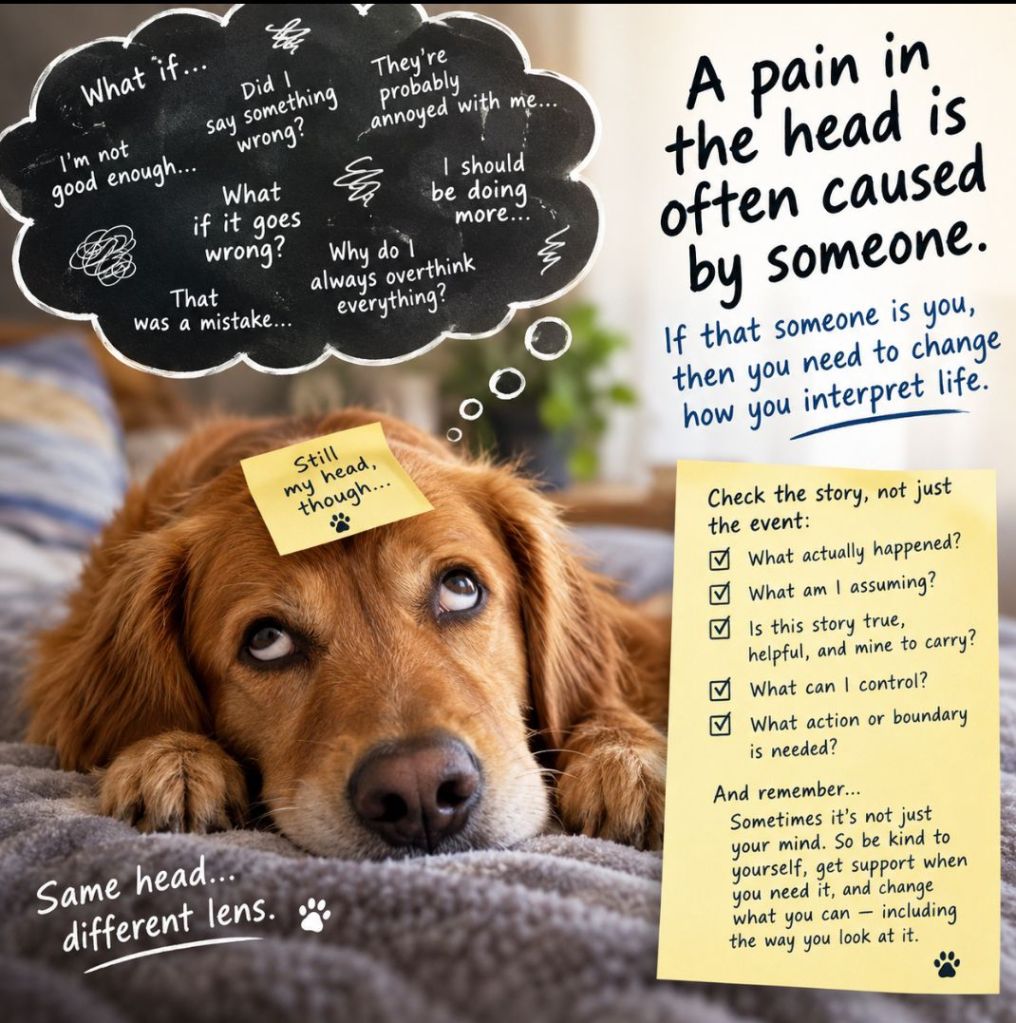
Because if someone else is causing you a headache? you can usually identify the problem. You can have a conversation. Set a boundary. Walk away. Or, in extreme cases, develop a sudden and mysterious interest in moving to another country.
But what do you do when you’re the one giving yourself the headache?
You can’t exactly walk away from yourself.
Although, judging by some of the things we do to ourselves, we occasionally seem determined to try.
We replay conversations that happened three years ago.
We worry about conversations that haven’t happened yet.
We interpret someone’s silence as rejection, their expression as criticism, and their perfectly innocent comment as evidence in a case we have already decided to prosecutep.
We expect ourselves to get everything right.
Then we criticise ourselves for not getting everything right.
And somewhere in the middle of all this, we wonder why our heads hurt.
Perhaps the problem isn’t always what happened.
Perhaps sometimes it’s what we have added to what happened.
There is the event.
And then there is the story.
Someone doesn’t reply to your message.
That’s the event.
“They’re annoyed with me.”
That’s the imagined story.
You make a mistake.
That’s the event.
“I’m useless.”
That’s the imagined story.
Something doesn’t go according to plan.
That’s the event.
“My life is falling apart.”
That’s the imagined story.
The interesting thing about stories is that we can become so familiar with them that we stop noticing we’re telling them.
They become reality.
But they aren’t necessarily reality.
So perhaps, when the pain in our head is coming from us, the answer isn’t to argue with the world.
Perhaps it’s to examine the lens through which we’re looking at it.
What actually happened?
What am I assuming?
Is the story I’m telling myself true?
Is it useful?
And perhaps most importantly:
Is it mine to carry?
This doesn’t mean that everything can be solved by changing our thoughts.
Some people genuinely cause us pain.
Some situations genuinely need to change.
Some problems require action, boundaries, distance, help, or simply the courage to say, “This isn’t good enough for me.”
And sometimes, a pain in the head is just a pain in the head.
But there is something strangely liberating about discovering that we don’t have to believe every thought we have.
We can notice it.
Question it.
And, if necessary, let it go.
Because sometimes the person standing between us and a little more peace isn’t somebody else.
It’s the person in our own head.
Fortunately, that person can learn to be a little bit kinder.