Perhaps the strangest thing I’ve come to believe is this:
You are perfect as you are today.
And tomorrow, you can be more perfect.
I know that sounds contradictory.
How can you be perfect and still need to become more?
Because perhaps we’ve misunderstood what perfect means.
Perfection doesn’t mean flawless.
It doesn’t mean you’ve made all the right decisions, understood everything, achieved everything you wanted, or become the person you imagined you’d be by this age.
It means that you are exactly who you are at this moment.
You are the result of everything you’ve experienced, everything you’ve learned, everything you’ve survived, everything you’ve misunderstood, everything you’ve loved, and everything you’ve lost.
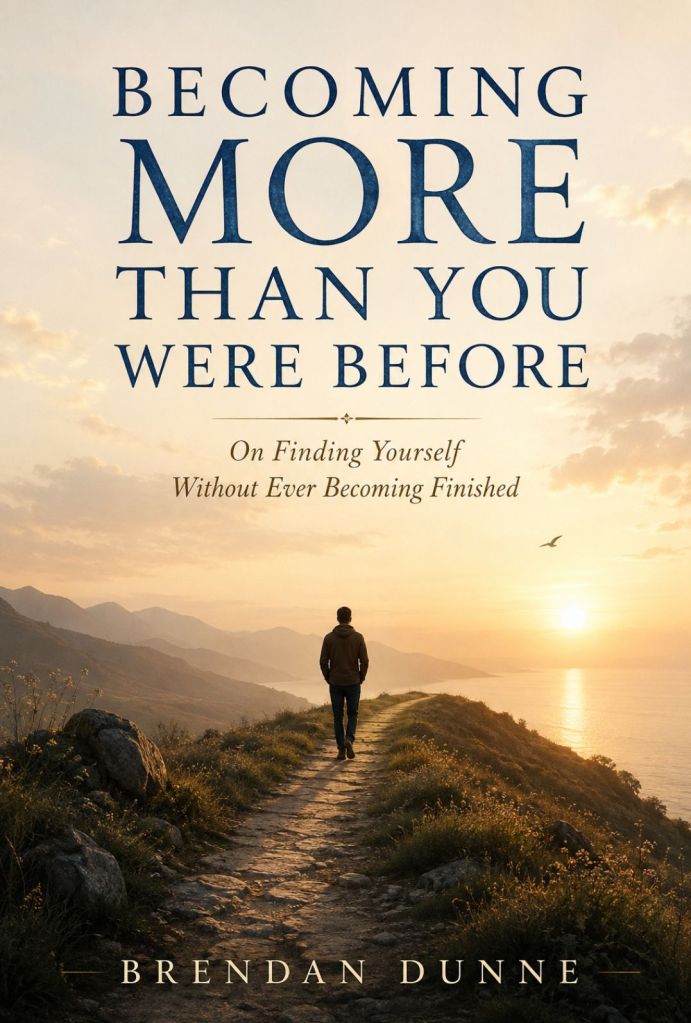
It’s a book about discovering who you might still become.
That distinction matters more than I can say.
Because most of us have spent years—decades, even—believing that in order to become better, we must first decide that who we were wasn’t good enough.
So we look backwards and see the mistakes.
The opportunities we didn’t take.
The years we think we wasted.
And somewhere along the way, we quietly make a judgement:
I should have been more.
But perhaps becoming isn’t about becoming more because you were once less.
Perhaps it’s about becoming more because you are still becoming.
The Journey of the Book
The book moves through four movements.
Part I — You Are Not Finished
You were always worthy.
Your story is only beginning.
You’re at a stage in your life where peace matters more than before.
And you can stop performing in the wrong room.
Part II — Learning to See Clearly
Acceptance is a foundation, not a grave.
Understanding yourself is neither the beginning nor the end of the journey.
Deep listening matters more than perfect recall.
And sometimes—like the blackberry—you’re not failing.
You’re just waiting for the weather to change.
Part III — Taking Back Your Agency
You’re not a victim anymore.
You can shift your emotional centre.
You don’t need unlimited freedom to change your life.
If you can’t win by the rules, you can change the rules.
Your mind is the greatest travel agent you’ll ever use—but you must learn to be your own travel consultant.
And yes, we’re all living on a borrowed dime.
That’s not our weakness.
That’s our superpower.
Part IV — Becoming
We all deserve a human golden retriever.
If you feel lost, you’re not lost—you’re exploring.
Manifesting is only the beginning.
The greatest revenge is forgiving yourself.
And there will come a morning you will not see—which is precisely why the morning you can see matters so much.
Why I Wrote It
Because I’ve been the person who felt behind.
Who felt finished.
Who wondered whether the best chapters were already written.
Because I’ve spent years learning that shame-driven improvement is brittle.
It shatters at the first stumble.
Witness-driven improvement is different.
It bends.
It observes the fall without panic.
And it gets back up.
Because I’ve discovered that a meaningful life can be built from surprisingly ordinary things.
A conversation.
A walk.
A boundary you finally establish.
A morning when you wake up and realise you are no longer trying to become someone else’s definition of successful.
And because I believe—genuinely, deeply—that you don’t have to despise the person you were to appreciate the person you’re becoming.
There’s Nothing and Everything Romantic About Learning to Love Yourself
I’ve been thinking about this line a lot lately.
There’s nothing romantic about learning to love yourself.
It doesn’t look like the movies.
There’s no candlelit dinner.
No grand gesture.
No one sweeping you off your feet.
It looks like getting up when the alarm goes off.
Choosing the tea you actually like.
Saying no to something that would quietly diminish you.
Putting down the phone and finishing your evening.
Forgiving yourself for the thing you said three days ago that still makes you wince at 1:17 a.m.
It’s unglamorous.
Unremarkable.
Often invisible.
And yet.
There’s everything romantic about it.
Because it is the great love story.
Not the one you were told to wait for—the one where someone else arrives and finally makes you feel worthy.
But the one where you stop waiting for permission to be loved and begin the slow, patient work of loving yourself.
That’s the plot twist nobody sees coming.
The love of your life isn’t out there. It’s in here.
The romance isn’t in grand gestures.
It’s in the quiet ones.
It’s in the moment you catch yourself being kind to the person you used to criticise.
It’s in the evening you choose rest over proving yourself worthy.
It’s in the morning you wake up and realise you are no longer trying to become someone else’s definition of successful.
It’s in forgiveness.
Not necessarily forgiveness of the people who hurt you—that may come later, or never.
But forgiveness of the version of you who stayed too long.
Trusted blindly.
Didn’t know then what you know now.
That’s the love story.
Notarescue.
Areclaiming.
Because it’s the only relationship you’ll have for the entirety of your life.
The only one that will be with you in every room, every season, every morning you wake up.
And when you finally stop abandoning yourself to keep everyone else comfortable?
That’s not cold.
That’s the most romantic thing you’ll ever do.
What This Book Is Not
It’s not a book that promises transformation in thirty days.
It’s not a book that claims to have all the answers.
It’s not a book that will work for everyone.
It’s a book for the reader who is ready to sit with questions.
To do the slow work of becoming.
To be patient with themselves and the process.
It’s a book that says:
You are not broken.
You are not behind.
You are not failing.
You are becoming.
An Invitation
Over the coming weeks and months, I’ll be sharing more from the book here—excerpts, reflections, and the occasional thought that didn’t make it into the final manuscript.
If any of this resonates, I’d love for you to come along.
Not because I have the answers.
But because I’m still learning them too.
And because I suspect that some of you are, as well.
We spend an extraordinary amount of our lives trying to understand things.
Why did that happen?
Why did they say that?
What am I supposed to do?
Where is my life going?
What does it all mean?
We treat understanding as though it is the final destination. As if, once we’ve figured everything out, we can finally relax.
But what if that’s the wrong way to look at some of life?
Let me be clear from the start: human beings live with a necessary tension.
There are moments when we need answers and moments when we need openness.
If a plane is losing altitude, we need to act. If a surgeon is operating, uncertainty doesn’t remove the need for the best decision possible. Some questions are practical problems, and practical problems demand practical answers.
But most of the questions that keep us awake at night aren’t engineering problems or medical emergencies.
They’re human mysteries.
And for those, the relentless demand for a neat explanation can become a cage.
What if nothing existential needs to be fully understood?
Not every experience needs a neat explanation.
Not every person needs to make sense.
Not every mistake needs to reveal its grand lesson.
Not every unanswered question is a problem waiting to be solved.
Sometimes something happens, and we simply don’t know why.
Sometimes, we make the best decision we can with the information we have, only to discover later that life had other plans.
Sometimes we never discover the reason at all.
And perhaps, for these particular questions, that’s perfectly okay.
The Freedom of Not Knowing
There is a strange freedom in admitting:
“I don’t know.”
Not as an intellectual failure, but as an honest starting point.
It leaves room for curiosity.
It leaves room for change.
It leaves room for the possibility that our current understanding isn’t the final version.
The danger isn’t not knowing.
The danger is becoming so attached to an explanation that we stop looking.
We create stories about ourselves.
Stories about other people.
Stories about how the world works.
Then we defend those stories as though they were facts.
But our understanding of reality is always incomplete.
We’re all walking around with partial information, interpreting events through our experiences, expectations and assumptions.
We are, in many ways, unreliable narrators trying to make sense of a story while we’re still living it.
And sometimes the story we construct isn’t an explanation.
It’s simply a way of making uncertainty feel uncomfortable enough to disappear.
Knowing When Not to Know
Perhaps wisdom isn’t knowing everything.
Perhaps it’s knowing which questions require an answer and which require us to become comfortable with the absence of one.
We must act decisively in the cockpit or the clinic.
But in the quiet hours of our lives, we can afford humility.
To mistake a human heart for a broken engine is to treat a mystery as a malfunction.
People aren’t always problems to be fixed.
Experiences aren’t always puzzles to be solved.
And life doesn’t necessarily owe us an explanation for everything that happens to us.
Sometimes, we need an answer.
Sometimes, we need acceptance.
And sometimes we need to recognise the difference.
Perhaps the Question Is Enough
I’ve come to think that curiosity doesn’t always need to end in certainty.
You can wonder without concluding.
You can explore without arriving.
You can change your mind without having failed.
You can live with an unanswered question without treating it as an unfinished life.
Wisdom may not be the accumulation of answers.
It may be learning which answers matter—and becoming peaceful enough not to invent the ones we don’t have.
The world will keep turning whether we understand what set it in motion or not.
The sun will rise.
People will surprise us.
Plans will change.
We will make mistakes.
We will fall in love.
We will lose things.
We will discover things.
And through it all, there will be questions we answer and questions we don’t.
That’s life.
Maybe we’re not here to solve the mystery.
Maybe we’re here to experience it.
To ask better questions.
To remain curious.
To laugh occasionally at our certainty.
To change our minds when new understanding arrives.
And when it doesn’t?
That’s okay too.
Because an open question isn’t an empty space.
It’s an invitation.
An invitation to keep looking.
To remain curious.
To leave room for possibilities we haven’t considered.
And perhaps most importantly, to stop confusing the absence of an answer with the absence of meaning.
You don’t need to understand everything to appreciate something.
You don’t need to explain everything to experience it.
And you don’t need to know where the story is going to enjoy being in it.
The question can remain open.
You can keep moving.
And the world can keep revolving—even if none of us ever truly understands what set it all in motion to begin with.