Perception can be altered. Your reality can be altered, too.
I’m not an expert today. But I could be tomorrow. Or the day after tomorrow.
Not because tomorrow grants me some magical ability I don’t have today.
Because tomorrow gives me the opportunity to do what every expert once had to do:
Start before I felt ready. Ask the question that sounded stupid. Practise while it was still awkward. Make mistakes. Fail in public. Learn from the embarrassment. Adjust. Try again. And then do it all over again.
Expertise rarely arrives like a lightning bolt. More often, it grows quietly in the background through a thousand ordinary decisions to keep going.
The first time you write something, it probably won’t be very good. The secret is to keep writing until you can look back and recognise how far you’ve come.
The first time you speak in front of people, your voice might shake. Your mouth might go dry. But if you persevere, you’ll learn to speak like someone who has found their voice.
The first time you try something new, you might look like someone who has absolutely no idea what they’re doing.
That’sokay.
You aren’t supposed to look like an expert while you’re becoming one. You aren’t supposed to know everything at the beginning. You’re supposed to be curious enough to learn.
So I’m not pretending to know it all. I’m practising like I’m becoming. Because I am.
Today, I’m a beginner with direction. Tomorrow, I’ll be a beginner with more experience. The day after that, I’ll have a few more mistakes behind me, a few more lessons learned, and perhaps a little more confidence.
And one day, without even noticing when it happened, I’ll look up and realise something:
I became the person I kept showing up as.
I didn’t become an expert because I waited until I was ready. I became one because I started before I was.
So, if you’re standing at the beginning of something today, don’t worry about being good enough. Don’t worry about knowing enough. Don’t worry about looking foolish.
Start.
You don’t have to be an expert today. You just have to be willing to become one tomorrow.
That’s right, I’m changing how I interpret my thoughts.
There comes a point in life when you realise that something happened to you that you never deserved.
Someone hurt you.
Someone betrayed you.
Someone underestimated you.
Someone walked away when you needed them most.
Perhaps circumstances dealt you with a life you would never have chosen. Perhaps you grew up believing that life was something that happened to you rather than something you could participate in shaping.
And for a while, the story of what happened may have become the story of who you were.
I was abandoned.
I was rejected.
I was bullied.
I was never given a chance.
I always get treated this way.
People like me don’t get opportunities.
There may be truth in every one of those statements.
Identities are remarkably difficult prisons to escape from because eventually, we stop noticing the bars.
But perhaps one of the most powerful things you can ever say is:
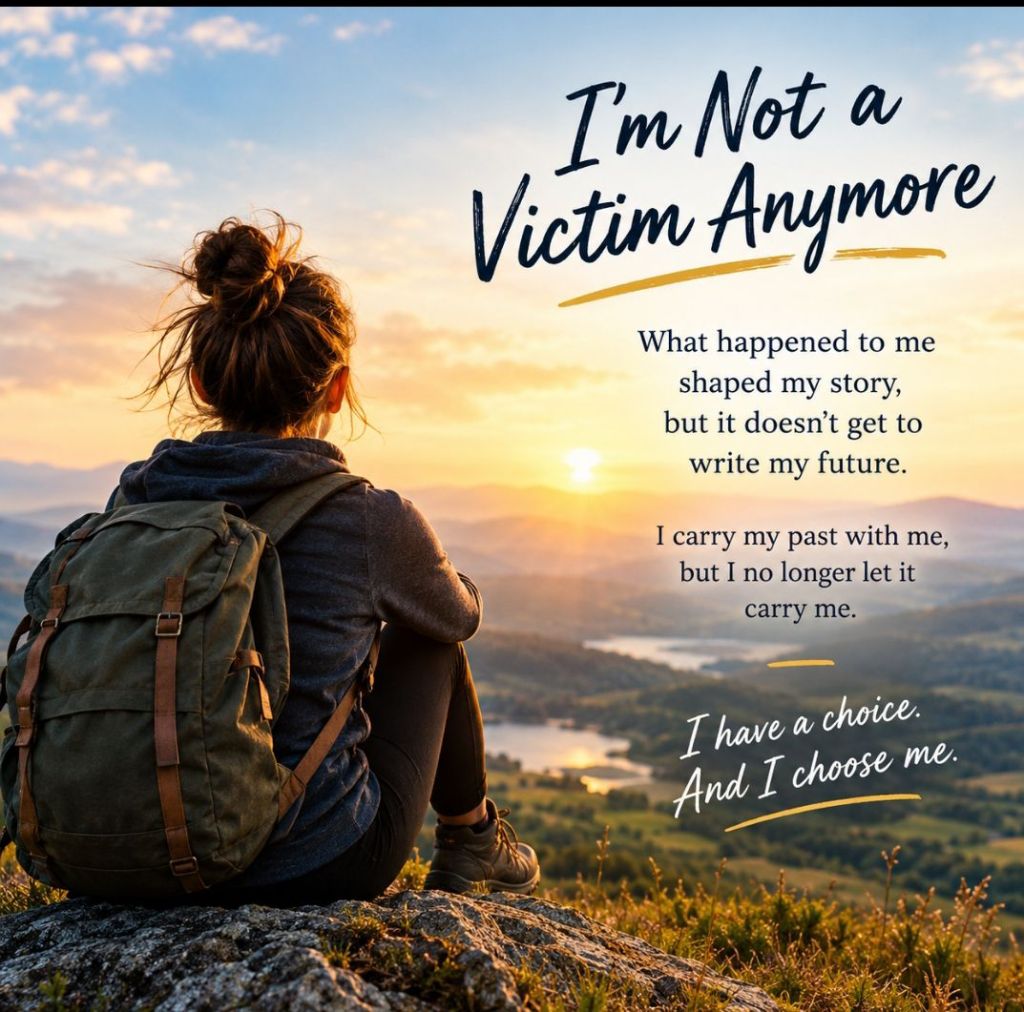
I’m not a victim anymore.
Not because nothing happened.
Not because it didn’t hurt.
Not because the people who hurt you suddenly deserve forgiveness.
And certainly not because you have decided that everything was somehow your fault.
You say it because you have decided that what happened to you no longer gets to have the final word about what happens next.
Imagine someone who was bullied throughout school.
For years, they carry the belief that there must be something fundamentally wrong with them.
They avoid social situations. They don’t put themselves forward at work. They assume people are judging them. When someone doesn’t reply to a message, they immediately think they’ve done something wrong.
The bullying ended years ago.
But the bully is still living inside their interpretation of the world.
Then, one day, they begin to notice something.
The person insulting them at fifteen is no longer standing in front of them.
Yet they are still allowing that person’s opinion to determine their behaviour at thirty.
That realisation doesn’t erase the past.
But it creates a choice.
Perhaps they start speaking in meetings.
Perhaps they join a club.
Perhaps they make a new friend without assuming rejection is inevitable.
Perhaps they finally apply for the job they have repeatedly convinced themselves they aren’t good enough for.
Nothing magical has happened.
They have simply stopped allowing an old wound to make every new decision.
That is what reclaiming your life can look like.
It isn’t always dramatic.
Sometimes it looks like raising your hand.
Making the phone call.
Walking through the door.
Saying no.
Saying yes.
Trying again.
Or consider someone whose relationship ended badly.
They were cheated on, lied to, or emotionally neglected.
Understandably, they become cautious.
But caution can slowly become a philosophy.
“Nobody can be trusted.”
So every new relationship is examined through the evidence of the previous one.
A delayed message becomes suspicious.
A change in tone becomes threatening.
Someone needing time alone becomes proof that they are losing interest.
The new person is being judged for the behaviour of someone they have never met.
Again, the past isn’t imaginary.
The betrayal really happened.
But there is a difference between learning from the past and living inside it.
Learning says:
“I know what red flags look like now.”
Victimhood says:
“Everyone will eventually hurt me.”
One gives you wisdom.
The other gives your past control over your future.
This doesn’t mean you should pretend you had more control than you actually did.
There are things that happen in life that are profoundly unfair.
People lose jobs they desperately needed.
Children grow up in homes they didn’t choose.
People become ill.
Families break apart.
Friends betray one another.
Opportunities disappear.
Sometimes another person’s cruelty changes the direction of your life.
There is no inspirational slogan capable of making that fair.
And telling someone who has suffered that they simply need to “change their mindset” can be another form of cruelty.
You don’t always choose what happens.
But there is often a space, however small, between what happened and what you do next.
That space matters.
You may not be able to change the fact that your employer treated you unfairly.
But you might be able to update your CV.
You may not be able to make your former partner apologise.
But you can decide whether you will spend the next ten years waiting for an apology.
You may not be able to change the childhood you experienced.
But you can decide what kind of adult you want to become.
You may not be able to make someone recognise your worth.
But you can stop using their inability to see it as evidence that you don’t have any.
That is the shift.
Not from “nothing bad happened to me” to “everything is my fault.”
But from:
“My past determines me.”
to:
“My past informs me, but it does not have to define me.”
There is enormous power in taking responsibility for your future without taking full responsibility for everything that happened to you.
Those are not the same thing.
If someone breaks your heart, you didn’t necessarily cause the heartbreak.
But healing is still your responsibility.
If someone treated you badly, you didn’t necessarily deserve it.
But deciding what boundaries you have in the future is your responsibility.
If someone convinced you that you weren’t good enough, their words weren’t necessarily true.
But rebuilding your relationship with yourself may still be your work.
This is not blame.
It’s agency.
And agency is one of the first things we lose when we begin seeing ourselves exclusively through the lens of what has been done to us.
Perhaps you’ve spent years saying:
“I can’t because of what happened.”
Try asking a different question.
“What can I do now, despite what happened?”
That question doesn’t deny the obstacle.
It simply refuses to let the obstacle become the entire landscape.
Maybe you were made redundant at fifty-five.
You can’t undo the redundancy.
But perhaps you can learn something new, contact people you haven’t spoken to in years, start a small business, retrain, volunteer, or discover that the career you thought you needed was never actually the life you wanted.
Maybe you were rejected for an opportunity.
You can’t change the decision.
But you can apply somewhere else.
Maybe someone underestimated you.
You don’t need to spend the rest of your life proving them wrong.
You can simply become the person you know you are capable of becoming.
That is freedom of a different kind.
And perhaps the most surprising part is that becoming free doesn’t always feel like triumph.
Sometimes, it feels like grief.
Because when you stop blaming your past for everything, you may have to confront something uncomfortable:
You now have choices.
Not unlimited choices.
Not perfect choices.
Not choices unaffected by circumstance.
But choices.
And choices bring responsibility.
You can no longer spend quite as much time waiting for someone else to rescue the life you have been given.
You have to participate in it.
You have to decide what stays.
What goes.
What matters.
What you will tolerate.
What you will pursue.
Who you will become.
That can be frightening.
But it is also extraordinarily hopeful.
Because if you have some influence over what happens next, then your story isn’t finished.
I’m not a victim anymore doesn’t mean:
“I was never hurt.”
It means:
“I refuse to build my entire identity around the hurt.”
It doesn’t mean:
“They were right to hurt me.”
It means:
“They don’t get to decide what I become because they hurt me.”
It doesn’t mean:
“My suffering didn’t matter.”
It means:
“My suffering will not be the only thing that matters.”
And it doesn’t mean:
“I control everything that happens to me.”
It means:
“I will pay attention to what remains within my control.”
Sometimes, that might be a lot.
Sometimes, it might be very little.
But even a small amount of agency is worth protecting.
Because a life doesn’t necessarily change when the past disappears.
Sometimes, it changes when you stop asking the past for permission to begin again.
You don’t need to become a completely different person tomorrow.
You don’t need a five-year plan.
You don’t need to suddenly feel confident.
Startsmaller.
Make one decision that belongs to you.
Set one boundary.
Take one risk.
Have one honest conversation.
Apply for one opportunity.
Walk away from one thing that continually diminishes you.
Return to one thing you abandoned because someone convinced you that you weren’t capable.
Let yourself imagine a future that isn’t simply a reaction to your past.
Then do something, however small, that moves towards it.
Because healing isn’t always a dramatic transformation.
Sometimes, it’s the quiet accumulation of choices that gradually teach you:
I have more influence over my life than I thought.
And eventually you look back and realise something extraordinary.
The person who hurt you is still part of your history.
The experience is still part of your story.
The scars may still exist.
But they are no longer holding the pen.
You are.
And perhaps that is what it really means to say:
I’m not a victim anymore.
Not that life suddenly became fair.
Not that the past stopped hurting.
But that you finally decided your future deserved your voice too.
There is a certain kind of intelligence that doesn’t rush to choose. It can stand between opposing ideas and ask, “What if both contain something true?”
This is dialectical thinking. It’s uncomfortable because we’re often taught to understand life through opposites: right or wrong, success or failure, strong or weak, freedom or responsibility.
But life rarely obeys such clean equations.
You can love someone and still need distance from them. You can be grateful for your life and still want to change it. You can understand why someone behaved badly and still hold them accountable. You can accept reality without accepting that reality must remain unchanged.
Acceptance is not surrender. You can say, “This is where I am,” while also saying, “But this doesn’t have to be where I remain.”
Why Our Minds Resist Holding Two Truths
Our minds prefer certainty. Certainty feels safe.
If someone is either good or bad, we know how to treat them. If an experience is either a success or a failure, we know where to file it. If a decision was either right or wrong, we don’t have to wrestle with the uncomfortable possibility that it might have been both understandable and mistaken.
But human beings are rarely that simple.
“What happens if I hold both?”
Imagine someone in a job they dislike.
One voice says, “Be grateful. You have security.” Another says, “Life is too short. You need to leave.”
It is tempting to choose one and dismiss the other—especially when confirmation bias helps us gather supporting reasons for the side we prefer.
But perhaps both voices are carrying something valuable.
Security matters. Meaning matters.
The deeper question is not necessarily “Which one is right?” But “How can I protect what matters while creating a path toward what I want?”
Perhaps the answer is not to quit tomorrow or remain indefinitely. Perhaps it is to keep the job while developing new skills, exploring alternatives, saving money, and gradually creating an exit.
The contradiction has produced a possibility that neither extreme could see.
Relationships Teach Us the Same Lesson
Forgiveness does not require pretending that what happened was acceptable.
You can release resentment and maintain a boundary. You can understand someone without trusting them. You can love someone without allowing them unlimited access to your life.
Compassion and self-respect do not have to be enemies. Sometimes, they are both necessary.
When Holding Two Truths Goes Wrong
There is an important caveat.
Holding two truths can become an excuse for endless indecision.
Not every contradiction contains equal wisdom. Sometimes, one position is simply false. Sometimes, one option is harmful. Sometimes, someone is manipulating the situation by presenting two choices as equally reasonable when they aren’t.
Dialectical thinking is, therefore, not a refuge from responsibility. It is a tool for discernment—one that requires us to actively counteract confirmation bias.
We listen. We question. We weigh. And eventually, we act.
There may be no perfect answer. There may simply be the most honest choice available to you. And it’s often found between:
Hope and realism. Freedom and responsibility. Acceptance and ambition. Compassion and boundaries. Gratitude and dissatisfaction. Certainty and curiosity.
Remember Listen. Question. Weigh. Then, take one honest step in the right direction for you.
Ifyou’reangry, don’t send the message. Write it. Save it. Walk away. Read it tomorrow. You’ll delete half of it.
Don’tmakeimportantdecisionsimpulsivelyorwhenyou’retired. Tiredness turns temporary problems into permanent conclusions. Learn to say, “Let me think about that.”
Make trivial decisions when you can’t make important decisions.
Putthingsbackwhereyoufoundthem. Use notes, calendars, reminders, password managers. Photograph important documents before you need them. Your memory is for thinking, not storage.
Designyourenvironmentaroundyourintentions. Phone in another room when you need to think. Fruit is visible when you want to be healthy, biscuits in the shop. Shoes by the door ready for walking.
Leaveearlierthannecessary. Ten minutes early is always better than ten minutes late.
Ifdon’twanttobeinterrupted, stoplookingavailable. Sometimes, the most effective boundary is closing the laptop and putting the phone away.
Believepatterns, notpromises. One incident can be explained. A pattern usually can’t.
Stop arguing with people who aren’t trying to understand you. You can win the argument and still lose your afternoon.
Ifthesameargumentkeepshappening, changethequestion. More volume rarely produces a different outcome.
Don’tconfusefamiliaritywithcompatibility. Something can feel comfortable simply because you’ve done it many times.
When someone compliments you, say thank you.
Writedownexactlywhatyou’reafraidwillhappen. Vague anxiety becomes less powerful when forced to become a sentence.
Ask, “Will this matter in five years?”
Respect the things you own. If you can’t afford to replace it, you can’t afford to be carelessly with it.
Don’tkeepcheckingwhetherit’sworking. Plants, investments, creative projects, relationships, and bread all suffer from constant interference.
Keeppromisestoyourself. Don’t make promises you know you won’t keep because you will end up not trusting yourself.
Ifyoukeepavoidingsomething, askwhetheryouactuallywantitinyour life.
Dosomethingbadlyonpurpose. Sing. Draw. Dance. Write. Cook. Learn a language. Tolerating being a beginner is one of the great freedoms of adulthood.
Rememberthatnobodyiscomingtoorganiseyourlifeforyou. That’s not depressing. It’s liberating. You get to decide what deserves your attention.
And the biggest one: stopwaitingtofeelready. You become ready by doing the thing while feeling unready. Much of the advice you need isn’t hidden. You already know it. You’re just hoping there’s a more complicated answer.