The Day the Flags Never Rose.
Clontarf, 8 October 1843
Based on true events:
On this day, Daniel O’Connell’s planned “Monster Meeting” at Clontarf was banned by the British government. Thousands of Irish men and women had gathered peacefully to demand the repeal of the Act of Union. Troops and gunboats were sent to suppress them. No blood was shed — only silence, vast and heavy — and that silence became Ireland’s quiet defiance.
—
The rain had not yet fallen, but the sky was a promise of it — a low, bruised ceiling of cloud pressing down upon the shore.
From the window of her cottage near Dollymount Strand, Niamh Byrne watched the world hold its breath. In her hands, the green silk banner was a cold weight. Three nights she’d spent over it, her needle stitching the golden harp, the words Erin go Bragh. A labour of love for the Monster Meeting — for the day Daniel O’Connell would shake the foundations of the empire with nothing but the weight of their numbers.
But the empire had answered with its own weight.
Redcoats. A scarlet weed choked the road to Clontarf, their bayonets a row of sterile thorns. Further out, the dark hulks of two gunboats rested on the slate-grey water, and their cannons like blind eyes turned toward the empty field. They were not there for peace.
Her father, Seamus, had left at first light. His back was a rod of defiance, but his eyes held the ghosts of ’98.
“They can ban a meeting, Niamh,” he’d said, his voice gravelly with a past she only knew from his nightmares. “But they cannot ban a man from standing on his own land.”
She had clutched his arm, the proclamation’s words echoing in her mind: treated as traitors. He had patted her hand — a gesture meant to comfort that only frightened her more.
“This time, it’s with words, not pikes,” he’d said. “This time, we win with silence.”
The news arrived not with a shout but a sigh — a rumour slipping under doors and through the damp air: Cancelled. O’Connell has called it off. The hope, so carefully stitched, began to unravel.
By noon, Seamus returned. The fire in him was quenched. He moved like a man carrying a great, invisible burden, his shoulders bowed under the weight of a speech never given. He sank into his chair by the cold hearth.
“They came,” he whispered, not to her but to the memory. “Thousands of them. From the hills and the bogs. They came because their hearts had already spoken.” He looked up, his eyes hollow. “And when they saw the guns, the red line… they turned. All of them. Not a curse, not a rock thrown. Just… a great, turning away. A silence louder than any cannon.”
Niamh looked down. A drop of rain had found its way through a crack in the window frame and landed on the banner. The gold thread of the harp began to blur, the green silk to darken.
“What will we do with it now, Da?”
He had no answer. The silence of the thousands had stolen his words.
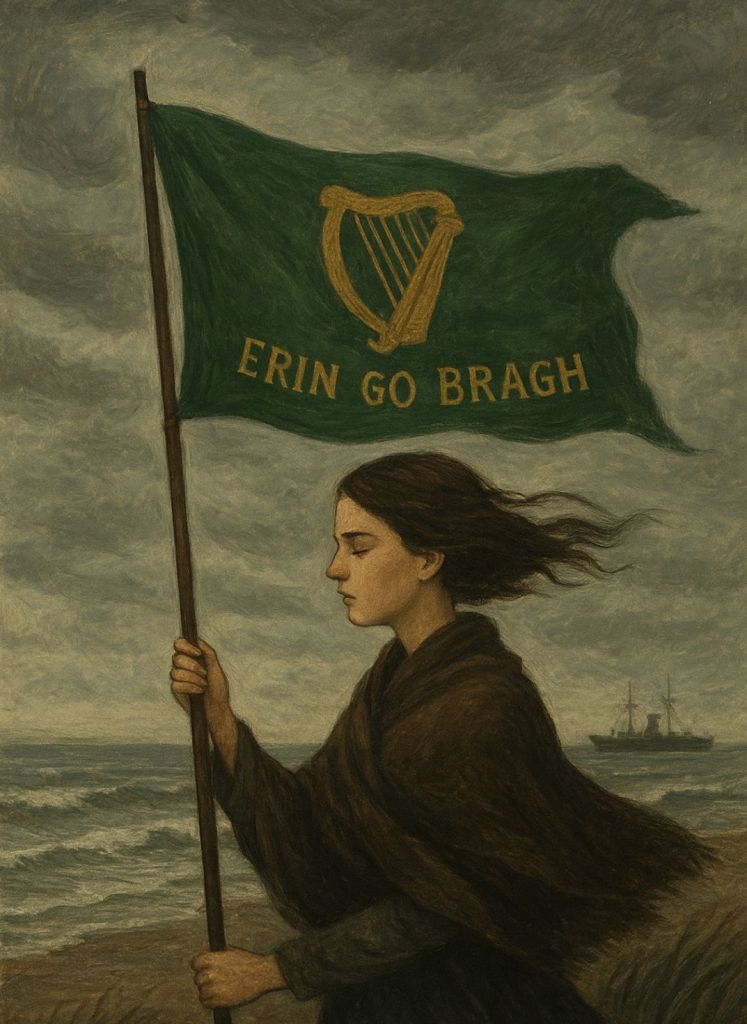
That night, while the cottage slept fitfully, Niamh took the banner. The rain was a soft, persistent shroud. The tide was far out, leaving the sand exposed and dark — a blank page. She did not look like a revolutionary, just a young woman in a worn shawl, planting a stick in the sand.
She thrust the pole deep into the wet earth. The wind caught the silk instantly, snapping it taut — a vibrant, foolish, beautiful declaration to the empty sea and the watching gunboats. The golden harp shimmered in the gloom.
“Let them ban their meetings,” she said, her voice steadier than she felt. The words were not a shout but a seed. “Ireland is not a place on their maps. It is a memory in here.” She pressed a hand to her heart. “And it remembers.”
She left it there, a lone sentinel against the incoming tide.
By dawn, it was gone. No pole, no silk. But as the weak sun broke through the clouds, it caught the edge of the retreating wave, and for a moment, the water seemed to glitter with a thousand scattered threads of gold.
The rebellion had not been drowned.
It had been dissolved — absorbed into the very landscape, waiting to be breathed in again by the land and its people.
Unseen. But not undone.
P.S. Ireland’s defiance has always been more than rebellion. It is memory made flesh — a refusal to let silence mean surrender.
