Brendan Dunne is an Irish author whose work spans self-help, philosophy, speculative science fiction, contemporary fiction, and humour. Across every genre, his writing is united by a belief in justice, curiosity, human resilience, and the extraordinary possibilities hidden within ordinary life.
Known for blending philosophy, psychology, humour, and imagination, Dunne’s books encourage readers to question assumptions, embrace wonder, and discover meaning in everyday experiences. With 47 published titles, he has built a diverse catalogue that ranges from uplifting nonfiction to emotionally engaging novels and thought-provoking speculative fiction.
Writing Style & Themes
Dunne’s writing explores the strange, funny, and deeply human experience of being alive. His fiction features:
– Surreal science fiction and time-bending adventures
– Character-driven stories exploring love, identity, and connection
– Emotional mysteries that blur the boundaries between reality and imagination
– Humorous tales that reveal profound truths through everyday life
His nonfiction combines psychology, philosophy, and practical wisdom, offering thoughtful reflections on personal growth, resilience, critical thinking, and finding clarity in an increasingly complex world.
Notable Works (click to purchase)
Among his best-known books is The Less Gullible Generation, an exploration of critical thinking and clarity in the modern age. Other popular titles include Where New Beginnings Are Born, a compassionate guide inspired by psychology and hope, along with Where the Lightness Lives, The Bella Universe series, and numerous works exploring human potential and modern life.
Background & Inspiration
From an early age, Brendan developed a fascination with human behaviour and the questions that shape our lives. That curiosity evolved into a lifelong interest in psychology, philosophy, storytelling, and personal development.
Drawing inspiration from both everyday experiences and life’s biggest questions, he creates books that entertain while encouraging readers to think differently about themselves and the world around them. Whether writing fiction or nonfiction, his aim is the same: to leave readers with a renewed sense of curiosity, hope, and possibility.
He continues to write across multiple genres, believing that the best stories—and the best ideas—help us see familiar things in entirely new ways.

Category: creativity
-
I’ve published over 40 books across many different genres.
Mystery. Science fiction. Humour. Philosophy. Self-help. Literary fiction. Psychology. Time travel. Satire.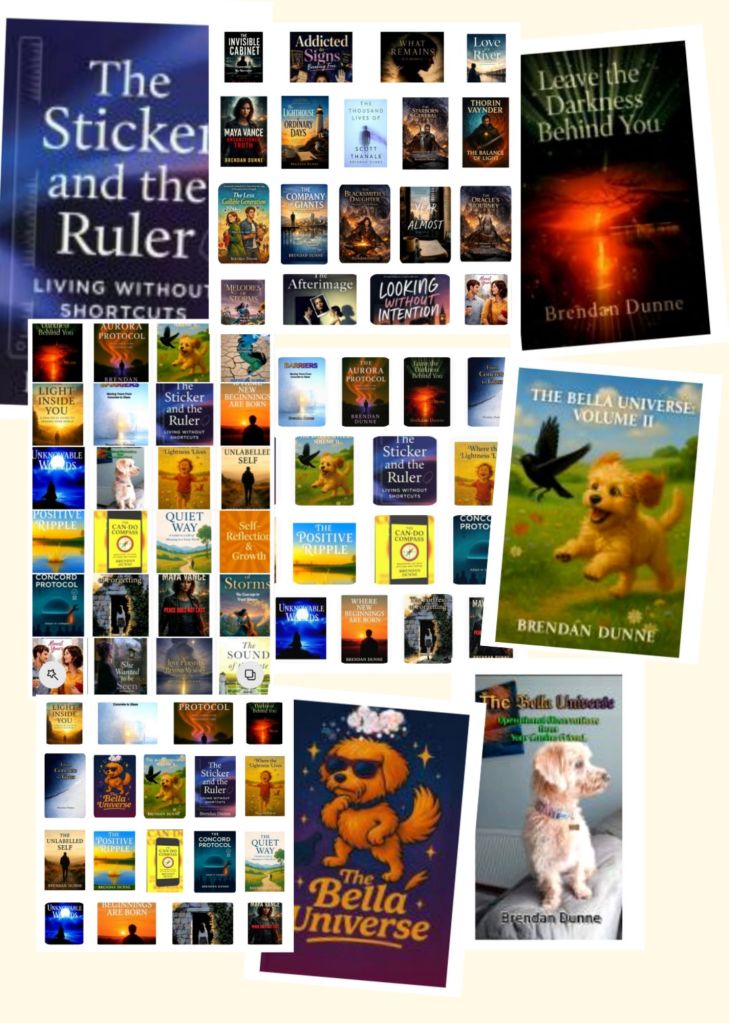
To some people, that might seem like a lack of focus.
To me, it reflects a simple belief:
There’s meaning in everything.
A puppy chasing a shadow.
A husband hiding in a garage.
A civilisation reaching for the stars.
A person quietly rebuilding their life after loss.
Different stories. Different genres. The same question.
What does it mean to be human?
Every book I write is another attempt to explore that question from a different angle.
Because meaning isn’t confined to a single shelf in a bookshop.
It’s everywhere. -
The Blacksmith’s Daughter: The Gods’ Fourth Mistake
Introduction
It’s a love story for people who love stories.
You know who you are. You’re the one who stayed up past midnight reading under the covers. Who named a pet after a fictional character. Who has cried over a book and then immediately pressed it into a friend’s hands saying “you HAVE to read this.”
This one’s for you.
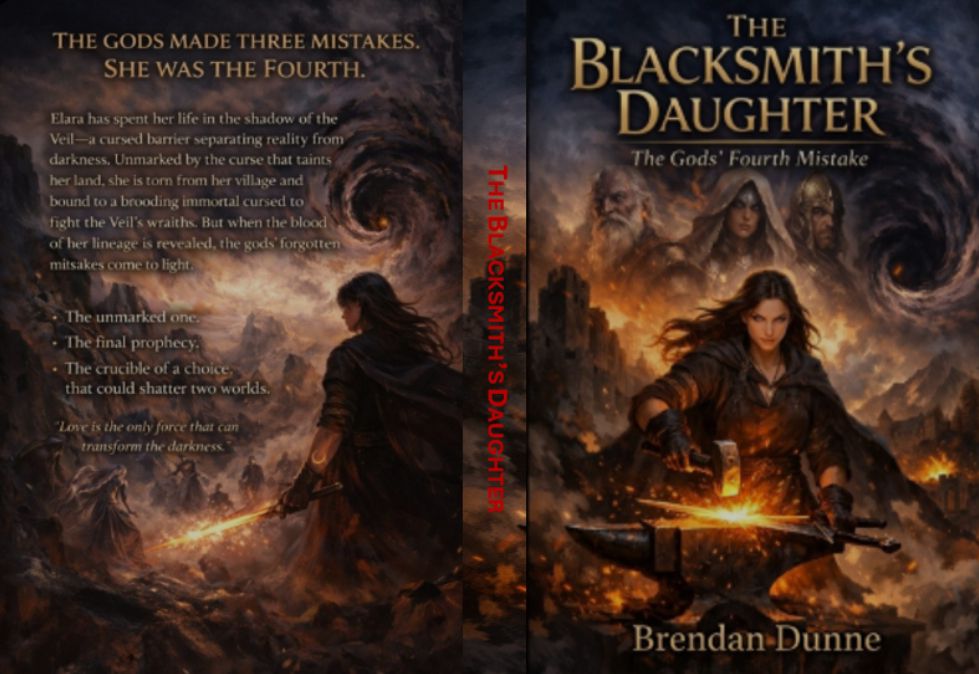
The gods made three mistakes.
First, they loved mortals—too deeply, too desperately, too much. They poured their divine hearts into fragile beings and watched them break.
Second, they tried to stop loving. They built a Veil between worlds and stuffed their hunger inside, hoping distance would cure what connection had caused.
Third, they cursed the world to carry what they could not. The mark of the gods’ own loneliness, passed down through generations, turning lovers into monsters and desire into destruction.
She was the fourth.
Elara Voss is a blacksmith’s daughter. Unmarked. Untouched. The only mortal in a century who has never felt the curse’s pull. She’s spent her whole life hiding in shadows, waiting for the world to end.
Then Kael Draven finds her.
He’s everything she should fear—a Starborn general, last of the First Marked, a man who hasn’t slept in a century and can’t die. They say when he looks at you, he sees the exact moment your soul will break.
But when he looks at Elara, something else happens.
The bond between them ignites. Every touch burns. Every secret shared unravels the lies they’ve both lived under. And the Veil between worlds is cracking faster than either can outrun.
Some prophecies aren’t destiny. They’re a death sentence.
The gods made three mistakes. Elara is the fourth—and she might be the only one who can save them all.
Or destroy everything.
This is a love story for people who love stories.
It has:
· A heroine who hides until she can’t anymore
· A hero who’s been frozen for 140 years and doesn’t know how to thaw
· A bond that hurts to touch and hurts more to break
· Gods who made mistakes and are terrified to admit it
· A void that learns to create flowers
· A hunger that becomes a mother
· An orchard planted one tree at a time
· Letters written across decades
· A daughter with a too-loud laugh and storm-grey eyes
· An ending that will make you cry and smile and immediately start reading againIf you’ve ever believed that love is the only thing that survives, even death.
If you’re ready to meet two people who will live in your heart long after the last page—
Turn the page.
The gods made three mistakes.
She was the fourth. This is her story.
In the end, she became the bridge that connected everything. -
It’s a romantic comedy for a time when the rules of the game have changed.
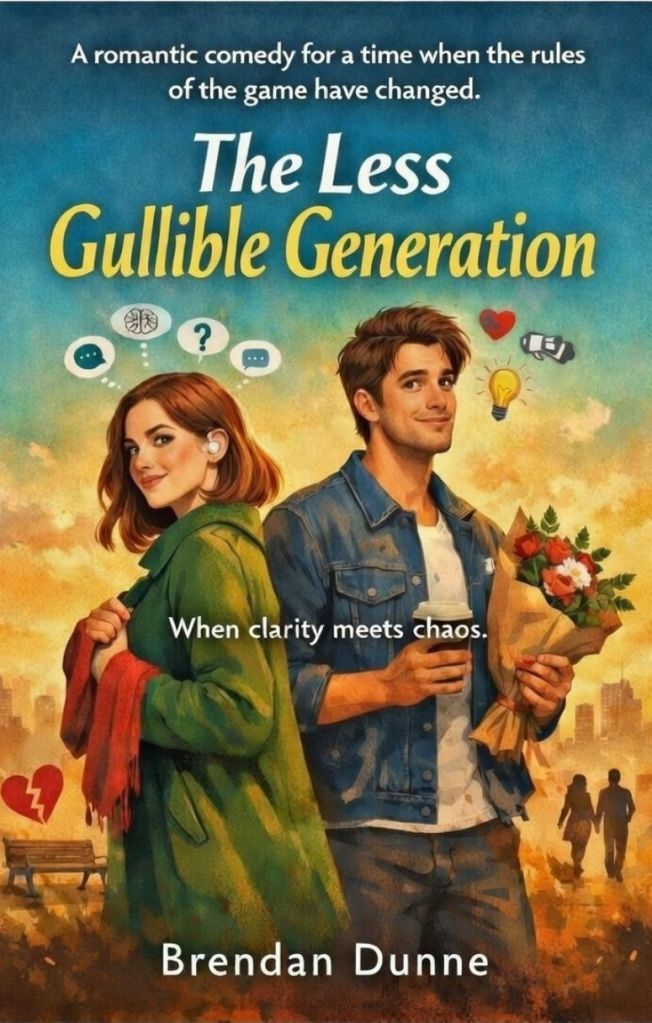
She has a neural implant designed to prevent self-deception.
He runs a wellness startup, specialises in grand gestures, and has absolutely no idea what he’s actually feeling.They meet when he steals her scarf.
In a world where everyone has a Companion nudging them to question their thoughts, misunderstandings are rare. Projection is inefficient. Drama is exhausting.
Falling for lies is almost impossible.
Falling for someone?
That’s more complicated.The Less Gullible Generation is a romantic comedy about what happens when clarity meets chaos, when scepticism meets longing, when the most self-aware generation in history attempts the one thing that still requires a little irrational belief.
It’s for anyone who has ever analysed themselves into paralysis.
Anyone who has ever been called “too much” or “not enough.”
Anyone who has stood at the edge of love and thought:What if I’m wrong about this?
You probably are.
So is everyone.
The question isn’t whether you’re wrong.
The question is whether you jump anyway.
