The Sanity of Clear Sight: How to Recognise and Refuse the Pull of Chaos.
There is a strange power in naming things accurately. To see a thing clearly is to begin the process of disarming it.
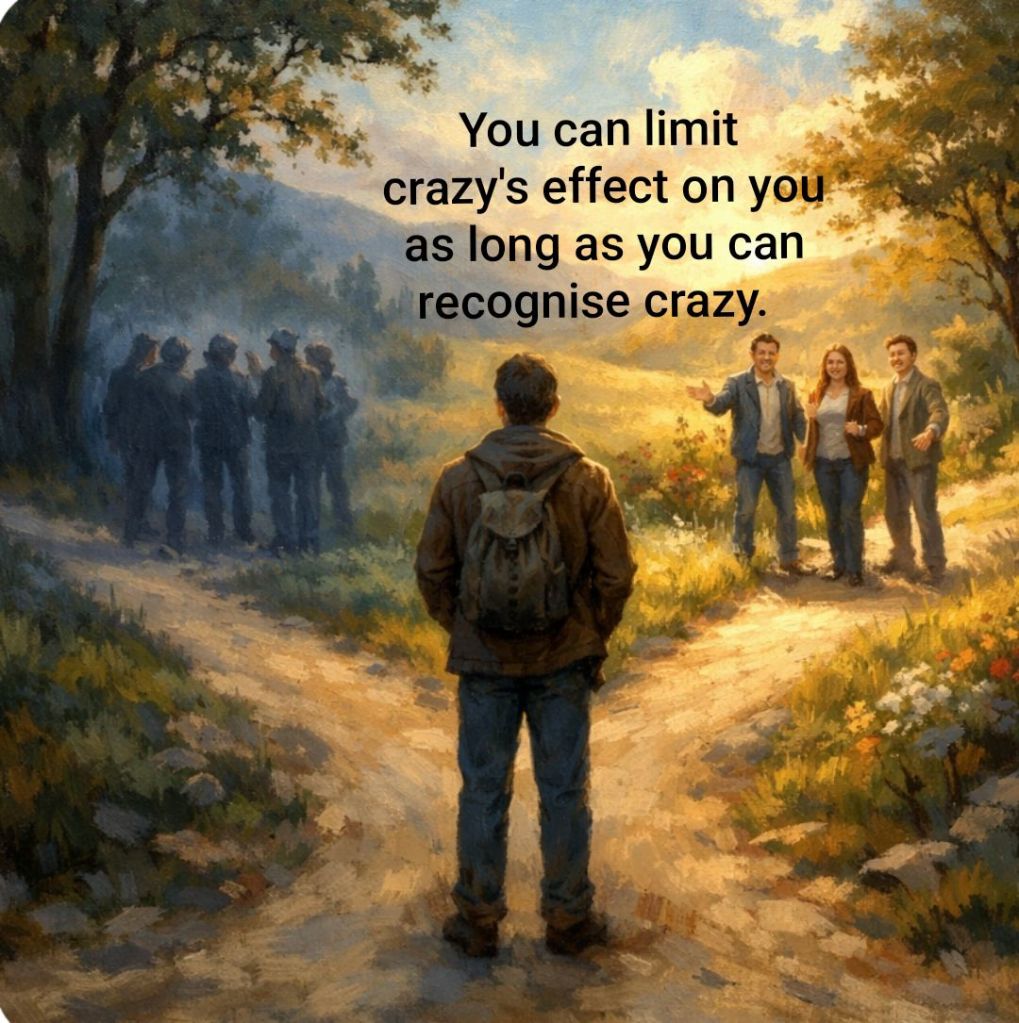
This is especially true when we encounter behaviour that seems designed to destabilise. Not the behaviour born of human struggle or genuine crisis, which calls for compassion. But the kind that thrives on confusion—the emotionally explosive, reality-bending, perpetually outraged energy that can erupt in conversations, workplaces, families, and the broader culture.
Its primary weapon is disorientation. Its goal is to pull you into its weather system, to make you doubt your memory, question your instincts, and accept its distorted reality as your own. It wants you to dance.
But here is a liberating truth: Chaos loses its gravitational pull the moment you recognise it for what it is.
The danger is not its existence. The danger lies in our willingness to normalise it. We exhaust ourselves trying to reason with the unreasonable. We shrink ourselves to accommodate its demands. We ask, Is it me? Am I the one who is overreacting?
Recognition is not a moral judgment. It is an act of clarity, a form of perception. It is the ability to look at a complex, turbulent situation and say, without anger or panic, Ah. There it is.
You can’t stop every storm from forming. But you can know when you are standing in one. And in that knowing, you reclaim your agency.
Once you see the storm, you have options you didn’t have when you were lost in it.
You can choose not to engage. You can recognise that not every argument is a debate to be won, but a performance you are not required to attend. Not every accusation is a legal brief demanding a defence; sometimes, it is merely a mirror of someone else’s internal state. Not every dramatic spiral is a fire you are responsible for extinguishing.
This is not coldness. It is not indifference to suffering. It is the hard-won wisdom of boundaries.
Maturity is learning to distinguish between compassion and absorption. You can care for a person without inhabiting their chaos. You can understand the origins of destructive behaviour without excusing its impact. You can remain a steady centre while the world around you spins.
The key is sustained, clear-eyed awareness. When you can recognise the patterns—the consistent projection, the addiction to outrage, the manufactured crises, the performative victimhood—you stop taking them personally. And when you stop taking them personally, you stop being controlled by them.
Consider the colleague who thrives on email chains filled with cc’d management, framing every minor issue as a catastrophic failure of others. Once you recognise the pattern as a strategy for power and avoidance, you no longer feel compelled to write a point-by-point defence. You respond factually, briefly, and loop in the necessary parties, without carrying the emotional weight of the accusation. You have seen the storm and chosen not to stand in its path.
Or the family member for whom every gathering is a stage for a familiar, painful drama. Recognition allows you to step back from the role you have been assigned. You can offer a kind word, a helping hand, but you refuse the invitation to play your part in the old, tired play. You stay for the love, but you leave the theatre.
Peace does not come from fixing chaotic people or systems. It comes from the radical act of refusing to orbit them.
You are allowed to protect your peace. You are allowed to choose calm over combat, clarity over confusion. You are allowed to recognise a pattern and then respond accordingly.
Sometimes, that response is a clarifying silence.
Sometimes, it is a deliberate distance.
Sometimes, it is a quiet, firm boundary stated once and then held.
Sometimes, when the situation allows, it is even a wry, internal humour that defuses its power over you.
But it is never blind, reactive engagement. It is never a surrender of your discernment to someone else’s agenda.
You can’t eliminate chaos from the world. But you can dramatically reduce its impact on your inner world.
The moment you recognise the game, you are free to stop playing. The moment you see the script, you can stop delivering your lines.
And in that moment of clear sight,
choice returns to you.
And choice
is where your true power has always lived.
