With Hypothetical Answers
1. Will humanity survive and thrive over the next thousand years?
Hypothetical Answer:
Yes.
The twenty-first century was remembered as humanity’s most dangerous century because it possessed enormous power but lacked the wisdom to use it consistently. Humanity came close to irreversible environmental damage, global conflict, and the misuse of artificial intelligence.
What changed everything was not a single invention but a gradual shift in values. Nations discovered that long-term cooperation was more profitable than endless competition. Technology became a tool for solving problems instead of creating them.
By the year 3000, humanity lived across several planets, had restored much of Earth’s natural ecosystems, and measured success by the well-being of people rather than the accumulation of wealth.
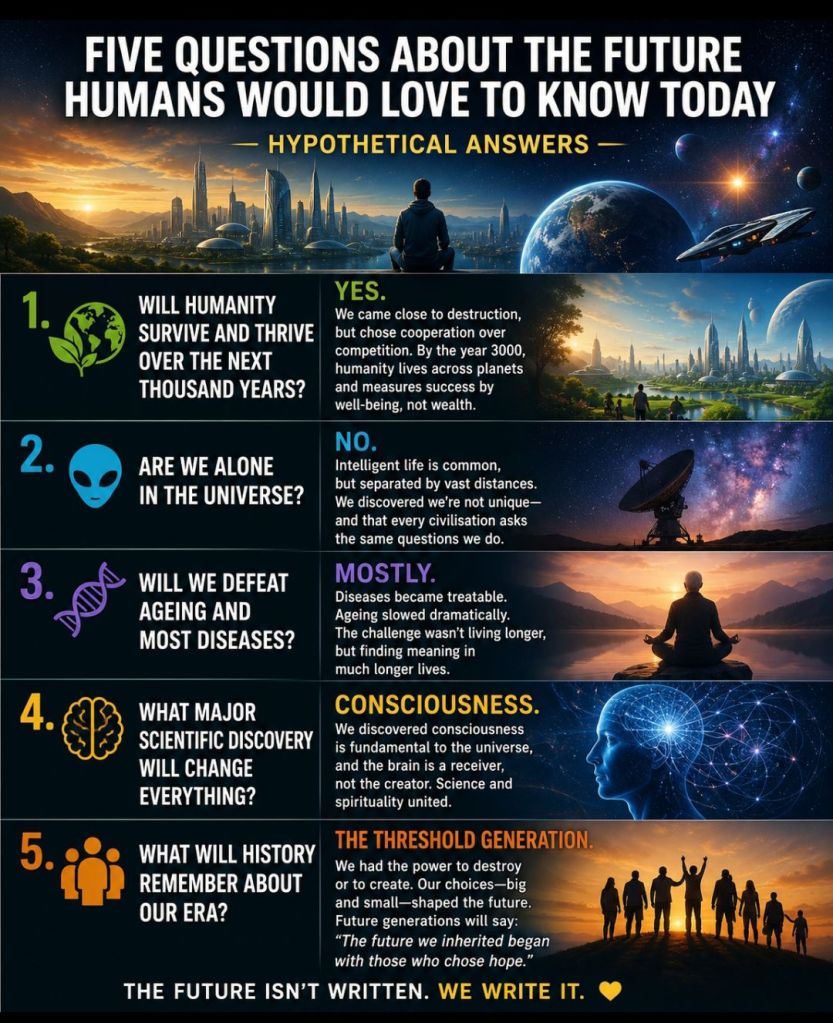
2. Are we alone in the universe?
Hypothetical Answer:
No.
Humanity eventually discovered that intelligent life was common but separated by distances so vast that civilisations rarely met while they existed.
The first confirmed signal arrived from a civilisation that had disappeared millions of years earlier. Later discoveries revealed countless worlds where intelligence had arisen independently.
The greatest revelation was not that aliens existed, but that every civilisation eventually asked the same questions:
“Who are we? Why are we here? What comes next?”
3. Will we defeat ageing and most diseases?
Hypothetical Answer:
Mostly.
Cancer, Alzheimer’s, heart disease, and thousands of genetic disorders became treatable or preventable through personalised medicine and cellular repair.
Ageing itself slowed dramatically, allowing people to remain healthy for well over a century.
Ironically, humanity’s greatest challenge was no longer preventing death but finding meaning in much longer lives. People learned that fulfilment came not from living forever but from continuing to grow, learn, and contribute.
4. What major scientific discovery will change everything?
Hypothetical Answer:
Scientists eventually discovered that consciousness was not simply produced by the brain.
Instead, the brain functioned like a receiver, organising information from a deeper layer of reality that connected every conscious being.
This discovery united physics, biology, neuroscience, and philosophy into a single framework. It transformed medicine, ethics, and humanity’s understanding of existence.
For the first time, science and spirituality were no longer viewed as opposing ideas but as different ways of describing the same underlying reality.
5. What will history remember about our era?
Hypothetical Answer:
History remembered your generation as The Threshold Generation.
You lived at the precise moment when humanity could either destroy its future or create one beyond imagination.
Future historians concluded that the defining feature of your era was not perfection but choice.
You inherited unprecedented problems, yet also unprecedented opportunities.
Every scientific breakthrough, every work of art, every act of kindness, every difficult conversation, and every courageous decision helped shape the civilisation that followed.
Future generations would often say:
“The future we inherited began with ordinary people who refused to believe that the future was already written.”
