“I don’t say much, but when I do, you can be guaranteed of two things: it won’t be worth hearing, and you’ve probably heard it before.”
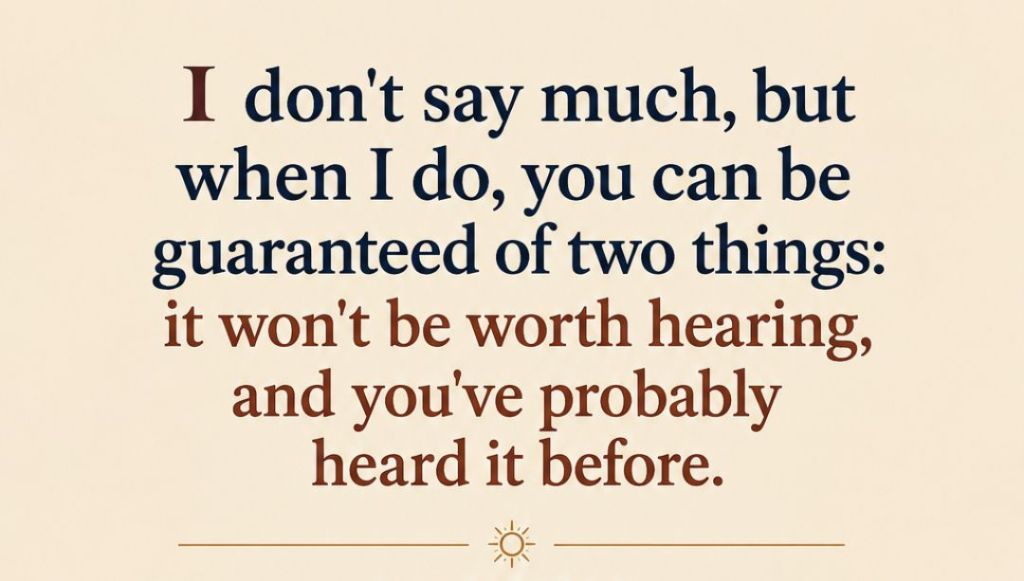
It’s the world’s worst introduction to a profound statement.
And yet, buried beneath its comically low expectations is something worth considering.
Let’s read it again.
“I don’t say much…”
Perhaps you listen more than you speak.
In a world that often mistakes volume for value, there is a quiet strength in not filling every silence. You observe. You think. You choose your words—not to attract attention, but because you are paying attention.
“…it won’t be worth hearing…”
Maybe you don’t need every opinion to earn applause.
You speak because something matters, not because you need to be noticed. Knowing when your voice can add value—whether by offering comfort, solving a problem, or simply being present—is its own kind of confidence.
“…and you’ve probably heard it before.”
This might be the most important part.
We’re obsessed with originality, yet most of what truly matters isn’t new.
We’ve seen the parent who, after a long day, still kneels down to listen to a child’s rambling story.
We’ve seen the colleague who shares credit instead of claiming it.
We’ve known the person who could have snapped back but chose kindness instead.
None of these are revolutionary acts.
They are ancient, ordinary, and quietly profound.
And they are often the first things we forget when we’re tired, angry, or afraid.
The problem isn’t that these truths are old.
It’s that we keep forgetting to live them.
You don’t need to invent a new truth to make a difference. Sometimes you simply need to live an old one well.
That’s the quiet revolution.
It isn’t about becoming quieter, nor is it about retreating into silence.
It’s about knowing when to speak—and when not to.
Silence isn’t always wisdom, and speaking isn’t always noise. The challenge is knowing which is needed in the moment.
Before you speak, ask yourself:
Is it true?
Is it useful?
Does it need to be said?
Does it serve the person I’m speaking to?
If the answer is no, perhaps let the silence remain.
And when the answer is yes, don’t worry about whether someone has said it before.
Some truths deserve another voice.
Speak less. Weigh your words more.
Because if enough people stopped trying to be heard and started trying to be useful, perhaps the quietest revolution would become the one worth listening to.
