The Reality of Life.
What if school prepared children for life—not just for exams?
Imagine a school where children still learn mathematics, science, history, languages and literature.
But alongside those subjects, they learn something else.
How to live.
Not how to live according to one particular philosophy.
Not what they should believe.
Not how to become successful according to society’s definition of success.
But how to navigate the reality of being human.
I call it The Reality of Life.
It isn’t intended to replace traditional education.
It is intended to complete it.
Because a child can leave school knowing how to solve an equation while having no idea how to manage a bank account.
They can memorise historical dates while struggling to understand their own emotions.
They can write an essay while being unable to recognise manipulation.
They can pass an examination while having no idea how to cope with failure, uncertainty, grief, conflict or the ordinary difficulties of being alive.
Perhaps we should teach some of those things, too.
1. Understanding Yourself
Children could learn how emotions work.
How to recognise what they are feeling.
How to tolerate discomfort without immediately trying to escape it.
How to calm themselves.
How to recover from setbacks.
They could explore mindfulness, breathing, sleep, exercise, nutrition, journalling and digital habits—not as magic solutions, but as tools for understanding and looking after themselves.
The lesson wouldn’t be:
“Don’t feel bad.”
It would be:
“Understand what you feel before allowing it to decide what you do.”
Feelings are information.
They aren’t necessarily instructions.
2. Learning How Life Actually Works
There are things almost everyone encounters as an adult that many people are never properly taught.
Money.
Budgeting.
Taxes.
Debt.
Interest.
Contracts.
Renting.
Insurance.
Employment.
Negotiating a salary.
Cooking.
Basic first aid.
Simple repairs.
Digital security.
And increasingly, how to use artificial intelligence responsibly.
These aren’t glamorous subjects.
But they are extraordinarily useful.
Education should not only prepare a child for a career.
It should prepare them for the life that happens outside the workplace.
3. Learning How to Think
Perhaps one of the most important things we could teach is the difference between believing something and knowing something.
Children could learn about evidence, probability, statistics, logic and cognitive biases.
They could learn how easily human beings can fool themselves.
They could learn to ask:
How do we know this?
What evidence supports it?
What evidence would change my mind?
What assumptions am I making?
Could I be wrong?
The objective wouldn’t be to produce children who distrust everything.
It would be to produce adults who can distinguish between a fact, an opinion, a possibility and a story they have simply become accustomed to believing.
That is a very different skill from memorising information.
It is learning how to think.
4. Learning How to Be With Other People
Much of human happiness happens through relationships.
So does much of human suffering.
Yet we often leave children to discover relationships through trial and error.
Perhaps they could learn about listening.
Boundaries.
Consent.
Communication.
Conflict.
Apology.
Forgiveness.
Negotiation.
Friendship.
Love.
Grief.
Manipulation.
And how to disagree without turning another human being into an enemy.
The goal wouldn’t be to teach children how to avoid conflict.
It would be to teach them how to repair what can be repaired—and recognise what cannot.
Because relationships aren’t about never getting things wrong.
They are about learning what to do when we do.
5. Learning Through Doing
Education can become excessively theoretical.
So give children things to make.
Things to grow.
Things to repair.
Things to build.
Problems to solve.
Projects to complete.
Art to create.
Communities to contribute to.
Perhaps even small businesses to experiment with.
Let them fail.
Let them start again.
Let them discover that being bad at something today doesn’t mean being incapable of doing it tomorrow.
A collection of examination grades tells us something about a student.
But so does a portfolio of things they have created, repaired, explored, attempted and learned from.
Perhaps we need both.
6. Exploring Meaning
Eventually, every human being encounters questions that mathematics cannot answer.
Why am I here?
What makes a good life?
What should I do when doing the right thing is difficult?
Why do good people suffer?
What do I owe other people?
What happens when I lose someone I love?
What does death mean?
What is enough?
What is worth sacrificing for?
These aren’t questions that require children to be given a particular answer.
Quite the opposite.
They deserve the opportunity to encounter different philosophies, cultures and perspectives and learn how to think about them.
Meaning shouldn’t be imposed. It should be explored.
And perhaps children should learn that uncertainty isn’t necessarily a failure of knowledge.
Sometimes, uncertainty is where deeper thinking begins.
7. Returning to the Physical World
A human being is more than a mind connected to a screen.
Children need movement.
Nature.
Fresh air.
Manual skills.
Sensory experience.
Time away from technology.
An understanding of how their bodies work.
There is something important about making something with your hands, walking through a forest, planting something and watching it grow, repairing something that is broken, or simply sitting quietly without needing to be entertained.
Technology can expand our world.
But it shouldn’t replace it.
And How Would We Teach It?
Probably not by adding another textbook to an already crowded timetable.
The Reality of Life would need to be experienced.
Through discussion.
Projects.
Real-world problems.
Apprenticeships.
Community involvement.
Experiments.
Reflection.
Socratic questioning.
Collaboration.
Perhaps even mixed-age learning where appropriate.
Teachers would become less like dispensers of information and more like guides, coaches and facilitators of discovery.
Assessment would increasingly involve demonstration rather than memorisation.
Can you actually do it?
Can you explain your reasoning?
Can you work with someone who disagrees with you?
Can you recover when something goes wrong?
Can you apply what you have learned to an unfamiliar situation?
Can you think for yourself?
These things may be difficult to measure.
But they are also difficult to fake.
We Don’t Need to Teach Children What to Think
Perhaps the greatest danger in creating a curriculum about life is that we accidentally create another system for telling children how they should live.
That would defeat the purpose.
The Reality of Life should be pluralistic, evidence-informed and open to disagreement.
It should expose children to ideas without demanding that they adopt them.
It should encourage curiosity rather than conformity.
It should teach them how to question even the things they are taught.
Including the curriculum itself.
Because the objective isn’t to create children who think like us.
It is to help create adults capable of thinking for themselves.
Where Do Books Fit?
Books could become one of the tools.
Not textbooks containing the correct answers.
Books that create questions.
A story can introduce an idea.
A character can embody a dilemma.
A philosophical question can disturb an assumption.
A humorous observation can expose something we normally overlook.
A piece of writing can make someone stop and think:
“What if that’s true?”
And then:
“What do I think?”
That second question is the important one.
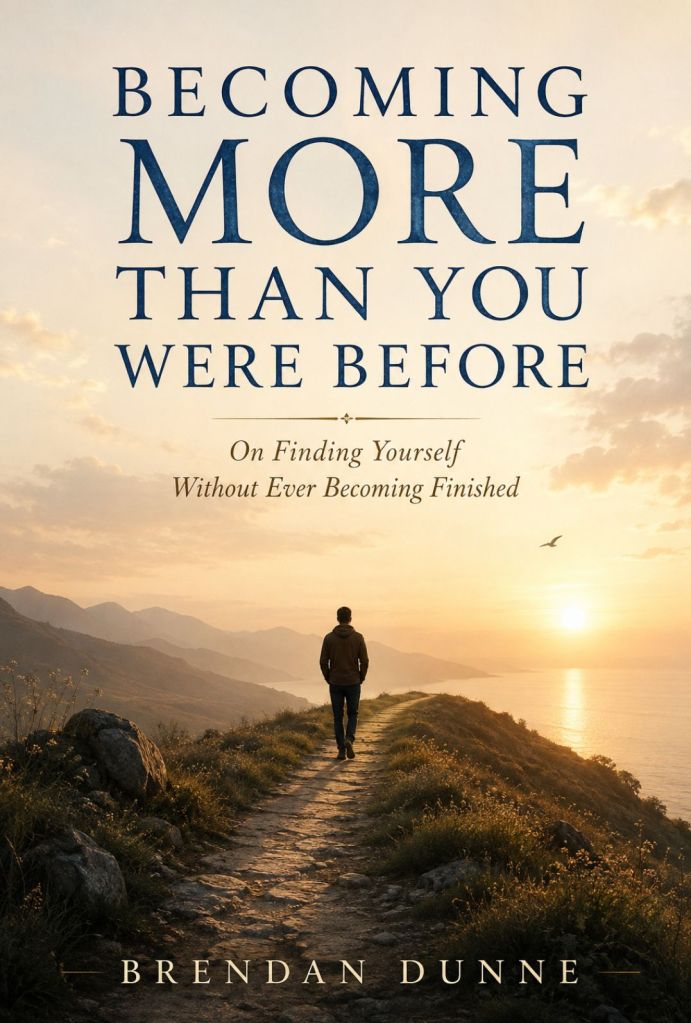
This is where I see Becoming More Than You Were Before, my most recent book, potentially becoming one small starting point.
Not because I believe it contains answers that children should be taught.
It doesn’t.
I deliberately don’t write that way.
My books are intended to point towards questions, perspectives and possibilities—to provide a direction in which an answer might be found rather than claiming to possess the answer myself.
A chapter could become a classroom conversation.
A question could become a project.
A disagreement could become an opportunity to practise critical thinking.
A personal reflection could become the beginning of a conversation about identity, responsibility, expectations, failure, happiness or meaning.
The teacher doesn’t need to tell students what the book means.
They could simply ask:
What does it mean to you?
Do you agree?
Why?
What experience might lead someone to see it differently?
What have you learned from your own life that supports or challenges this idea?
And perhaps the most important question:
What question does this leave you with?
Because education doesn’t always have to end with an answer.
Sometimes, its greatest achievement is creating a better question.
From Reading to Living
Imagine a student reading a passage about becoming more than they were before.
The lesson doesn’t end when they finish reading.
They might be asked to identify something they previously believed about themselves.
Something they would like to understand better.
Something they would like to learn.
Something they would like to change.
Then they might spend the following weeks exploring it.
Not because a teacher has told them who they should become.
But because they have discovered something they want to investigate for themselves.
That is the difference between teaching personal development and creating the conditions for personal development.
The first tells someone what they should become.
The second helps them discover what they might become.
Perhaps education should lean much more towards the second.
The First Experiment
Perhaps The Reality of Life doesn’t need to begin with a new education system.
Perhaps it begins much smaller.
One teacher.
One classroom.
One conversation.
One book.
One question.
Read a chapter.
Ask the questions.
Let the students disagree.
Let them challenge the author.
Let them challenge one another.
Let them challenge themselves.
Then see what happens.
If something works, learn from it.
If something doesn’t, change it.
If the evidence suggests a better approach, follow the evidence.
Because The Reality of Life should itself follow the principle it hopes to teach:
Don’t assume you have the answer.
Explore.
Question.
Learn.
Adapt.
Become more than you were before.
The School We Might Build
Perhaps the school of the future shouldn’t simply ask:
“What do you want to be when you grow up?”
Perhaps it should also ask:
Who do you want to become?
What kind of relationships do you want to have?
What do you want your life to mean?
How will you know when enough is enough?
What will you do when life doesn’t go according to plan?
How will you decide what is true?
What will you do with the life you’ve been given?
These questions don’t have examination-board answers.
And perhaps that’s precisely why they belong in education.
Because eventually every child leaves school.
The examinations end.
The certificates go into drawers.
The timetable disappears.
And then life begins asking its own questions.
We can leave children to discover the answers entirely by themselves.
Or we can give them better tools for finding them.
Not certainty.
Not ideology.
Not a prescribed meaning.
Tools.
Tools for thinking.
Tools for feeling.
Tools for relating.
Tools for creating.
Tools for questioning.
Tools for recovering.
Tools for living.
And perhaps the greatest lesson of all:
You don’t have to have all the answers.
You simply need to know how to keep looking.
That, to me, is what education at its best could become.
Not preparation for a test.
Preparation for reality.
