You’ve All Heard of Albert Einstein. But Have You Considered How Much You Have in Common With Him?
We picture the wild hair, the tongue poking out, the baggy sweater, and the chalkboard of equations that somehow unlocked the universe. We picture genius – a word reserved for people who make the rest of us feel we should have paid more attention in physics.
Strip away the Nobel Prize, the theory of relativity and the name that became shorthand for brilliance, and what’s left? A human being. An unusual one, but human all the same. His most useful qualities weren’t the ones we usually label ‘genius’.
He wasn’t always the obvious choice
Einstein disliked rigid teaching, questioned authority, and saw little point in learning things simply because he was told to. He was strong in mathematics and science yet struggled in a system that prized obedience and memorisation over independent thought. He failed the non-science sections of his first entrance exam to the Zurich Polytechnic – passing maths and physics, of course. Even Einstein had subjects he wasn’t particularly good at. Somewhere, a former classmate probably still remembers beating him.
The point isn’t that exams don’t matter. It’s that potential can’t always be measured by one set of results or one set of opinions. Sometimes, the person who doesn’t fit the system simply thinks differently.
He was passionately curious
Einstein said: ‘I have no special talents. I am only passionately curious.’
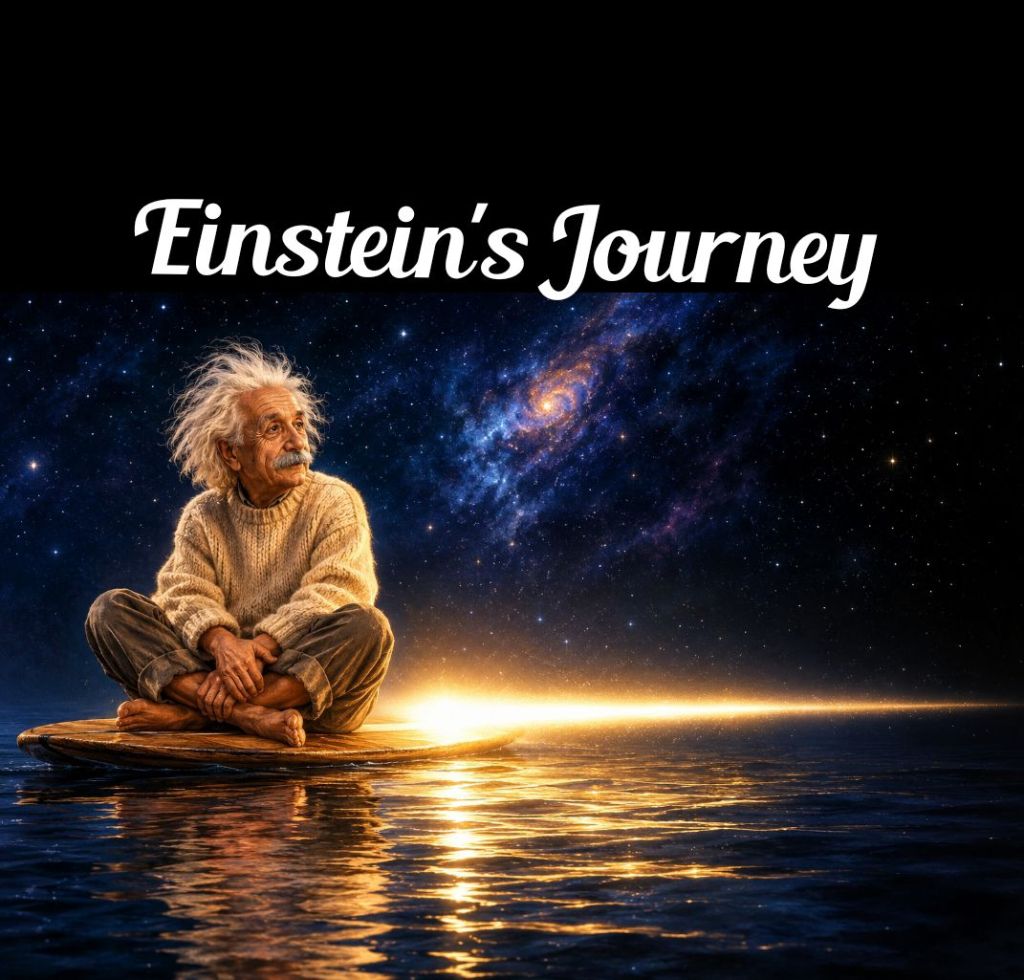
This is the man who rewrote our understanding of the universe, crediting curiosity above special gifts. He refused to accept things merely because they had always been understood that way. He asked what would happen if he travelled alongside a beam of light. He questioned time, space, and gravity. Curiosity wasn’t a hobby; it was how he met the world.
You do this, too. You’ve wondered why people behave as they do, why systems persist long after they stop working, why the supermarket has seventeen kinds of pasta and one functioning checkout. The scale differs. The principle doesn’t. Don’t stop asking questions.
He had a rather human private life
Extraordinary intellect does not come with an automatic gift for everything else. Einstein married twice, had three children with his first wife, and became stepfather to two more. His marriages were imperfect; he had affairs; he was not always an attentive husband. His relationship with his children was complicated, and his younger son’s schizophrenia caused him real distress.
The man who could explain the universe was not always brilliant at explaining a marriage. Being exceptional in one domain does not make you exceptional in every other. You can understand relativity and still struggle to relate to people.
He had a messy desk and a few unusual habits
He cared little for appearances – unruly hair, casual clothes, an indifference to socks. He loved sailing despite being a poor sailor who couldn’t swim. His desk was often a mess. Looking organised was never a prerequisite for thinking clearly. He had more important things on his mind (or he’d simply lost the filing system).
He played the violin. Enthusiastically.
Music mattered to him – Mozart and Bach especially. Playing helped him relax and sometimes think through hard problems. He once said that if he hadn’t been a physicist he might have been a musician. He didn’t need to be the world’s greatest violinist. He played because he enjoyed it. Not everything has to be turned into an achievement or measured against someone else’s standard. Sometimes doing something simply because it makes you happy is enough.
He made mistakes. Big ones.
He called the introduction of the cosmological constant his biggest blunder (the story is more complicated, given its later relevance). He resisted key aspects of quantum mechanics – ‘God does not play dice’ – and could be stubborn about ideas he had long defended. He wasn’t always right.
You’ve argued passionately for something only to discover you were wrong. You’ve ignored evidence and held opinions past their sell-by date. Being intelligent is not the same as believing you are always right. Einstein understood that being wrong was part of understanding.
He knew he wasn’t perfect (so, did his wives)
He recognised his shortcomings. Intellectual power did not automatically produce wisdom in every area of life. He could be forgetful, difficult, unconventional, and inconsiderate. He could also change his mind and admit the limits of what he knew. The more he learned, the more he realised how much remained unknown.
In a world full of people certain about subjects they discovered eleven minutes ago, a little of that humility would not go amiss. You don’t have to be right about everything. You don’t have to be good at everything. And you don’t have to pretend otherwise.
The real point
We have spent a century turning Einstein into a symbol – genius, scientific legend, the man who made the universe look complicated while his hair suggested a violent encounter with a hairdryer. Underneath was a curious boy, a sometimes frustrated student, a husband, a father, a musician, a sailor and a man who made mistakes. He had extraordinary abilities and ordinary weaknesses.
We look at extraordinary people and focus so hard on what makes them different that we miss what makes them familiar. We assume they were born with something we were not given. Sometimes, they simply kept using something many of us gradually stopped using: curiosity, imagination, the willingness to question what everyone else accepts, the courage to be wrong while searching for something better.
The next time you forget something, make a mistake, question an accepted idea, or pursue an interest nobody else quite understands, don’t be too hard on yourself. You’re not Einstein. But Einstein wasn’t ‘Einstein’ when he started, either. He was a young man asking questions.
You don’t have to be extraordinary to think differently. You don’t have to be perfect to make a difference. And you don’t have to know all the answers to ask a really good question.
Remember: If you have a messy desk. You’re in good company.
