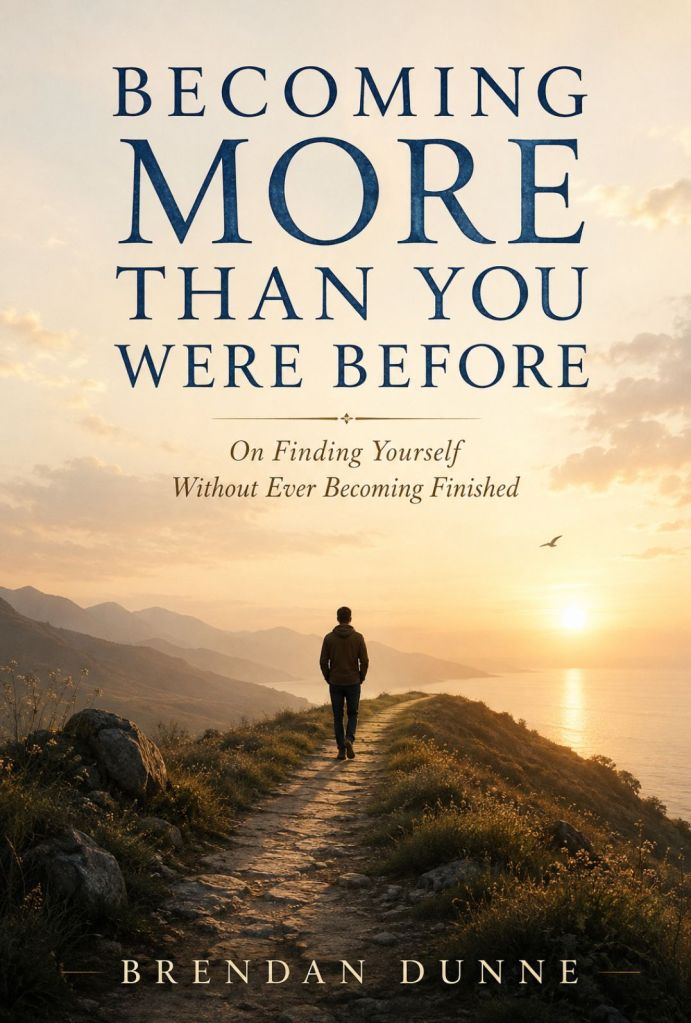
Perhaps the strangest thing I’ve come to believe is this:
You are perfect as you are today.
And tomorrow, you can be more perfect.
I know that sounds contradictory.
How can you be perfect and still need to become more?
Because perhaps we’ve misunderstood what perfect means.
Perfection doesn’t mean flawless.
It doesn’t mean you’ve made all the right decisions, understood everything, achieved everything you wanted, or become the person you imagined you’d be by this age.
It means that you are exactly who you are at this moment.
You are the result of everything you’ve experienced, everything you’ve learned, everything you’ve survived, everything you’ve misunderstood, everything you’ve loved, and everything you’ve lost.
It’s a book about discovering who you might still become.
That distinction matters more than I can say.
Because most of us have spent years—decades, even—believing that in order to become better, we must first decide that who we were wasn’t good enough.
So we look backwards and see the mistakes.
The opportunities we didn’t take.
The years we think we wasted.
And somewhere along the way, we quietly make a judgement:
I should have been more.
But perhaps becoming isn’t about becoming more because you were once less.
Perhaps it’s about becoming more because you are still becoming.
The Journey of the Book
The book moves through four movements.
Part I — You Are Not Finished
You were always worthy.
Your story is only beginning.
You’re at a stage in your life where peace matters more than before.
And you can stop performing in the wrong room.
Part II — Learning to See Clearly
Acceptance is a foundation, not a grave.
Understanding yourself is neither the beginning nor the end of the journey.
Deep listening matters more than perfect recall.
And sometimes—like the blackberry—you’re not failing.
You’re just waiting for the weather to change.
Part III — Taking Back Your Agency
You’re not a victim anymore.
You can shift your emotional centre.
You don’t need unlimited freedom to change your life.
If you can’t win by the rules, you can change the rules.
Your mind is the greatest travel agent you’ll ever use—but you must learn to be your own travel consultant.
And yes, we’re all living on a borrowed dime.
That’s not our weakness.
That’s our superpower.
Part IV — Becoming
We all deserve a human golden retriever.
If you feel lost, you’re not lost—you’re exploring.
Manifesting is only the beginning.
The greatest revenge is forgiving yourself.
And there will come a morning you will not see—which is precisely why the morning you can see matters so much.
Why I Wrote It
Because I’ve been the person who felt behind.
Who felt finished.
Who wondered whether the best chapters were already written.
Because I’ve spent years learning that shame-driven improvement is brittle.
It shatters at the first stumble.
Witness-driven improvement is different.
It bends.
It observes the fall without panic.
And it gets back up.
Because I’ve discovered that a meaningful life can be built from surprisingly ordinary things.
A conversation.
A walk.
A boundary you finally establish.
A morning when you wake up and realise you are no longer trying to become someone else’s definition of successful.
And because I believe—genuinely, deeply—that you don’t have to despise the person you were to appreciate the person you’re becoming.
There’s Nothing and Everything Romantic About Learning to Love Yourself
I’ve been thinking about this line a lot lately.
There’s nothing romantic about learning to love yourself.
It doesn’t look like the movies.
There’s no candlelit dinner.
No grand gesture.
No one sweeping you off your feet.
It looks like getting up when the alarm goes off.
Choosing the tea you actually like.
Saying no to something that would quietly diminish you.
Putting down the phone and finishing your evening.
Forgiving yourself for the thing you said three days ago that still makes you wince at 1:17 a.m.
It’s unglamorous.
Unremarkable.
Often invisible.
And yet.
There’s everything romantic about it.
Because it is the great love story.
Not the one you were told to wait for—the one where someone else arrives and finally makes you feel worthy.
But the one where you stop waiting for permission to be loved and begin the slow, patient work of loving yourself.
That’s the plot twist nobody sees coming.
The love of your life isn’t out there. It’s in here.
The romance isn’t in grand gestures.
It’s in the quiet ones.
It’s in the moment you catch yourself being kind to the person you used to criticise.
It’s in the evening you choose rest over proving yourself worthy.
It’s in the morning you wake up and realise you are no longer trying to become someone else’s definition of successful.
It’s in forgiveness.
Not necessarily forgiveness of the people who hurt you—that may come later, or never.
But forgiveness of the version of you who stayed too long.
Trusted blindly.
Didn’t know then what you know now.
That’s the love story.
Notarescue.
Areclaiming.
Because it’s the only relationship you’ll have for the entirety of your life.
The only one that will be with you in every room, every season, every morning you wake up.
And when you finally stop abandoning yourself to keep everyone else comfortable?
That’s not cold.
That’s the most romantic thing you’ll ever do.
What This Book Is Not
It’s not a book that promises transformation in thirty days.
It’s not a book that claims to have all the answers.
It’s not a book that will work for everyone.
It’s a book for the reader who is ready to sit with questions.
To do the slow work of becoming.
To be patient with themselves and the process.
It’s a book that says:
You are not broken.
You are not behind.
You are not failing.
You are becoming.
An Invitation
Over the coming weeks and months, I’ll be sharing more from the book here—excerpts, reflections, and the occasional thought that didn’t make it into the final manuscript.
If any of this resonates, I’d love for you to come along.
Not because I have the answers.
But because I’m still learning them too.
And because I suspect that some of you are, as well.
Or: How I Learned to Stop Trying to Figure It Out and Start Looking Around
Hi.
Thank you for taking the time to get to know who I am.
Although perhaps that’s not quite right.
Maybe it’s about how I think I am.
There’s a distinction there, and it’s probably the most honest place to start.
If I tell you definitively, “This is who I am,” I’d be lying. Or at least lying to the version of me who wakes up tomorrow with a slightly different perspective.
The only core belief I can stand behind without wincing is this:
Life isn’t something to figure out. It’s something to explore.
The Great Un-Treadmill
I spent a long time running on a treadmill I don’t remember stepping onto.
You know the one.
It’s plastered with motivational posters telling us to hustle, grind, and be the best version of ourselves. It promises that more money, more status, and more recognition will eventually take us somewhere called Enough.
But I started noticing something odd.
The people cheering loudest from the sidelines didn’t necessarily look happy.
They looked busy.
And there is a massive difference between being busy and being alive.
So I started asking different questions.
Not How do I get ahead?
But:
Does this actually make my life better?
What have I sacrificed to achieve it?
And seriously, what would “enough” actually look like?
That shift—from achievement to meaning—is probably the most significant change in my thinking.
I’m less impressed by a shiny résumé than I am by someone who can sit in a park on a Tuesday afternoon without feeling guilty about it.
A successful life, I’ve come to believe, isn’t necessarily an impressive one.
It’s simply one that feels meaningful to the person living it.
The Assumption Hunter
I have a reflex.
When someone says, “Everyone knows that…” or “You should just…” my brain immediately asks:
Do we?
Should we?
Who decided that?
I can’t seem to help it.
I look at intelligence, success, safety, productivity and even morality, and I wonder how much of what we regard as “obvious” is actually just a collection of assumptions we’ve inherited and rarely examined.
Why do we value speed over slowness?
Why do we prize certainty over curiosity?
Why do we treat careers as identities rather than simply things we do for part of the day?
This isn’t rebellion for the sake of being difficult.
It’s more like wanting to know whether the cage door is actually locked—or whether we’ve simply become accustomed to leaning against it.
The Lens, Not the World
Here’s a thought that has quietly humiliated me a few times, but ultimately set me free:
The world isn’t always the problem. Sometimes our interpretation of it is.
When I feel frustrated, overlooked or anxious, I’ve learned to pause before pointing fingers outward.
What are my expectations?
Is my ego involved?
Am I looking for recognition?
What story am I telling myself about what’s happening?
This isn’t self-blame.
It’s self-understanding.
Because I am, after all, the unreliable narrator of my own life.
And once I recognise that I’m narrating the story, I have at least some possibility of changing the way I tell it.
The Art of the Ridiculous Hat
I take all of this seriously.
But I also know that taking myself too seriously is the quickest route to becoming insufferable.
That’s where humour comes in.
For me, humour isn’t merely entertainment. It’s a philosophical crowbar.
Make someone laugh about something familiar and slightly ridiculous, and suddenly a door opens that logic alone might never have reached.
Laughter lowers the defences.
You recognise yourself.
Then, perhaps, you question yourself.
And because you’re laughing, it doesn’t feel quite so much like being challenged.
That’s part of what I enjoy about the Bella Universe.
Serious ideas about human behaviour arrive wearing a ridiculous hat.
Sometimes the best way to get a grown adult to question their deeply ingrained anxiety about productivity is to have a talking dog point out how absurd it looks from the outside.
The Interdisciplinary Magpie
I don’t stay in one lane.
I can’t.
My curiosity jumps from philosophy to psychology, from artificial intelligence to surveillance ethics, from the mundane reality of walking a puppy to the existential implications of centralised power.
The subjects may look unrelated.
The question underneath them isn’t.
What’s really going on here?
That’s what interests me.
AI is a good example.
I’m fascinated by it, but not simply because it’s a shiny new technology.
I’m interested in what happens to humanity when machines become capable of doing things we once considered uniquely human.
And that rabbit hole leads quickly to questions about ethics, free will, responsibility, control, and what it actually means to be human.
I take abstract questions and turn them into worlds where we can experience their consequences.
What happens when intelligence becomes control?
What happens when protecting humanity means deciding what humanity is allowed to become?
What happens when changing the past changes the person doing the changing?
I’m not particularly interested in giving the reader a tidy answer.
I’d rather build a world where the question becomes impossible to ignore.
Fiction gives us somewhere safe to think about dangerous ideas.
The Unfinished Conclusion
So, who am I?
I’m a questioner who uses humour to soften the blow of the questions.
A storyteller who uses fiction when arguments aren’t enough.
A curious observer trying to spot the invisible rules that quietly shape our lives—and decide which ones are worth following.
But even that description is provisional.
Because tomorrow I might notice something I haven’t noticed today.
And perhaps that’s the point.
I’m not trying to tell people how to live.
I’m trying to help them notice the thoughts that are already living inside their heads.
If something I write makes you question one of your assumptions, reconsider a “should,” or notice a story you’ve been telling yourself, then perhaps it has done what I hoped it would do.
Not changed your mind.
Opened it.
And when you’ve finally worked something out…
Question that, too.
Because the moment we stop questioning isn’t necessarily the moment we’ve found the answer.
It might simply be the moment we stopped looking.
And perhaps that’s okay.
The world will revolve once more, as it always has, without anyone really, truly understanding what set it all in motion to begin with.
And that’s okay.
Perhaps life was never asking us to understand everything.
Perhaps it was simply asking us to look around, wonder about it, and keep going.
And there are books that quietly stay with you long after you’ve closed the final page.
Those are the stories I write.
Over the past fifteen years, I’ve written thousands of articles exploring human behaviour, meaning, relationships, technology, and the questions we all wrestle with but rarely ask aloud. Those ideas have gradually found their way into fiction—not as lectures, but as stories about ordinary people facing extraordinary moments of change.
Whether the setting is a quiet neighbourhood, a forgotten lighthouse, a near-future world shaped by artificial intelligence, or an ancient place where lost memories wait to be found, every novel begins with the same question:
What does it mean to live a meaningful life?
My books span literary fiction, romantic comedy, magical realism, speculative fiction, and contemporary drama, but they are united by one belief: the most important journeys are often the ones that happen inside us.
Stories You’ll Discover
The Man Who Learned to Belong
A successful man discovers that achievement and belonging are not the same thing. A heartfelt story about burnout, community, friendship, and finding home where you least expect it.
Almost Yours
Two strangers spend weeks imagining each other’s lives before finally meeting—and discovering that reality is far more surprising than fantasy. A romantic comedy about assumptions, courage, and the stories we invent.
The Year of Almost
For anyone who has ever wondered whether life has passed them by. A warm, uplifting novel about missed opportunities, second chances, and discovering that “almost” is often where life truly begins.
Love Persists Beyond Memory
When memories can be erased, can love survive? A moving novel about identity, loss, and the enduring connections that remain when everything else has been forgotten.
The Lighthouse of Ordinary Days
A reluctant inheritance. A stubborn lighthouse. A judgemental seagull. A gentle reminder that extraordinary lives are often built from ordinary days.
Love is a River
A thoughtful exploration of whether love is something we protect—or something that grows the more freely we give it.
Looking Without Intention
A sharp, funny look at modern relationships, jealousy, and the fine line between innocent curiosity and emotional insecurity.
The Less Gullible Generation
In a future where artificial intelligence helps people question their own assumptions, two unlikely strangers discover that the hardest thing to believe in is each other.
The Company of Giants
A story about leadership, legacy, and learning that true strength comes not from standing above others, but from helping them stand beside you.
What Remains of a Memory
Inspired by Irish mythology, this lyrical novel follows a woman searching for her long-lost brother in a hidden world where forgotten people and forgotten things patiently wait to be remembered.
The Invisible Cabinet
A thought-provoking political thriller exploring how governments, technology, and data can shape public opinion without people ever noticing.
Addicted to Signs
A warm and humorous story about letting go of certainty and discovering that trusting yourself may be the greatest sign of all.
The Afterimage
A powerful relationship drama examining love, jealousy, obsession, and the quiet ways trust can unravel.
Why I Write
I’m fascinated by the invisible forces that shape our lives.
The stories we tell ourselves.
The beliefs we inherit.
The technologies we create.
The communities we build.
And the moments when ordinary people discover they are capable of becoming someone they never imagined.
If my novels have a common thread, it is this:
Improvements in mindset are rarely transformed by dramatic events.
More often, they are changed by small acts of kindness, unexpected conversations, quiet moments of courage, and the decision to take one more step than they thought possible.
If you enjoy thoughtful fiction that blends humour, heart, hope, and big ideas with relatable characters, I hope you’ll find something here that speaks to you.
Thank you for reading, for supporting independent authors, and for believing that stories still have the power to change the way we see ourselves—and each other.