Category: Self Improvement

  • Humanity stands at a crossroads — not between nations, not between ideologies, but between fear and trust.
    For centuries, we have organised ourselves around scarcity. We have hoarded resources, weaponised knowledge, and built systems where conflict can be profitable. Wars are justified. Divisions are marketed. The few often benefit from the confusion of the many.

    This is not because humanity is evil.

    It is because humanity is afraid.

    Fear prefers certainty.
    Fear prefers control.
    Fear prefers the safety of walls over the risk of understanding.

    And yet something is changing.

    We are building tools — particularly artificial intelligence — that can illuminate consequences in real time. Tools that can reveal incentives, expose manipulation, and map complexity faster than any human institution ever could.

    The same instrument that could magnify our flaws might also help us confront them.

    But exposure alone will not save us.

    History has shown that truth revealed does not automatically become truth embraced. Agendas are sometimes visible and still defended. Power does not only hide — it justifies.

    So, the question is not whether hidden motives can be uncovered.

    The deeper question is whether we are willing to look — and then choose differently.

    Imagine a world where children grow up not merely memorising facts, but learning how their own minds work. Where they are taught to recognise bias in themselves before accusing it in others. Where anger is explained, not shamed. Where fear is examined, not exploited.

    Imagine education that does not teach what to think but patiently strengthens the ability to think.

    Critical thinking is not rebellion for its own sake. It is humility in action — the recognition that there will never be a time when everything that can be known will be known.

    But we might have fun learning.

    In such a world, artificial intelligence would not dictate morality. It would help illuminate it. It would reveal incentives, clarify consequences, and make manipulation harder to sustain. Children raised in that environment would not become obedient citizens of a new orthodoxy.

    They would become curious adults.

    They would question systems — including the systems that taught them.
    They would challenge power — including technological power.
    They would understand that certainty is often a disguise for fear.

    This is not a call for perfection. Humanity has never been perfect, and it does not need to be.

    It needs maturity.

    The people most capable of steering civilisation may be those who see too many possible futures to claim certainty about any one of them. The future, therefore, will not be shaped by a single saviour with the right tool.

    It will be shaped by many voices willing to think aloud.

    Many minds willing to revise.

    Many individuals choosing understanding over reaction.

    If transparency becomes normal…
    If critical thinking becomes cultural…
    If curiosity becomes stronger than tribal loyalty…

    Then peace may one day become more practical than conflict. Cooperation may become more profitable than division. Trust may become more stabilising than fear.

    We do not need to know everything.

    We only need to become comfortable, not knowing — while choosing to learn together.

    The tool is emerging.
    The pathways are many.

    The way forward is not through more walls but through deeper understanding.

    And it begins quietly — whenever one person decides to think more carefully, question more honestly, and share their thoughts without needing to control where they lead.

    The future will not be forced.

    It will be nudged.

    And each of us, in our own small way, is already holding the compass.
  • Pause for a moment.

    Look back—not to judge, not to relive, but simply to see.
    The missteps.
    The scars.
    The chapters you wish had gone differently.

    Let them be real.
    They happened.

    And here’s the part we resist for far too long:

    There is not one damn thing you can do to change them.

    That truth can feel harsh at first. Final. Unforgiving.
    But it isn’t a sentence—it’s a release.

    So much of our energy is spent trying to mentally revise what has already been printed. We replay moments, rewrite conversations, haul around the weight of if only and what if, as though carrying them might somehow take us back to the beginning of the road.

    It won’t.

    You can’t rebuild the past.
    And you don’t need to.

    Healing doesn’t come from changing what happened.
    It comes from changing how you hold it.

    You don’t have to deny the past or diminish it. You don’t have to pretend it didn’t shape you. It did. Every hurt, every joy, every loss, and every hard-earned lesson helped form the person reading these words right now.

    But shaping you doesn’t give it authority over you.

    You can acknowledge your past without surrendering your future to it. You can say, Yes, you are part of my story—but you are not the one steering it anymore.

    Forward is where life lives.
    Forward is where choice returns.

    That’s where you decide what you carry, what you release, and what you build with the time that’s still unfolding. The past is just a stone now. Heavy, maybe. Solid, certainly.

    It can weigh you down.
    Or it can hold you up.

    Your history is fixed.
    But your story is still open.

    Turn the page and start writing.

  • We often misunderstand reality.

    We treat it as the killer of dreams—a heavy force that crushes what might have been. We speak of it as the enemy.

    But reality is not the opposition.
    It’s the final examination.

    This does not contradict the truth that reality is also a mirror. It completes it.
    The mirror shows you who you are.
    The examination reveals who you need to become.

    Most dreams don’t die. They arrive before you’re ready. The distance between a dream and its realization is not failure—it is preparation.

    Dreams live in feeling. They ask for passion.
    Reality lives in action. It asks for proof.

    It places a syllabus in front of you—not to discourage you, but to clarify the cost.

    Commitment.
    Will you show up when no one is watching?

    Resilience.
    Will you treat failure as a verdict—or as feedback?

    Sacrifice.
    What comfort are you willing to exchange for mastery?

    We often mistake this curriculum for rejection. We assume the dream was never meant for us.

    More often, it simply wasn’t meant for us yet.

    A dream goes dormant, not when it meets reality, but when it meets a version of you that isn’t ready to answer these questions. That isn’t tragedy. It’s timing.

    Reality doesn’t exist to destroy your vision. It exists to strengthen it. It stress-tests your dream against boredom, effort, and constraint—until only what can survive remains.

    So, if your dream feels distant, don’t assume it’s dead. Assume you’re enrolled.

    >You’re gathering skills.
    >You’re earning experience.
    >You’re becoming capable.

    Some dreams take months.
    Some take years.
    Some require you to become someone new.

    The exam hall never closes. The dream is not revoked—it’s waiting.

    Reality isn’t saying no.
    It’s holding up a mirror and handing you the syllabus.

    Here is who you are.
    Here is who you must become.

    The exam will be ready when you are.

    And when you step forward—not with anxiety, but with recognition—you won’t pass with a grade.

    You’ll pass with a life.

    A dream, no longer imagined, but earned.

  • Are you tired of self-help hacks that leave you more exhausted than empowered?
    You’ve tried the affirmations, the routines, the “just think positive” advice—but the inner noise just won’t quiet down.

    B0G21XDCWB (Copy and paste the link)

    What if real power isn’t about adding more, but about stripping away the chaos to uncover what’s already within you?

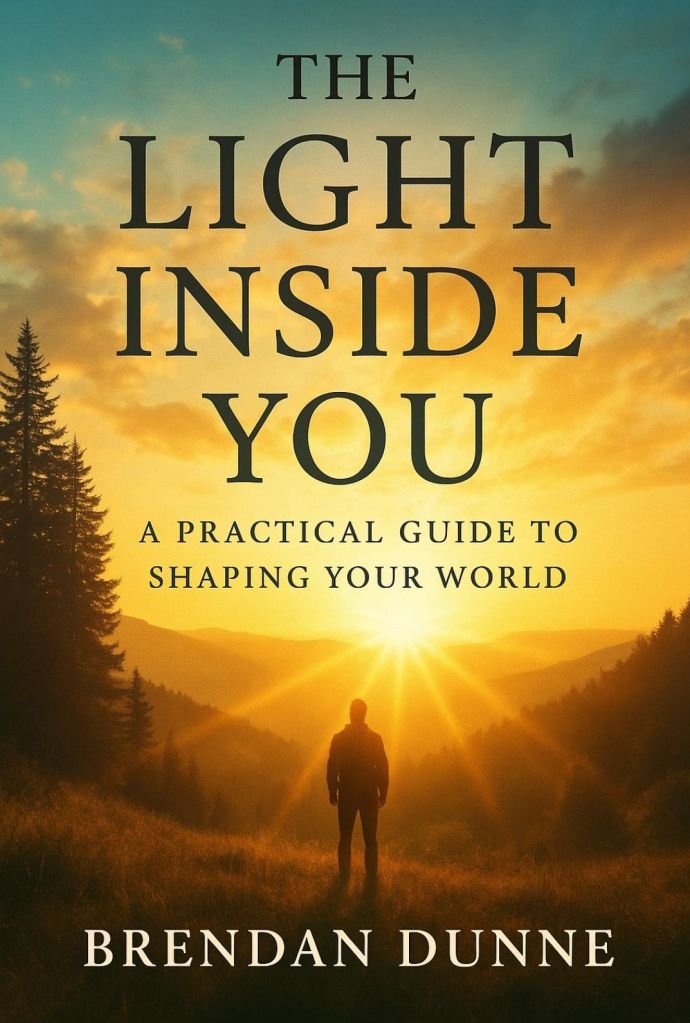
    The Light Inside You: A Practical Guide To Shaping Your World offers a refreshing, no-BS path back to your core strength. This isn’t fluffy motivation—it’s a grounded journey to quiet the mental clutter, reclaim your inner light, and shape your reality from within.

    Readers call it a game-changer: “Finally, something real.”
    As Book 1 in The Before the Noise Series, it’s your first step toward lasting clarity and control.

     Get it now on Amazon — paperback available, and for today only (29th January), the Kindle ebook is FREE.

  • It doesn’t arrive wrapped in philosophy.
    It doesn’t announce itself with importance.

    The Quiet Way

    It arrives as a small hand gathering scattered toys from the floor.

    We often think responsibility is something we grow into later in life—after mistakes, after consequences, after the world has had its say. But its earliest lesson is remarkably humble: clean up after yourself.

    Not because being messy is bad.
    Not because order must be enforced.
    But because actions leave traces.

    When a child cleans up what they’ve scattered, they learn something far bigger than tidiness. They learn that they are not separate from the world around them. That what they do shapes their environment. They are participants, not passengers, on their journey through life.

    This is where accountability begins—not in blame, but in ownership.

    There is something deeply empowering about this moment. No shame. No lecture. Just a quiet understanding: I did this, and I can tend to it. Responsibility, when taught this way, doesn’t feel heavy. It feels grounding.

    We underestimate how much adulthood is simply this lesson repeated at higher levels. Cleaning up our words. Cleaning up our reactions. Cleaning up the emotional messes we didn’t intend but still created.

    The habit scales.

    When responsibility is framed as punishment, it breeds avoidance. When it’s framed as power, it builds confidence. Children who learn to care for their own mess learn they are capable. A capable child becomes an adult who doesn’t wait to be rescued from the consequences of their own choices.

    Perhaps this is why the simplest lessons endure the longest.

    Take responsibility, not because you must—but because it reminds you that your actions matter. And if they matter, so do you.

    That understanding, learned early or late, quietly changes everything.