Month: Jun 2024

  • It’s amazing how quickly moments turn into years when you’re not paying attention to the moments. The following story is about Ben’s awakening to that fact.

    Ben had always lived his life by a strict schedule. Each day unfolded with the same sequence: wake up at 6:30, check phone, shower, breakfast, commute, work, gym, dinner, social media, bed. His friends often joked that you could set your watch by his routine. But Ben found comfort in predictability, believing it brought him efficiency and success.

    One overcast Tuesday morning, something unusual happened. Ben’s alarm didn’t go off. Panicked, he jumped out of bed, hurriedly dressed, and rushed out the door. As he hurried to catch the bus, he noticed a colourful mural on the side of a building he passed every day. He had never seen it before, though he must have walked by it hundreds of times. The mural depicted a lively scene of people dancing and celebrating, a stark contrast to his rigid, mechanical life.

    Ben caught his bus and made it to work just in time, but the image of the mural stayed with him. For the rest of the day, he couldn’t shake a sense of unease. If he could miss something as big, bright, and bold as that mural, what else was he missing?

    That evening, Ben decided to take a different route home. He walked slowly, observing the world around him with fresh eyes. He noticed the friendly nod of the newspaper vendor, the aroma of fresh bread from the bakery, and the laughter of children playing in the park. These everyday scenes, once blurred in the background of his regimented life, now appear vivid and full of life.

    In the days that followed, Ben began to question his routines. He realised that his strict schedule had turned his life into a series of automatic responses, leaving little room for spontaneity or awareness. He decided to make small changes: trying a new café, taking up a hobby, and reconnecting with old friends.

    One evening, while having dinner with Claire, an old friend, Ben shared his recent experiences. Claire listened intently and then said, “You know, Ben, if you don’t notice change, nothing will change. It’s like driving on autopilot—you might get where you’re going, but you’ll miss the journey.”

    Her words resonated deeply with Ben. He understood that recognising the need for change was the first step towards transformation. Over the next few months, he made a conscious effort to live more mindfully. He started a journal, recording moments of gratitude and reflection. He learned to savour his morning coffee, enjoying its warmth and aroma rather than drinking it absentmindedly.

    Gradually, Ben’s life began to shift. He felt more connected to the world around him, more engaged with his work, and more present in his relationships. He found joy in the small, everyday moments that he had previously overlooked.

    One day, as he walked by the mural that had sparked his awakening, Ben stopped and smiled. The people in the mural were still dancing and celebrating, just as they always had been. But now, Ben felt like he was part of the dance. He realised that change doesn’t happen overnight, nor does it always require grand gestures. Sometimes, it begins with simply noticing what’s been there all along.

    “Life moves pretty fast. If you don’t stop and look around once in a while, you could miss it.” – Ferris Bueller
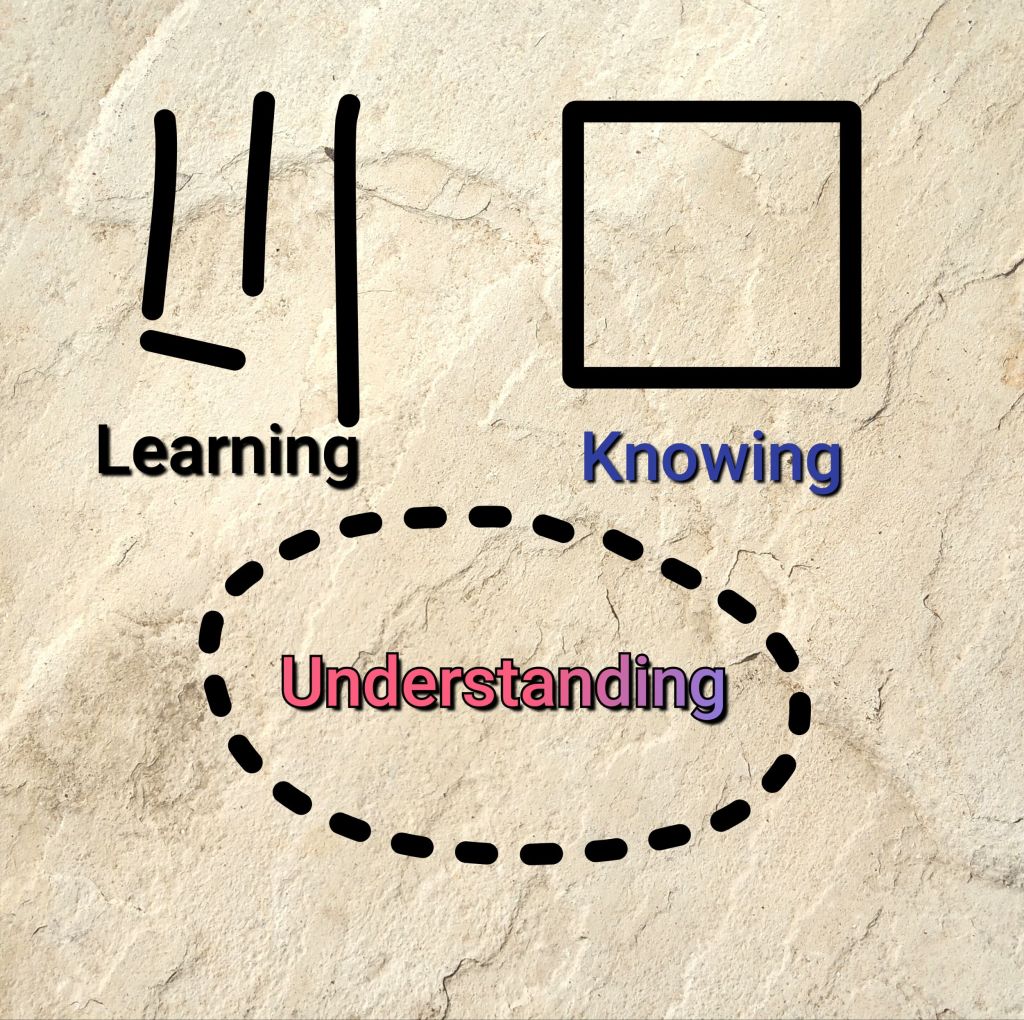
  • Understanding is always being aware that your knowledge is incomplete.

    Learning, knowing, and understanding are the three steps on people’s intellectual journey through life. Not everyone reaches all levels.

    Learning

    Everyone has the ability to learn. Their interests will determine if they move onto the knowing stage about any subject.

    Knowing

    Knowing is the ability to retain and recall the information you learn. This is as far as most people will reach because they’re interested, but not that interested in the subject. A good example of this is people who know how to do their job, but may not fully understand how their job fits into business’s objectives.

    Understanding

    Many people acquire knowledge and retain it, but not everyone achieves understanding. Traits such as curiosity, critical thinking, open-mindedness, and a willingness to challenge one’s own assumptions play crucial roles in reaching this level.

    You see, understanding requires effort and reflection, and not everyone is inclined or able to invest their time in this process.

    Conclusion

    The people who reach the knowing level without questioning if there’s anything left to learn are the luckiest people because they’re concentrating on enjoying their life, not trying to understand their life.

  • You will never reach enlightenment. However, you can become enlightened. Read Ben’s story about how he learned that lesson.

    Ben and Jacob had been friends since childhood, but their paths in life had taken them in different directions. Ben was a seeker, always searching for something greater, something profound that would give his life meaning. Jacob, on the other hand, seemed to have found a sense of peace and fulfilment that Ben couldn’t quite grasp.

    Ben travelled far and wide, attending workshops, reading countless books on philosophy and spirituality, and meditating for hours each day. He was determined to reach enlightenment, to find that ultimate state of understanding and bliss. Every new experience brought him hope but also frustration, as he felt he was always just out of reach of his goal.

    One summer, Ben visited Jacob in the small, serene village where Jacob had settled. As they sat on the porch of Jacob’s modest home, Ben shared his struggles.

    “I’ve been everywhere, tried everything,” Ben sighed. “But I still feel like enlightenment is always just one step ahead of me. How did you find it, Jacob? How did you reach enlightenment?”

    Jacob smiled, his eyes calm and steady. “Ben, enlightenment isn’t a place you reach. It’s not a destination at the end of a long journey. It’s a way of being, a state of mind.”

    Ben looked puzzled. “But how can that be? I’ve read so many teachings that describe it as the ultimate goal.”

    Jacob nodded. “Many teachings describe it that way, but the essence of enlightenment is in the present moment. It’s about being fully aware and accepting of life as it is, without constantly striving for something else. I used to be like you, always searching. Then, one day, I realised that the search itself was keeping me from seeing the truth. Enlightenment is not something you find; it’s something you become.”

    Ben pondered Jacob’s words, still unsure. “So, what should I do?”

    “Stop searching,” Jacob replied gently. “Start living. Be present in each moment, and accept yourself as you are. When you let go of the need to reach enlightenment, you’ll find that it’s already within you.”

    Over the next few days, Ben tried to follow Jacob’s advice. He spent time in the village, observing the simple beauty of everyday life, talking to the locals, and sitting quietly by the river. Gradually, he began to feel a sense of peace that had eluded him for so long. He realised that in his relentless pursuit of enlightenment, he had overlooked the beauty and wisdom of the present moment.

    One evening, as the sun set over the hills, Ben sat with Jacob once more. He didn’t need to say anything; the contentment in his eyes spoke volumes.

    Jacob smiled. “You see, Ben, enlightenment isn’t something you chase after. It’s something you allow yourself to experience here and now.”

    From that day forward, Ben stopped searching and started being. He found joy in the simplicity of life, and in doing so, he finally understood what it meant to be enlightened. Jacob had shown him that the journey to enlightenment was not about reaching a distant goal but about embracing the present with an open heart and a peaceful mind.

    Remember, nothing of importance is found at your destination if you don’t enjoy the journey.

  • It’s no fun seeing what people don’t want you to see. Please read Ben’s story on finding a balanced relationship with other people’s behaviour.

    Ben had always been a curious soul, eager to understand the intricacies of human behaviour and the world around him. From a young age, he devoured books on psychology, sociology, and philosophy, seeking to unravel the mysteries behind why people behaved the way they did.

    As he grew older, Ben’s thirst for knowledge only intensified. He found himself observing people wherever he went – at the grocery store, in cafes, on public transport. He noticed patterns in their behaviour, subtle cues in their expressions, and the complexities of their interactions. It fascinated him how each person seemed to carry a unique story hidden beneath the surface.

    Initially, Ben’s insights brought him a sense of fulfilment. Understanding others made him feel connected and empathetic. He offered a listening ear to friends in need, provided thoughtful advice, and seemed to navigate social situations with ease.

    However, as Ben delved deeper into understanding human nature, something began to change within him. The more he observed, the more he noticed flaws and inconsistencies in people’s actions. He saw how insecurities drove someone to boast, saw how people smiled with clenched fists, how fear masked as anger in another, and how jealousy tainted relationships.

    Initially, Ben brushed off these realisations, believing that understanding human complexities was a natural part of growth. But over time, he found himself becoming disillusioned. The idealised images he once held of people shattered as he uncovered their vulnerabilities and imperfections. What had once been a source of fascination now weighed heavily on his spirit.

    One day, while sitting in a bustling cafe, Ben watched a couple at a nearby table. He saw the subtle signs of tension in their conversation, the forced smiles, and the underlying frustration. As he observed, he couldn’t help but feel a pang of sadness. The intimacy and connection he had hoped to find in understanding others seemed elusive.

    That evening, Ben reflected on his journey. He realised that his deep insights into human behaviour had come at a cost. The more he understood, the less content he felt. He longed for the simplicity and innocence of seeing people at face value, without dissecting their motives or analysing their actions.

    In the days that followed, Ben made a conscious effort to strike a balance. He acknowledged the importance of empathy and understanding but also recognised the need to preserve his own sense of peace and contentment. He sought solace in nature, where the complexities of human interaction faded against the backdrop of the natural world.

    Ben’s journey taught him that while seeking to understand others was valuable, it was equally important to accept them as they were—imperfect, vulnerable, and multifaceted. He found fulfilment not just in unravelling the mysteries of human behaviour but also in embracing the beauty of genuine connections and the simple joys of life.

    You can see too much. However, you can learn to see just enough.

  • Positive thinking, the placebo effect, and self-fulfilling prophecies all share a common theme: the power of your belief system in creating your future. Here’s how they do it.

    1. Positive Thinking
    This involves maintaining a hopeful and optimistic mindset, expecting good outcomes, and focusing on solutions rather than problems. Whatever you expect has a habit of showing up.

    2. Placebo Effect
     This occurs when a person experiences a real improvement in their condition after receiving a treatment with no therapeutic value, purely because they believe it will help. Whatever you expect has a habit of showing up.

    3. Self-Fulfilling Prophecies
     This happens when a person’s expectation about a situation or another person leads to actions that cause the expectation to come true. Whatever you expect has a habit of showing up.

    In all three cases, beliefs and perceptions play a crucial role in determining outcomes. By believing in positive possibilities, trusting in treatments, or expecting specific outcomes, individuals can significantly influence their reality.

    Whatever you expect has a habit of showing up.