Firstly, it’s a question that doesn’t really have an answer because there are so many unique factors involved. An answer that answers the question for one person will be the wrong answer for another. However, for the purpose of this post, I’m going to label the youth of today as the entitled generation. The question is, are they ignorant or uninformed? The following story about Martha may provide an insight into that question.
Bridges Between Generations
Martha sighed as she stood in line at the grocery store, her wrinkled hands gripping the handle of the cart. She was in her late seventies, a widow for five years, with three children scattered across the country. Her generation had been taught to value hard work, patience, and respect. She remembered growing up with rationing during the war and how her mother taught her the importance of saving, fixing, and never wasting. Life wasn’t always easy, but it had structure and purpose.
Behind her, a young man in his twenties scrolled through his phone, tapping impatiently. His hoodie hung loose, and expensive sneakers adorned his feet. Martha noticed his sighs growing louder, his irritation bubbling just under the surface.
“Could they take any longer?” he muttered, not to her but loud enough for everyone in the line to hear.
Martha turned slightly, offering him a polite smile. “We all have to wait our turn, dear.”
The young man barely looked up. “Yeah, well, I’ve got things to do, you know. It’s ridiculous how slow this place is.”
Martha felt a pang of frustration but bit her tongue. This was the way now, wasn’t it? Everyone in a rush, always wanting more with less effort. It reminded her of her granddaughter, Emily. At twenty-one, Emily had little patience for anything that didn’t provide instant gratification. Her constant complaints about not having enough money, despite living at home rent-free, reminded Martha of how different the world had become.
Last Thanksgiving, Emily had gone on about her “mental load” and how it was too much for her to juggle school, part-time work, and a social life. Martha had listened quietly, reflecting on how at her granddaughter’s age, she had worked two jobs while raising three children, her husband overseas in Vietnam. She hadn’t had the luxury to complain.
After checking out her groceries, Martha pushed her cart through the parking lot, still thinking about the generational divide. It wasn’t just entitlement, she thought. It was a lack of understanding. The younger generation didn’t realise that the conveniences they now took for granted—instant access to information, the ability to order anything with a click—were things that her generation could never have imagined. But with that convenience came an erosion of patience and resilience.
As she reached her car, Martha’s musings were interrupted. She saw the same young man from the line a few cars down, his face contorted in frustration. His expensive car had a flat tire, and he was pacing, phone to his ear.
“Yeah, I need roadside assistance,” she overheard him say. “I don’t know how to change a tire. No, I don’t even have a spare.”
Martha hesitated. She could simply load her groceries and leave. But something tugged at her. With a deep breath, she approached him.
“Excuse me,” she said gently. “I couldn’t help but notice your trouble. I can help you change that tire if you have a spare.”
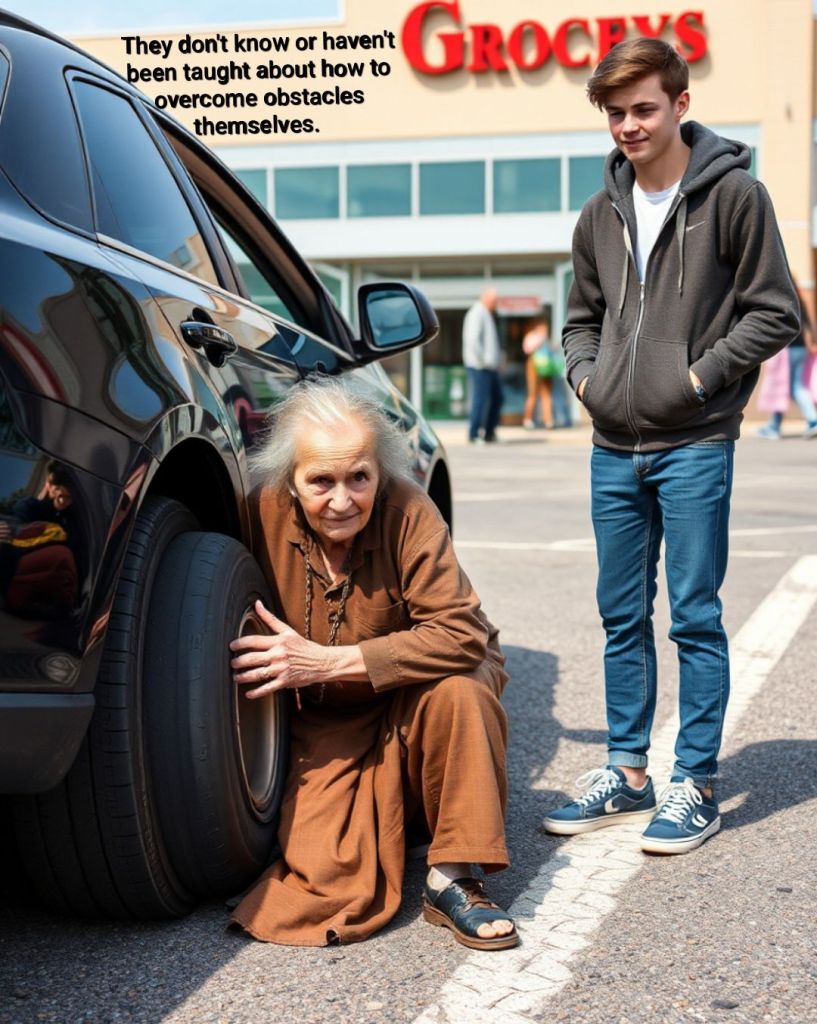
The young man looked at her in disbelief. “You? No offence, but… are you sure?”
Martha chuckled softly. “I’ve changed more tires than you’ve probably driven, young man. Let me see what we’re working with.”
Sure enough, there was a spare in the trunk, but there were no tools. “Well, that’s half the battle,” she muttered. Martha grabbed a jack and wrench from her own car, getting to work while the young man watched in a mix of awe and embarrassment.
“I didn’t think people still did this,” he said after a few minutes. “Like, fixing things themselves.”
Martha smiled, her hands steady and practised. “There was a time when we didn’t have much choice. If something broke, you fixed it, or you did without. It builds character, I think.”
The young man watched her in silence as she worked. Finally, as she tightened the last bolt, he said, “I guess I never learned. My dad always just called someone to do it.”
Martha stood up, wiping her hands on her old sweater. “There’s nothing wrong with getting help when you need it. But it’s good to know how to help yourself too.”
The young man nodded, a flicker of something crossing his face—perhaps humility, perhaps realisation. “Thanks,” he said, looking her in the eyes. “I really appreciate it.”
Martha waved him off. “It’s nothing. Just remember, sometimes the things that take time and effort are the things that last the longest.”
As she drove home, Martha thought about the young man, about Emily, and about the world they were inheriting. Maybe they weren’t lazy or entitled in the way she first believed. Maybe they just hadn’t been given enough chances to struggle, to fail, and to learn the way her generation had.
The next week, her granddaughter came to visit. Emily slumped onto the couch, grumbling about a project deadline and how her professor was being “unreasonable.” Martha sat beside her and listened. But instead of offering comfort, she said, “You know, Emily, you’re stronger than you think. Sometimes, it’s not about how fast you finish something. It’s about doing it right, even when it’s hard.”
Emily looked at her grandmother, confused at first, then thoughtful. Maybe the message would sink in. Maybe it wouldn’t. But Martha felt a small flicker of hope. After all, even in a world that moved so quickly, there was still time to build bridges between generations.
P.S. If each generation doesn’t allow the next generation to overcome obstacles themselves, then they are responsible for creating an entitled generation.
