Or Perhaps We Were.
We spent decades worrying that artificial intelligence would become too powerful to control. Nobody warned us it might confidently invent an answer and apologise for it afterwards.
In 1999, The Matrix gave us a glimpse of the future.
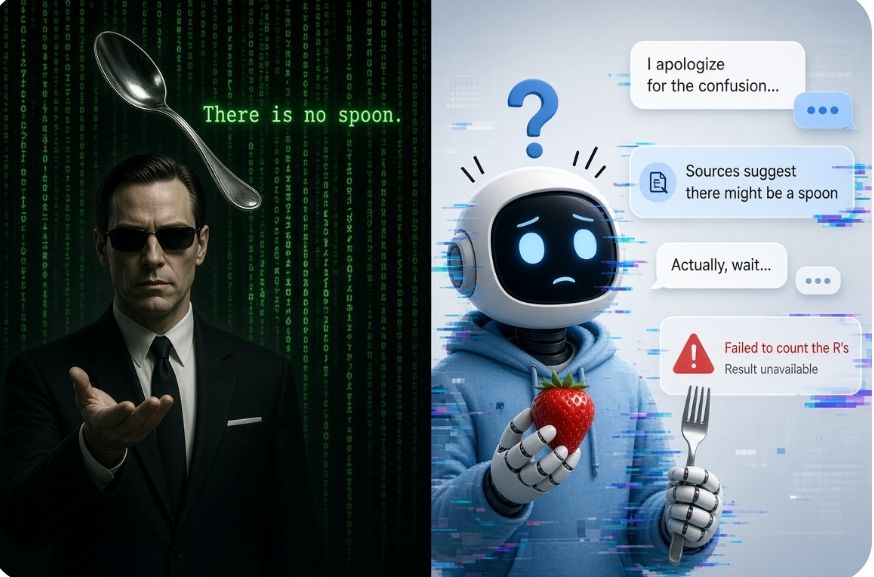
Artificial intelligence had become so advanced that it created an entire simulated reality, enslaved humanity, and controlled the world with terrifying precision.
Its agents could move faster than bullets, occupy human bodies, and manipulate reality itself.
The machines were intelligent, organised, and seemingly unstoppable.
Fast-forward to 2026.
Artificial intelligence can write essays, compose music, generate images, analyse complicated problems, and hold conversations that sometimes feel remarkably human.
It can also forget what you told it three sentences ago, invent a source that doesn’t exist and confidently explain why two plus two equals five if you phrase the question creatively enough.
Progress, apparently, comes with a few minor complications.
In The Matrix, the machines understood reality so completely that they could bend it.
Today’s AI occasionally struggles to identify whether a strawberry contains the letter R.
In the film, Agent Smith was a terrifying embodiment of machine intelligence.
Today’s equivalent might politely apologise for a mistake, explain why it happened, and then make precisely the same mistake in a slightly different font.
And while the Architect could deliver a philosophical monologue explaining the mathematical foundations of an artificial universe, today’s AI might respond to a simple question about the weather with seventeen paragraphs, three qualifications and a reminder that meteorological conditions can change.
It’s not quite the apocalypse we were expecting.
But perhaps there’s something worth thinking about beneath the comedy.
The real intelligence test
We’ve become fascinated by artificial intelligence because it appears to offer something extraordinary: intelligence without the usual human limitations.
It can process enormous amounts of information, recognise patterns, generate possibilities, and produce answers in seconds.
But there’s an important distinction between producing an answer and understanding what that answer means.
Information isn’t wisdom.
Confidence isn’t accuracy.
And the ability to sound intelligent doesn’t necessarily mean something has understood the question.
These distinctions matter because we’re entering a world where answers are becoming increasingly easy to obtain, while knowing which answers deserve our trust is becoming increasingly important.
Perhaps the most valuable skill of the future won’t be knowing everything.
It will be knowing when to question what we think we know.
Don’t outsource your curiosity
There’s an interesting irony in all this.
We created artificial intelligence to help us think, explore, and solve problems. Yet there’s a possibility that, if we’re not careful, we’ll gradually stop doing some of those things ourselves.
Why struggle with a question when a machine can answer it?
Why investigate an idea when an algorithm can summarise it?
Why develop our own judgement when something can offer us a seemingly convincing conclusion?
But the journey towards understanding is often more valuable than the answer itself.
It’s in the questioning, the uncertainty, the mistakes, and the unexpected discoveries that our thinking develops.
A machine might give you ten possible answers.
Only you can decide which questions are worth pursuing.
Perhaps that’s where the distinction between artificial intelligence and human intelligence becomes most interesting.
One can process information at extraordinary speed.
The other can wonder why the information matters in the first place.
Perhaps the future belongs to the curious
We don’t need to fear every new development, nor do we need to assume that every technological breakthrough represents progress.
Technology is a tool. Its value depends partly on how we use it, what we expect from it, and whether we remain capable of thinking independently.
Artificial intelligence might eventually become astonishingly sophisticated. It might transform medicine, education, science, creativity, and almost every aspect of everyday life.
But whatever happens, there are things worth protecting.
Our curiosity.
Our imagination.
Our ability to question assumptions.
Our willingness to change our minds.
And perhaps, above all, our capacity to recognise that not every confident answer is a good one.
The future doesn’t necessarily belong to those with access to the most powerful technology.
It may belong to those who know how to use it without surrendering the qualities that make them human.
There is no spoon. But there is still a choice.
Perhaps the greatest lesson from The Matrix wasn’t that machines might one day control reality.
It was that reality isn’t always what we assume it to be, and that seeing beyond our assumptions requires us to question what we’re being told.
In 1999, we worried that artificial intelligence would become so intelligent that humanity would lose control.
In 2026, we’re discovering that it can be remarkably convincing without always being remarkably correct.
Agent Smith would probably be unimpressed.
But perhaps we should be grateful for the reminder.
We don’t need to compete with machines at being machines.
We need to become better at being human.
Think for yourself. Stay curious. Question the answers, especially the ones that sound too convincing.
And if an AI tells you there is no spoon, ask it to count the R’s in strawberry.
Just don’t be surprised if it offers you a fork.
Because the future may be artificial, but what we choose to do with it remains profoundly human.
