Some people believe that talking on their phone while they’re out walking will keep them safe. But the truth is simple: the only person it actually reassures is the person sitting at home… who is already safe.
There’s a strange comfort in holding a phone to your ear—like it creates a bubble around you. A shield. A companion. But safety doesn’t come from distraction. It comes from awareness.
When you’re on the phone, your focus is elsewhere. Your eyes see the path, but your mind is miles away. You’re half in the world you’re walking through and half in the world of conversation. And any time you’re split like that, you’re not fully present for either.
Realsafety lives in alertness. In paying attention to the quiet things: footsteps behind you, the shift of a shadow, the change in energy on a street. These are the natural instincts that protect you—not the ringtone, not the conversation, not the illusion of connection.
Ironically, the person you’re speaking to doesn’t need protection. They’re at home. Warm, comfortable, safe. And the phone helps them feel better because they know where you are. But it doesn’t help you. Not in the moment where it matters.
If you want to feel safe, step off the call. Lift your head. Trust your senses. Walk with purpose. Move through the world like you belong in it—because you do.
Real safety isn’t in your hand. It’s in your awareness. And that’s something no phone can give you.
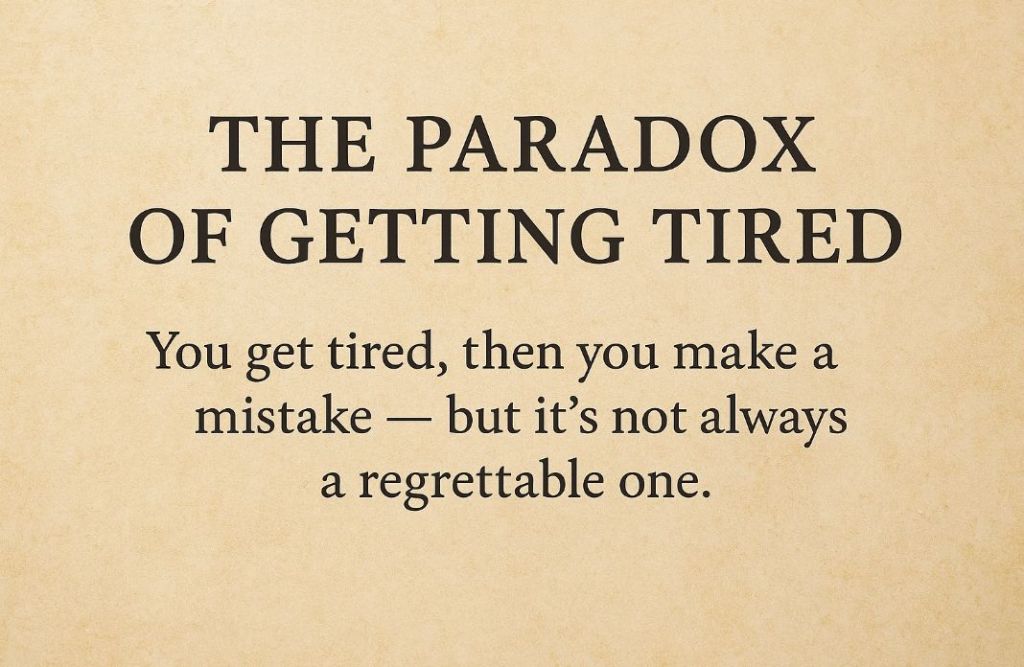
You get tired, then you make a mistake — but it’s not always a regrettable one.
It begins as a law of nature, immutable as gravity: you get tired, then you make a mistake.
Fatigue is the universal solvent of precision. It erodes willpower, blurs the surgeon’s line, and sharpens a lover’s tongue. Systems fail — from the human body to the vast, humming grid of commerce — not from a lack of courage, but from a simple deficit of energy. This is the first truth, the one etched in the ledger of loss.
But there is a second, more mysterious truth.
Sometimes, exhaustion does not lead to error but to surrender. We grow too tired to hold the old grief, too weary to force the familiar shapes. And in that release, we stumble into a different kind of seeing.
Alexander Fleming, his mind and lab both cluttered, left a petri dish unattended. He returned to a mess. And within that neglected dish, he saw it: a ring of death around a mould — the unplanned birth of penicillin. Jackson Pollock, fatigued by the tyranny of the brush, let paint fall and fly, discovering a unique chaos that inspired a generation of painters.
We rarely consider the effects of our tired behaviour in the moment; that vision is only granted in hindsight. The world’s great breakthroughs are often not achievements of will, but artefacts of exhaustion — happy accidents witnessed only after the guard of perfectionism falls.
There is a strange grace in this.
Fatigue dismantles the arrogant idea that mastery is the sole source of meaning. It humbles us. It forces us to create not from a place of tight control, but from a looser, more honest core — a place where the door to failure and the path to discovery are one and the same.
So yes, the law stands: you get tired, then you make a mistake. But if you are brave enough not to look away, you might find that the mistake was not an ending. It was the crack where the light got in.
There’s a little voice inside your head that never shuts up. You know the one. It’s currently replaying that embarrassing thing you said in 2014 and wondering if cats have any concept of Thursday.
That voice — the chaotic, cryptic, and surprisingly brilliant roommate living rent-free in your skull — is your subconscious mind. And it’s not just a tenant; it’s your best friend. You’ve just been having a decades-long argument because you don’t speak the same language.
Your subconscious is fluent in the dialect of vibes, cryptic dreams, and gut feelings that scream “ABORT MISSION” right before you order a third cocktail. It’s the friend who can’t say, “Darling, he’s a human red flag,” so instead, it gives you a full-body cringe when he uses the word moist. That’s not anxiety; that’s loyalty.
Picture this: you walk into a party. Your conscious mind is having a full-blown panic attack — Do I smell weird? Is my smile doing that thing? Why did I wear this? Meanwhile, your subconscious is lounging in the control room like a zen master, sipping metaphorical tea. It’s already scanned the room, identified the snack table, and flagged the one person who looks kind. It’s been running this “human interaction” software since we were dodging sabertooth tigers. Your only job is not to trip over the rug.
We treat this inner genius like a weird cousin who might start yodelling at a funeral. But your subconscious isn’t trying to embarrass you — it’s trying to save you. It’s been compiling data since you were traumatised by that clown at your fifth birthday party, building a bespoke internal GPS for your life. You just keep ignoring the directions because it refuses to use Waze.
Sometimes, it communicates through dreams. And yes, the dreams are unhinged. One night you’re late for a meeting because you have to wrestle a sentient stapler; the next, you’re peacefully having a picnic with a talking sloth. Your subconscious isn’t crazy — it’s a stressed-out intern trying to file that day’s emotional paperwork, and it’s working with the office supplies it has. Every dream is a note that says, “Here’s what’s up,” but it’s written in glitter glue by a raccoon on espresso.
If you could translate it, you’d see your subconscious is the most patient, ride-or-die companion you’ll ever have. It listens to you rant about your boss for the 47th time, forgives you for that haircut, and never says, “I told you so,” even though it absolutely did — via a suspicious stomach lurch and a vivid flashback to that time you trusted a guy named Ace.
It knows you’re not okay before you do. It sends memos: the 2 PM exhaustion that feels like a weighted blanket of sadness, the sudden, furious urge to reorganise your sock drawer at 2 AM. It’s your inner friend gently shaking your shoulders, saying, “Hey. We’re not fine.” But since you’re monolingual, it has to use your own adrenal system as a translator.
We live in a world that worships logic and spreadsheets. Your subconscious runs on poetry, intuition, and the unwavering belief that karaokeing Bohemian Rhapsody is a good idea. It’s the part of you that falls in love while your brain is still drafting a pros and cons list. It’s the part that knows the answer before you’ve finished the question. It’s the part that still believes in you when you’ve decided you’re a lost cause.
Itdoesn’tjudge. Itdoesn’tghostyou. It’s in the passenger seat on every road trip, every bad date, every silent 3 AM moment when you think you’re completely alone.
So the next time you’re spiralling, try something radical: stop. Breathe. Listen. Your subconscious might not use words, but it’s got your back with the ferocity of a honey badger that thinks you’re its cub.
It’s the invisible hype-man that cheers when you’re brave, the comfort blanket that wraps around you when you’re broken, and the DJ that plays your favourite forgotten song exactly when you need it most.
And maybe that’s the truest kind of friendship — not someone who always gets you, but someone who never, ever leaves. A built-in guardian that quietly, constantly guides you home.
The Joys of Growing Older: A Limited-Time Offer You Can’t Refuse, literally.
Who says getting older is a bad deal? In fact, it might just be the best package on the market—complete with perks you never expected.
✨ Unlimited Free Time – You now have the entire day to put off doing the things you don’t want to do. (Procrastination: rebranded as a lifestyle choice)
✨ Built-in Nostalgia Filter – Every memory looks golden when you can’t quite remember it properly. Was life hard? Maybe. Was it wonderful? Absolutely.
✨ Every Room = A Mystery Tour – Why are you in the kitchen? What mission brought you upstairs? Who knows! Every step is a surprise adventure.
✨ Doorways: The New Puzzles – Stand still too long, and suddenly you’re trapped in a thrilling game of “In or Out?” The stakes have never been higher.
✨ Zen-Level Serenity – Life’s annoyances now bounce right off you. That thing that once drove you mad? You smile at it. Because you know—life really is too short.
So don’t fear the passing years. Embrace them. Growing older isn’t the decline everyone warned you about—it’s the VIP upgrade to life’s most ironic comedy club.
If people learned to disassociate their fears from the words used to describe unfortunate events, then a lot of people would live happier, healthier lives because;
“We suffer more often in imagination than in reality”. ~ Lucius Annaeus Seneca.
Unnecessary suffering. That’s the real problem people face on a daily basis. Too many people let their imagination create anxiety. They allow words to have more control over their thoughts than is needed.
Some of those words are pandemic, cancer, death, murder, Suicide, mental illness, drug addict, financial disaster, racism. The thing to remember is that they are only words. If you don’t know the context behind the words, that’s all they ever will be. Words.
Let’s put some of those words into context.
Pandemic: the current virus sweeping the globe is dangerous, however, if you consciously social distance at all times, wash your hands, avoid touching your mouth or nose when you’re out shopping or on any other trip. Wear a mask when it’s not possible to ensure social distancing. You will be safe.
Cancer: It’s another word that creates fear and panic. However, over the years, doctors and scientists are getting to grips with this disease, and the survival rate is on an ever upward spiral. If somebody is unfortunate enough to pick up this disease, their fate is in the hands of their doctor and their fate. Worrying about it is not going to help. And yes, I know it’s easier said than done, but that’s where people need to have faith in their fate.
Death: a fate that’s waiting for everybody. If the natural order prevails where the person is born, lives a long and happy life, then departs. It’s relatively acceptable. However, when the natural order is not followed, it causes anxiety. The only thing I can say in this situation is that it can’t be undone.
Murder: it happens. However, the percentage of people who die on the grand scale is very low. I don’t believe anybody should commit suicide. However, when you hear of a murder/suicide, I always wonder why they couldn’t be brave enough to depart on their own.
Suicide: I believe it’s the side effect of the next topic.
Mental illness: I personally believe there should be more psychiatrists than any other practitioner in the medical system. Mental illness should be discussed as easily as the common cold. People should be saying, “I felt a little mental last week.” And the person they’re speaking with will reply, “that’s a coincidence, I had the same thing the week before.” The old saying, “when you shine a light on a shadow, the shadow disappears,” is very apt, nobody should be allowed to suffer in the darkness.
Drug addict: These people want to escape from reality. Their reasons are more than likely the ones they brought with them from their childhood. Didn’t deal with it then, and I’m not going to deal with it now. If you’re lucky, you had a good childhood and good parents who taught you how to deal with the problems you’ll face during your lifetime. These people didn’t have one or both of them.
Financial disaster: There are many different levels of being poor, I have absolutely no pity for somebody who has to sell their 10-bedroom mansion to live in a bungalow. All I say is, welcome to the real world. When I hear of people who don’t have enough to eat, I wish the governments of the world would find a peaceful solution to their conflicts and spend the money they save, feeding the world’s poorest.
Racism: it seems to be the reason behind everything these days. If you don’t agree with somebody from a different culture, you’re racist. I believe that any headline that has a colour to differentiate between people is creating a division in our society. There should never be a story where it says, “Black man shot by police or white man shot by police. It should read.” “Man Shot by Police.” And then let the people who’re interested in those stories read them.
As I mentioned in the title, words without context are meaningless, I’ve given you a small taste of the meanings I associate with those words, however, everybody else will have their own perceptions of them. The one thing I will add is.
I don’t spend my time unnecessarily worrying about any of them. (Thinking and worrying are not the same thing.) I’ll leave you with one final thought.
What do I really know? I know very little, and even that’s drifting away as time goes by.