The benefit of giving will only be truly appreciated by the giver.
What you give away for free may one day return to you — not as you expect, but as something richer.
Fourteen years ago, I began writing daily. Not for fame or fortune, but to think in public. One post every day. A simple act of giving whatever was on my mind.
That act became 2,500 posts. A lifetime of thinking, shared freely.
And slowly, something happened. Readers began to gather. Not many at first, but steadily. They returned not because I was selling anything but because I was giving something away: a perspective, a laugh, a moment of clarity.
Then, earlier this year, they gave something back. They said: Turn these into books. Especially the ones about Bella.
So I did.
Those daily posts — given away for years — have now become 20 short-form books on Amazon, born entirely from the encouragement of those who read them when they cost nothing.
The benefit of giving was never just spiritual. It became practical. It built a community. It created trust. It formed a path to creation that I didn’t have to walk alone.
Along the way, those ideas grew. Some evolved into sci-fi worlds — places where responsibility is power and justice is transparent. Others stayed close to home, following Bella, the dog who became CEO of my imagination.
But beneath all of it, the same principle remains:
Give first. Create openly. Let the journey unfold with those who choose to walk with you.
Today, what began as a daily gift has given back in opportunities, clarity, meaning, and now — books.
The benefit was never just in what I gained, but in what we built together.
If you’d like to see where this kind of giving leads, the books my readers asked for are now available on Amazon — from mindful living to strategic snack acquisition (courtesy of Bella).
The Psychological Magic Trick of the “Talent-Free” Influencer.
(Thanks, Kardashians!)
We used to believe fame required talent — that you had to sing, act, or at least juggle flaming swords to earn attention. Then came the Kardashians, and the game changed forever.
Because it turns out you don’t need a craft. You just need a camera, an algorithm, and a deep understanding of human psychology.
Let’s unpack the magic tricks behind the “talent-free” influencer phenomenon — and how the Kardashians perfected them.
1. The “They Feel Like Family” Illusion (Even Though They’ve Never Met You).
The Psychological Sleight of Hand: Your brain can’t tell the difference between someone you actually know and someone you’ve watched eat salad on TV for 20 seasons.
The Kardashian Application: We’ve seen Kim cry over lost earrings, Khloé break up with losers, and Kylie… well, Kylie do whatever Kylie does. After 660 episodes of Keeping Up, they feel less like celebrities and more like that dramatic cousin you only see at weddings but somehow know everything about.
The secret sauce? Familiarity without obligation. You get the gossip without having to loan them money.
2. The “So Real, It’s Fake” Phenomenon.
The Psychological Sleight of Hand: We’re wired to sniff out phonies, so when someone seems “authentic,” we lower our guard.
The Kardashian Application: The genius of the Kardashians is performing calculated authenticity. Kim posts “unglammed” PJ selfies that still have perfect lighting. They promote “body positivity” while looking like they’ve never seen a carb. Kylie “admits” to lip fillers, then makes $360 million off the confession by selling lip kits.
It’s the modern marketing magic trick: turning an advertisement into a confession.
3. The “Monkey See, Monkey Follow” Effect.
The Psychological Sleight of Hand: If everyone else is watching, our monkey brains assume there must be a good reason.
The Kardashian Application: With a combined Instagram following of 1.2 billion, they’re not people anymore — they’re a human tsunami. When Kylie posted a photo of her baby, it became the most-liked picture in Instagram history (until an egg dethroned her, which honestly proves the point).
Today’s status symbol isn’t a Ferrari — it’s being too famous to be cancelled properly.
4. The “I’m Just Like You (But Richer)” Fairy Tale.
The Psychological Sleight of Hand: We connect with people who seem aspirational yet attainable — not so perfect they make us feel bad, not so ordinary they bore us.
The Kardashian Application: They mastered the “relatability sweet spot.” They’re rich enough to fascinate but flawed enough to feel human. They have family dinners, sibling fights, and public heartbreaks — they just happen to have them in $20 million mansions.
They’re the human equivalent of a McMansion: fancy enough to aspire to, tacky enough to believe you could actually live there.
5. The “Attention = Power” Equation.
The Psychological Sleight of Hand: Once upon a time, status went to the hunter or the warrior. Now it goes to whoever can make you pause your scrolling.
The Kardashian Application: Kim “breaking the internet” with her Paper magazine cover wasn’t about nudity — it was about dominance. When Kylie tweeted she no longer used Snapchat, $1.3 billion evaporated from the company’s value overnight.
Their art form isn’t music or film — it’s the alchemy of turning attention into currency.
6. The Algorithm Whisperers.
The Psychological Sleight of Hand: Social platforms reward engagement, not talent. Algorithms don’t care whether you’re loved or loathed — only that you’re being talked about.
The Kardashian Application: They don’t fight the algorithm; they flirt with it. Kim knows that controversy drives clicks. Kylie understands that drama equals dollars.
They don’t create content — they create algorithm catnip.
7. The “Hate-Watching Is Still Watching” Loophole.
The Psychological Sleight of Hand: Your brain doesn’t differentiate between positive and negative engagement. Dopamine is dopamine — whether you’re laughing with them or at them.
The Kardashian Application: Think they don’t know people mock them? They count on it. When Kim wore Marilyn Monroe’s dress to the Met Gala, the outrage and think pieces generated billions in free publicity.
They’ve mastered the dark art of turning your eye-rolls into income.
The Grand Finale: The Real Magic Trick.
The “untalented” influencer isn’t a cultural accident — they’re the perfect product of our psychological wiring.
The Kardashians didn’t hack the system; they are the system. They feed our need for connection, our hunger for authenticity, our weakness for social proof, and our willingness to trade depth for distraction.
Their true talent? Making us wonder about their talent while they cash the cheque.
As one academic put it:
“When people devote time and space to condemnation, it immediately makes me wonder what social fears or cultural desires might lie beneath the aggression.”
So the next time you ask, “But what do they actually do?” — the uncomfortable truth is, they’re doing it. (Living)
And we’re the ones watching.
The title is a bit misleading because the entire post shows you everything you need to do to become an influencer. However, if you don’t use any of those tricks, then you won’t become an influencer.
P.S. I couldn’t possibly become an influencer. However, I could definitely spend an influencer’s money.
I am writing to share an unfortunate and deeply frustrating experience my brother has endured while travelling with British Airways and through Aer Lingus staff at Dublin Airport.
My brother flew from Australia to Ireland via London with British Airways. Upon arrival in Dublin, he realised at the security gate that he had accidentally left his valid passport on the aircraft, tucked into the seat pocket of 20E.
He immediately asked if he could return to the plane to retrieve it. The aircraft was still visible from where he stood. His passport only metres away. Yet he was refused permission to go back on board. Instead, he was advised to speak to Aer Lingus staff and request assistance from one of their team.
Aer Lingus staff later informed him that the plane was “locked” and that nobody could go on board, even though it remained in plain sight. He was told the passport would be recovered in due course and sent to the Australian Embassy.
That was almost a week ago. To date, no passport has been located or returned.
This situation has created enormous disruption. My brother entered Ireland on an expired passport (from 2015) and now faces cancelled travel plans across Spain and Italy, along with uncertainty about his ability to return to Australia. All of this stems from the fact that he was not allowed to retrieve his passport in a timely manner when the problem could have been solved in minutes.
We understand that airports and airlines operate under strict rules for security. However, common sense and a measure of empathy should not be strangers to these policies. A traveller’s passport is not just another item of lost property—it is their identity, their freedom of movement, and their security.
Had he been allowed to return to his seat for less than a minute, none of this would have happened. Instead, bureaucracy has replaced service, and indifference has replaced care.
We urge British Airways and Aer Lingus to review how such situations are handled. Passengers deserve more than rigid rules—they deserve compassion, flexibility, and solutions that prevent unnecessary hardship.
This is not simply about one lost passport. It is about how airlines choose to treat the people who place their trust, money, and journeys in your hands.
Sincerely, Brendan Dunne
P.S. I don’t, as a rule, ask anyone who follows this site to share what I write. However, this time I’m going to make an exception. Please share this with everyone you know
20 Myths You Want to Believe (Even Though You Know Better).
Let’s face it—reality can be a bit of a buzzkill. Life is messy, unpredictable, and rarely unfolds like a movie montage set to an uplifting indie song. That’s why we cling to myths: tidy little narratives that make us feel safer, stronger, or just a little less lost.
These are the stories we want to believe—the cosy lies we tell ourselves while ignoring that nagging voice of reason in the back of our heads. They offer comfort, certainty, or a much-needed ego boost. And even when we know they’re probably not true… we still cross our fingers, close our eyes, and hope the universe is on our side.
What follows is a list of 20 such myths—seductive, persistent, and often surprisingly useful (until they’re not). They may not hold up under the microscope of logic, but hey, neither does love at first sight or buying crystals for your cat’s aura.
Ready to meet the lies we live by? Let’s dive in.
1. “Everything happens for a reason.”
It’s comforting to think there’s a cosmic plan behind every event, but chaos, randomness, and human choices often play a bigger role than fate.
2. “Good things happen to good people.”
A just-world belief feels fair, but reality often punishes the kind and rewards the cruel.
3. “You can be anything you want if you try hard enough.”
While effort matters, factors like opportunity, privilege, genetics, and luck have huge influence.
4. “True love will find you, no matter what.”
Romantic destiny is a nice idea, but relationships usually require effort, proximity, and timing—not just fate.
5. “Hard work always pays off.”
Some of the hardest-working people remain underpaid, overlooked, or exploited. Timing and connections matter.
6. “Success equals happiness.”
Many achieve success and feel empty, while others with less feel fulfilled. Meaning often trumps achievement.
7. “You only use 10% of your brain.”
A widely repeated myth that sells self-improvement gimmicks—your whole brain is active, just in different ways.
8. “Money doesn’t buy happiness.”
Beyond basic needs and security, it’s true—but a lack of money definitely buys stress and suffering.
9. “If it’s meant to be, it’ll happen.”
This relinquishes agency. In truth, most outcomes depend on action, not destiny.
10. “You’ll feel ready when the time is right.”
Most people don’t feel ready—they act while afraid. Waiting for perfect confidence is a trap.
11. “The truth will always come out.”
Unfortunately, plenty of lies go unexposed, and many truths stay buried indefinitely.
12. “Everything will be okay in the end.”
Sometimes it is. Sometimes it isn’t. The phrase is soothing but not guaranteed.
13. “People are basically rational.”
Behavioral economics and psychology consistently show that we’re more emotional and biased than logical.
14. “You’ll get what you deserve.”
Justice is ideal, not inevitable. Systems are flawed, and outcomes often don’t match merit.
15. “Time heals all wounds.”
Time can dull pain, but healing often requires effort, support, or change—not just waiting.
16. “Karma is always watching.”
The idea that cosmic justice balances the scales is poetic, but bad people often thrive, and good deeds go unnoticed.
17. “You’ll know when you’ve found ‘The One.’”
Love isn’t always a lightning strike—it’s often a slow burn built on choice, compromise, and shared TV remote negotiations.
18. “Follow your passion, and money will follow.”
Passion is great, but monetizing it isn’t guaranteed. Plenty of artists, writers, and musicians still need day jobs (and ramen budgets).
19. “People never change.”
They can—but usually only when they want to. Hoping someone will magically transform? That’s a myth wrapped in a red flag.
20. “You’ll regret the things you didn’t do more than the things you did.”
Tell that to anyone who’s ever sent a drunk text, invested in crypto, or tried to cut their own bangs. Some regrets are very action-based.
Final Thought:
Myths persist because they’re emotional armor—against uncertainty, unfairness, or the terrifying fact that we don’t always control our own stories. So go ahead, believe a few. Just don’t mortgage your future on them.
Now, which one will you pretend you don’t believe tomorrow? 😉
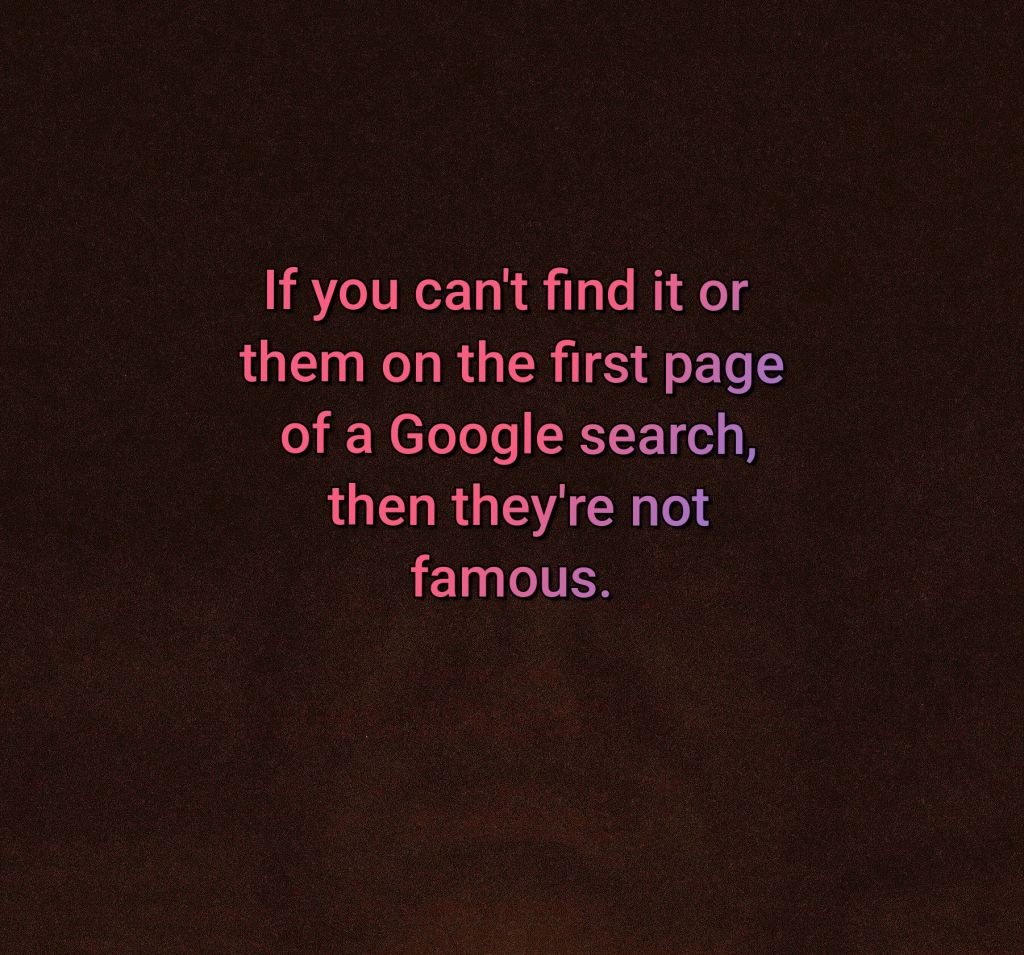
I rarely write about this topic these days. However, yesterday, I came across someone on Instagram who appeared to be famous, so I Googled their name and couldn’t find them. Based on that simple search, I made a number of assumptions that may or may not be true. Those assumptions are not important from an individual’s perspective, but if people are making the same assumptions about a business, then the business is in trouble.
Brand loyalty needs online visibility
When it comes to business today, the idea that “if you’re not on the first page of Google, you’re not famous” really rings true. For a company, especially, being easily found online is critical. Please allow me to elaborate:
1. Visibility and SEO
Getting on the first page of Google is vital. The majority of people don’t scroll past that first page. If your company or products aren’t showing up there, you’re essentially invisible to a large chunk of potential customers. This is where SEO comes in—optimizing your website with the right keywords, quality content, and the right technical tweaks will help boost your Google rankings. It’s a must-have for staying competitive online.
2. Trust and Authority
Think of it like this: people associate first-page results with trust and authority. If your business doesn’t show up, it can make you seem less established or credible, even if your products or services are great. Being visible helps build trust and signals that you’re a legitimate player in your industry.
3. Outpacing Competition
Your competitors are probably vying for those top spots, too. If you’re not there, you’re losing out on potential leads and sales. SEO helps you stay ahead of the competition. Without it, no matter how good your offering is, you’ll struggle to compete with businesses that are more easily found. (There’s no direct link between quality and Google ranking.)
4. Online Presence = Reputation
Your online visibility is, in many ways, a reflection of your reputation. Today, people judge businesses not just by what they sell but also by how accessible they are. Being on that first page gives the impression that your business is not just operational but thriving. (If people can’t find you when they need your service, then they will worry about finding you should something go wrong.)
5. Niche Fame
Now, if you’re targeting a niche market, you may not need to be famous to everyone, just to the right people. A smaller, specialised business might not hit the first page on broad searches, but it could dominate in its niche with targeted SEO efforts. So, it’s about knowing where and how you want to be “famous.” For example, if you Google “Brendan Dunne,” then you may find me. If you Google “Brendan Dunne mindfulness & positivity,” you will find me.
Bottom Line
Yes, everything you do in business affects your bottom line.
Not being on the first page of Google can hurt your growth and visibility, especially when customers are searching for what you offer. Investing in SEO and your digital presence is key to staying relevant and competitive, both in the short term and long term. Without it, even the best products can get lost in the crowd.
P.S. If you’re not going to invest in good SEO, then you can give yourmoneyto Google in the form of paid advertising.