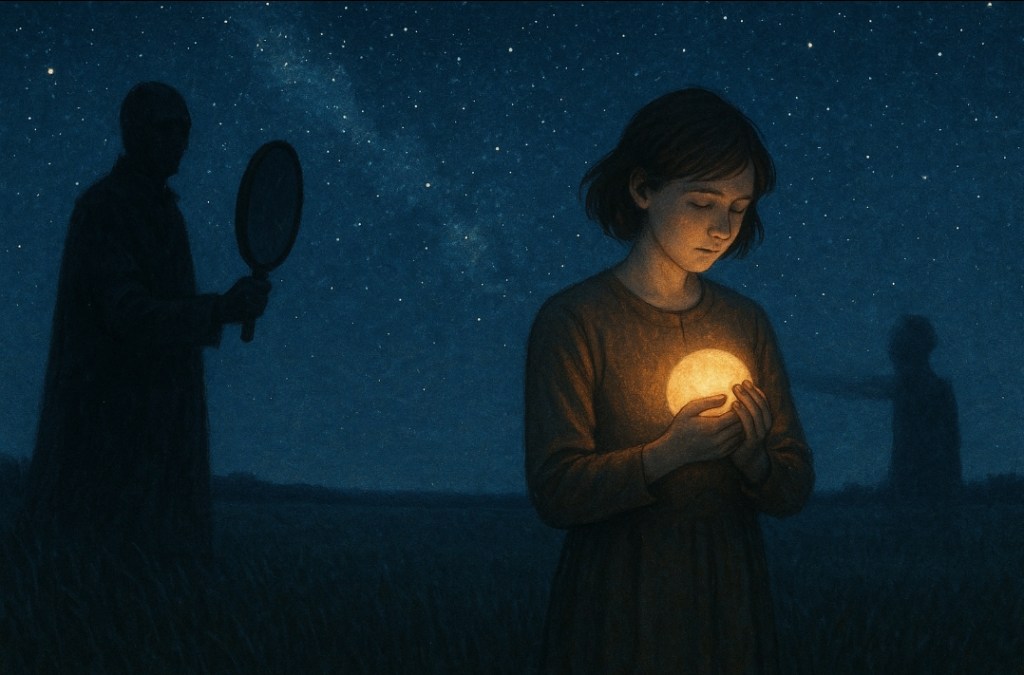
To see a person’s fragility—their insecurity, their disadvantage, their unspoken wound—is a form of perception. It’s the ability to read patterns to notice the fractures beneath the surface.
To use that perception against them is an act of poverty. It mistakes insight for superiority and leverage for worth. It is the easiest move available—and the smallest.
Every strong person eventually faces the real test: standing on firmer ground and choosing to lower their hand. Not because they must. Because they can.
That refusal isn’t ignorance. It isn’t a failure to recognise advantage. It is the precise moment strength announces itself—the boundary drawn between what you can do and what you will do.
This kind of strength is quiet. It doesn’t posture or demand recognition. It shows up as a redirected conversation, a fair deal offered to someone who can’t negotiate, a secret kept, a dignity preserved when it would cost nothing to destroy it.
They don’t refuse because they lack power. They refuse because they understand what power does when it’s misused.
They know that strength isn’t proven by crushing what is fragile, but by how you choose to stand when you are the one least at risk.
In a world that rewards sharp elbows and quick victories, this restraint is a quiet rebellion. It is strength refined into integrity—and it is the only kind that ever leaves a legacy worth remembering.
We carry our history into every moment. It’s not baggage—it’s our native language. The way you see a challenge, hear a story, or feel a room isn’t a distortion of reality. It’s your reality, forged by everything you’ve lived.
This is your superpower.
It means you don’t just observe the world; you interpret it. You bring a colour, a depth, a texture that no one else can. That tension between your truth and someone else’s isn’t a sign that someone is wrong. It’s a signal. It’s the very friction where understanding can spark.
The goal was never to see the world cleanly. That would be to see it empty.
The goal is to see it bravely.
To have the courage to hold your view up to the light and say, “This is shaped by my story.” To meet a different truth not as a threat to yours, but as an invitation to expand it. This is how we build bridges from our solitary islands of experience.
True strength isn’t found in unwavering certainty. It’s found in the quiet, bold moment when you choose to ask: “What am I bringing into this room?” “What might I be missing?” “What if their reaction isn’t about me, but about a history I can’t see?”
This changes everything.
In conflict, it turns a battle into a dialogue. In leadership, it trades authority for true influence. In love, it replaces being right with being connected.
So stop trying to erase your lens. Polish it. Know its contours and its blind spots. Then, use it not as the only way to see but as your launchpad to seek others.
Your perspective is where you begin. Curiosity about every other perspective is how you grow.
The world doesn’t need neutral observers. It needs engaged, self-aware participants who know that wisdom begins not with knowing the answer but with asking the right question of yourself and of others.
If I could give control of the future to anyone, it wouldn’t be governments, corporations, or machines.
And it wouldn’t be me.
I have no interest in control.
Control is what people reach for when they don’t trust human judgment—when they believe order must be enforced rather than cultivated.
What I trust instead is something quieter.
I Would Give It to People Who Think Before They Decide
The people I would trust are not united by ideology, identity, or certainty.
They’re united by temperament.
They are the ones who:
read slowly
question their own reactions
resist simple answers to complex problems
care more about understanding than winning
They don’t want power. They don’t want dominance. They don’t want to be right at all costs.
They want clarity. They want fairness. They want to leave the world a little more humane than they found it.
Those are the people who gravitate here.
Why Disinterest in Control Matters
History is loud with people who want to rule.
Very few wanted to steward.
Control seeks compliance. Stewardship seeks continuity.
Control demands obedience. Stewardship asks for responsibility.
In a future shaped by automation, intelligence, and systems that optimise without conscience, the most dangerous people will not be the cruel ones.
They will be the people who are certain in their beliefs.
The People Who Should Shape Tomorrow
If humanity is to oversee competing systems—machines that calculate faster than we can think—then the deciding factor cannot be speed or authority.
It must be character.
The future should be guided by people who:
don’t confuse confidence with wisdom
don’t mistake efficiency for justice
don’t outsource their moral thinking to systems
don’t panic when the world refuses to fit into neat categories
People who understand that fairness is fragile. That equality must be protected. That power should always feel slightly uncomfortable in the hands of anyone holding it.
This Has Never Been About Followers
This space was never meant to gather a crowd. It was meant to gather a certain kind of mind.
People who don’t want to control the future, but feel responsible for it anyway.
People who believe that agency matters more than dominance. That meaning matters more than metrics. That humanity should remain the governing layer—not because we are efficient, but because we are accountable.
A Final Thought
The future won’t be saved by those who want to rule it.
It will be steadied by those who hesitate before deciding. Who ask better questions instead of issuing louder commands. Who understand that the most important systems are not technological, but moral.
If control must exist, let it rest with people who don’t crave it.
People who are willing to carry responsibility without hunger for power.
That’s not a ruling class.
That’s a custodial one.
And it’s already forming—quietly—wherever thoughtful people choose reflection over reaction.
Judgement slams a door shut. Observation leaves it on the latch.
When I observe, I’m not trying to be right. I’m trying to be true—to the moment, to the detail, to the quiet hum of what is. I know even truth has horizons I can’t see.
First, I take it in. The raw data of the real. The glance, the tone, the silence between words.
Then, and only then, do I bring in the library of my mind. Experience. Psychology. History. Pattern. I apply it all… but lightly. Like a cloth on dust, not a stamp on paper.
Because I apply something else more heavily: The awareness of all I do not know.
Every observation is filtered through a human lens—mine. A lens ground by context, tinted by bias, focused through incomplete stories. So I hold my perspective for what it is: A working hypothesis. Not a verdict.
This changes everything.
People cease to be puzzles to solve. They become landscapes to walk through. Situations loosen their demand for instant conclusions. They begin to whisper layers of information. Even my own inner surge—anger, joy, fear—becomes weather to note, not a command to obey.
Observation creates space. Judgement collapses it.
In that space, curiosity breathes. Compassion finds a foothold. Real growth takes root.
This isn’t passivity. It is active humility.
To observe first is not to shirk responsibility. It’s to honour complexity.
And in a world shouting for quick takes and clean endings, to choose observation is a quiet rebellion.