Category: life lessons

  • The transatlantic marriage often founders on the oldest rock in the book: You don’t live here. You don’t get it.

    It’s the impasse every long-term couple knows—most infamously posed as, “Does this make me look big?” A question where honesty is the first casualty, and diplomacy the second.

    Which brings us, inevitably, to the United States and Europe.

    One is the dynamic, high-metabolism superpower living the drama in real time. The other is the long-suffering ambassador stationed in the next room, tasked with decoding the moods, soothing the outbursts, and explaining the entire spectacle to a skeptical world—while privately admitting that full comprehension is forever out of reach.

    The United States rightly claims her exclusives: perpetual revolutionary fever, the exhausting dream of endless self-reinvention, the eternal hunt for jeans (or policies) that can accommodate both her exceptionalist waistline and her sprawling, contradictory hips. Formidable. Exhausting. Iconic.

    But Europe endures a parallel, quieter hell: permanent residency as the live-in envoy to a nation we can never truly join.

    Our trials include:

    1. Hostage Negotiation Duty: Fielding inquiries like, “Does this foreign-policy swing make me look… imperial?” Every extraction plan ends in detonation—a trade spat, a summit sulk, or viral meme warfare.
    2. Emotional IT for an OS We Didn’t Code: Providing support for a chaotic system built from Puritan guilt, cowboy optimism, and reality-show spectacle. We can’t Ctrl+Alt+Del it, yet we’re blamed for every global blue screen.
    3. Geopolitical Flinch Response: The five-word thermonuclear alert: “We. Need. To. Talk.” (Transmission source: NATO, Fox/CNN, 3 a.m. hotline.) Fight means a lecture on burden-sharing; flight means tariffs—or a pointed, treaty-shaking silence.
    4. The Fix-It Fallacy: Our brains are hardwired for coalitions and quiet compromise. Yet we’re perpetually informed the real manual is Just Listen—a dialect our archives mysteriously corrupt every four to eight years.
    5. Retroactive Culpability: Being held responsible for American “bloating,” as if the Congress of Vienna secretly ratified supersized portions, suburban sprawl, and the monthly export of existential heartburn.

    To summarize, the theatre: America occupies the frontline of constant becoming—a biological and electoral metabolism in permanent overdrive. Europe mans the diplomatic listening post outside the blast doors, parsing signals from an ally whose internal storms obey a rigid two-party hurricane season.

    Are the struggles equivalent? Mon dieu, non.
    Are there casualties? Ambassador, we are all collateral damage.

    We share the same alliance mattress, bicker over the thermostat (Paris Accord edition), and keep the UN’s couples-counseling hotline on speed dial. The lights stay on through subsidized agriculture and bureaucratic inertia; the will to continue relies on the faint, desperate hope that tomorrow’s news cycle might feature a different global emergency.

    Dispatches from the Old World Embassy.
    Still standing—by which we mean: leaning perilously, but architecturally significant.

    Over.

    The United States’ official response was brief:

    “I’m not a woman.”

    She then turned, swayed her hips, and walked away—confident the conversation was over.

  • When I look back on my life,
    it will not be with regret.
    Not because every choice was right,
    or every path led where I hoped.

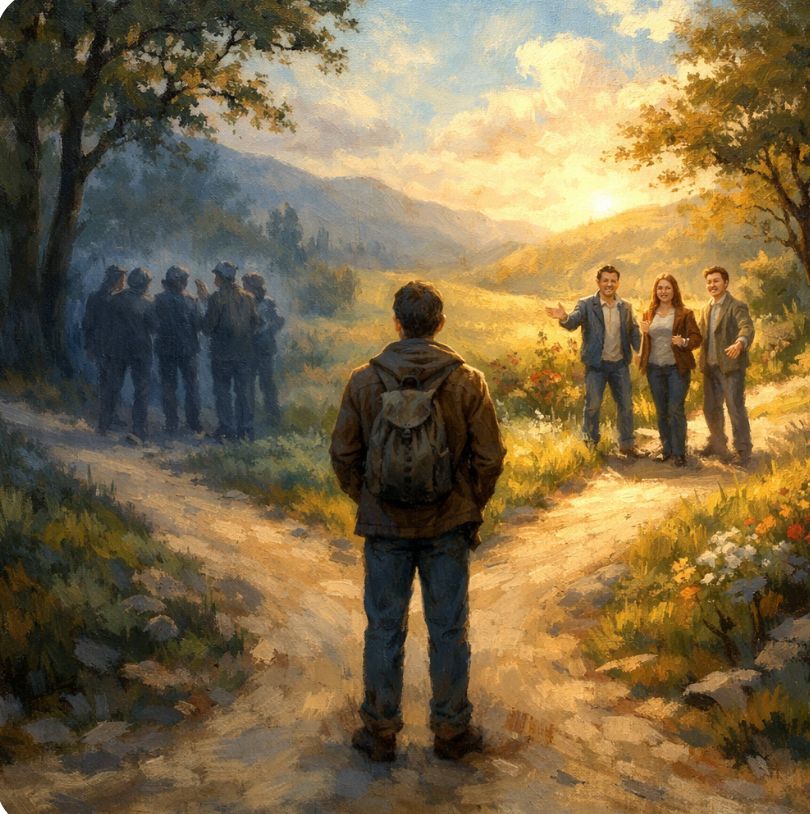
    But because, at every crossing,
    I made the best decision
    I had the strength to make
    with the light I had to see by.

    That distinction matters more than we admit.

    We judge our past selves with knowledge they didn’t yet own,
    with courage, they were still forging,
    with clarity purchased at a price they had not yet paid.

    But life is not lived in hindsight.
    It is lived in the fog of partial information,
    on ground that feels unsteady,
    with a heart sometimes full of quiet fear.

    Understand this: strength is not a fixed currency.
    It’s a muscle. It grows by bearing weight.
    What looks now like hesitation
    may have been the gathering of a breath.
    What looks like compromise
    may have been wisdom—
    choosing the living root over the perfect branch.

    There are seasons where bravery is the wild leap.
    And seasons where bravery is the deep, stubborn root.
    There are times when the most powerful move is not to escape the storm,
    but to learn its rhythm.

    Growth isn’t about rewriting your history.
    It’s about bowing to the person you were—
    the one who did the best they could
    with the tools they held,
    and still, somehow, kept the flame alive.

    So when I look back,
    I will not ask, “Why didn’t you do more?”
    I will ask, “Did you act, honestly, with the strength you had?”

    And if the answer is yes—and it will be— then nothing was wasted.
    It was a life lived.

    Not perfectly.
    But truthfully.

    And from that truth,
    every new step finds solid ground.

  • We carry our history into every moment. It’s not baggage—it’s our native language. The way you see a challenge, hear a story, or feel a room isn’t a distortion of reality. It’s your reality, forged by everything you’ve lived.

    This is your superpower.

    It means you don’t just observe the world; you interpret it. You bring a colour, a depth, a texture that no one else can. That tension between your truth and someone else’s isn’t a sign that someone is wrong. It’s a signal. It’s the very friction where understanding can spark.

    The goal was never to see the world cleanly. That would be to see it empty.

    The goal is to see it bravely.

    To have the courage to hold your view up to the light and say, “This is shaped by my story.” To meet a different truth not as a threat to yours, but as an invitation to expand it. This is how we build bridges from our solitary islands of experience.

    True strength isn’t found in unwavering certainty. It’s found in the quiet, bold moment when you choose to ask:
    “What am I bringing into this room?”
    “What might I be missing?”
    “What if their reaction isn’t about me, but about a history I can’t see?”

    This changes everything.

    In conflict, it turns a battle into a dialogue.
    In leadership, it trades authority for true influence.
    In love, it replaces being right with being connected.

    So stop trying to erase your lens. Polish it. Know its contours and its blind spots. Then, use it not as the only way to see but as your launchpad to seek others.

    Your perspective is where you begin.
    Curiosity about every other perspective is how you grow.

    The world doesn’t need neutral observers.
    It needs engaged, self-aware participants who know that wisdom begins not with knowing the answer but with asking the right question of yourself and of others.

    Start there.

  • Not Everything That’s Reported Deserves a Place in Your Mind.

    The news flows like a relentless stream, but much of what bobs to the surface isn’t water—it’s foam. It’s packaged as urgency, framed as a crisis, and delivered with an unspoken demand for our immediate emotional investment. Yet when we pause and let the moment settle, we often discover these stories, add little to our understanding of the world, and actively subtract from our sense of peace.

    New Beginnings

    Today’s news cycle is less concerned with informing than with capturing attention. Outrage generates more clicks than nuance. Fear travels faster than context. The volume is turned up while the meaning is dialled down.

    The challenge isn’t that difficult events occur—they always have. The challenge is that we are now expected to live in a state of perpetual emotional processing, reacting to everything as though it were proximate and personal, whether it truly concerns us or not, whether we can act on it or not.

    Attention is not passive. It is both a currency and a sculptor. What we consistently focus on shapes how we perceive reality, how safe we feel within our own lives, and how much empathy we have left to offer.

    Choosing what to ignore, therefore, is not ignorance—it is discernment. Staying informed does not require staying overwhelmed. Caring about the world does not mean surrendering your inner calm to every passing headline.

    Consider how often our attention is hijacked by:

    • The “Famous Stranger” Saga: endless updates on a celebrity’s divorce, diet, or feud—events with no bearing on our lives or communities.
    • Decontextualised Outrage: a viral clip of a minor, isolated incident presented as evidence of societal collapse, engineered to provoke anger rather than understanding.
    • The “Groundhog Day” Political Scandal: the twenty-fourth breathless report on the same talking point or procedural stalemate, offering no new insight, only repetitive agitation.
    • Fear-of-the-Day Forecasting: alarmist speculation about a possible future crisis, reported with urgency long before facts have settled.

    Some information is vital. Some stories rightly demand action. But much of what surrounds us is simply noise, amplified by the megaphone of the cycle.

    Peace of mind today is not found by consuming more, but by curating wisely. It begins with a quiet question before engagement: Does this concern me? Can I affect it? Does it deepen my understanding or merely deplete my spirit?

    A simple filter helps: Pause. Probe. Place.

    Pause before clicking.
    Probe its relevance and value.
    Place it consciously—or leave it at the gate.

    Your attention is precious. Guard it well.
    The world will continue to happen—but you still get to choose what is allowed to shape your inner world.

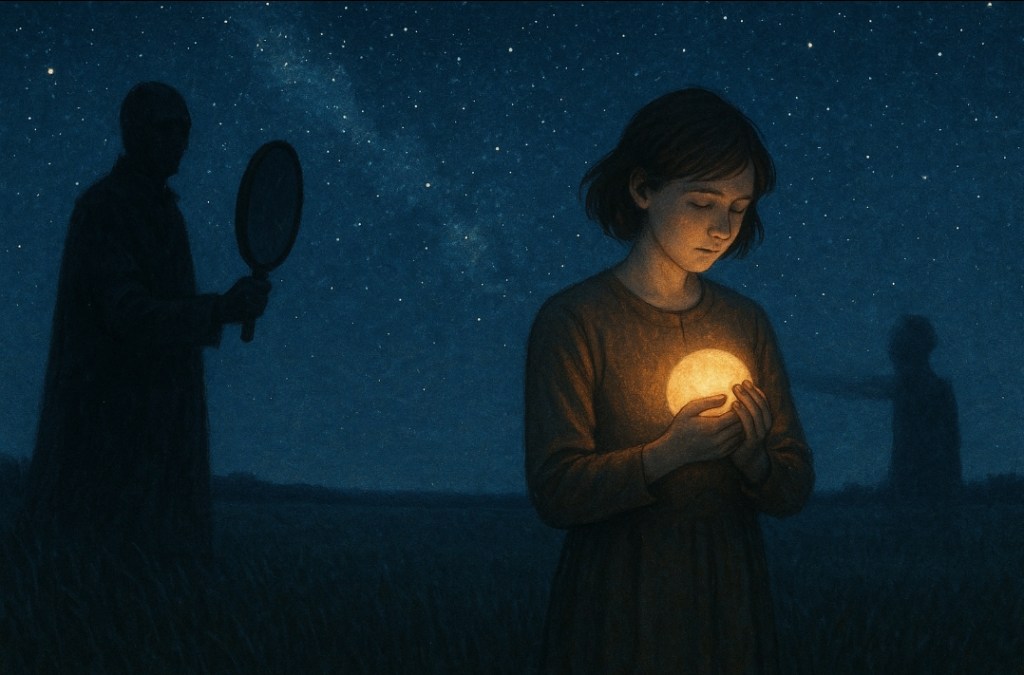
  • The mirror you carry everywhere you look is one you manufacture as you travel through life.

    It’s not a fixed photograph.
    It’s a story you tell yourself—quietly, repeatedly—with materials you’ve gathered along the way: glances, comments, wins, losses. You assemble it until it feels like fact.

    This is the subtle mechanism most miss:
    What you believe that mirror will show others is what you end up projecting. Not because it is truth, but because belief shapes your posture, your tone, your gaze, and your energy—long before objective reality gets a say.

    Self-image doesn’t ask for proof.
    It asks for repetition.

    Two people can enter the same room with similar histories, flaws, and strengths, yet be received differently. One anticipates judgment and moves like an apology. The other assumes a baseline of belonging and occupies space accordingly. Often, the room reflects this back.

    Not because the room is just.
    But because humans read signals long before they hear stories.

    A necessary truth: This power has its limits. The world contains rooms with pre-written scripts—bias, structure, and inequity—that no single posture can instantly rewrite. To edit your story is not to deny your past, your pain, or these external weights. It’s the slow, worthy work of separating their narrative from your own. Be patient with that process.

    Facts alone rarely build self-image.
    Interpretation does.

    You can catalogue achievements and still feel unworthy. You can stand with little external proof and radiate a quiet assurance. Self-image flows upstream of logic. It’s built from the meaning you assign to experiences, not the experiences themselves.

    The most crucial insight?
    The workshop remains open.
    The mirror is editable.

    A positive self-image isn’t arrogance.
    It’s alignment.

    It’s deciding—consciously, gradually—that you are not condemned to see yourself solely through your worst moments, your deepest mistakes, or the labels you once inhaled without question.

    When you alter the inner image, the outer world often shifts in response. Not perfectly. Not magically. Not every room will honour the new reflection. But in time, the rooms that matter will respect your new self-image.

    Remember:
    People rarely meet you first.
    They meet the reflection you have learned to carry.

    And that reflection?
    That story?
    You are both its keeper and its writer.