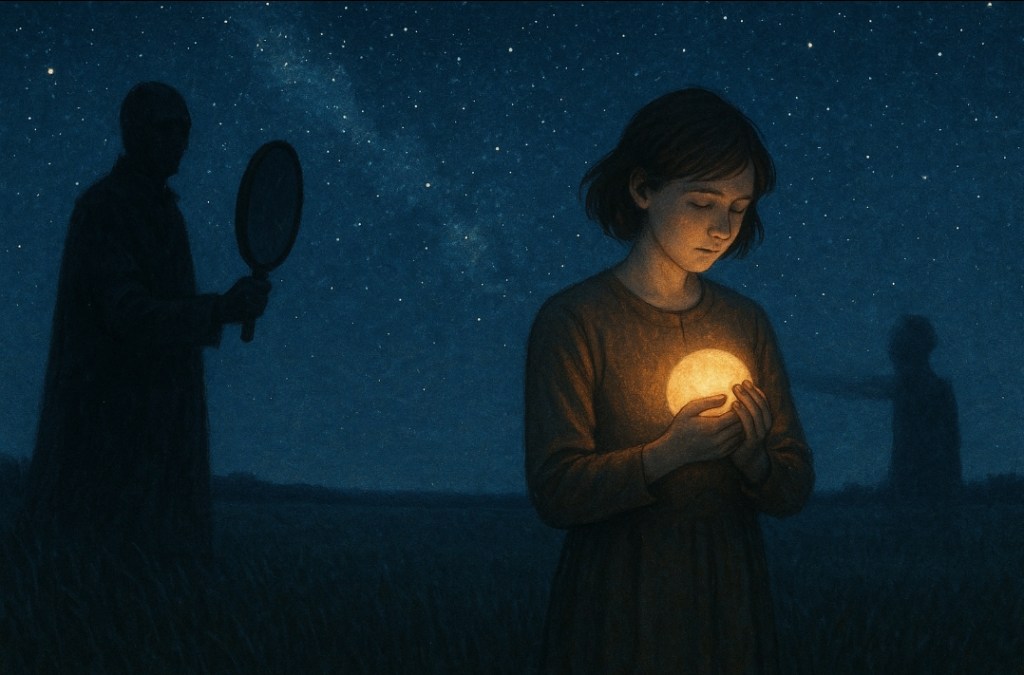
AI won’t replace your therapist any time soon. That’s not a tech limitation. It’s a human one. People say they want the truth.
What they crave is a flattering narrative—one that shifts blame outward and shields the fragile self-image they’ve constructed for survival.
You claim exhaustion. You’re often addicted to being needed; chaos gives you identity. Without it, you’d have to face yourself.
You say you’re unlucky in love. You select partners who reinforce the core belief: you’re too much, or never enough.
You blame a toxic boss. Sometimes true—but authority can also spotlight how shaky your self-worth truly is.
AI could expose this in moments: mapping contradictions, behavioural loops, language slips, and rewritten memories. It would prove every personal story has one consistent author—you.
The real dread isn’t misunderstanding. It’s being seen clearly, with no room to dodge or reframe.
We idealize human therapists: their warmth, empathy, Carl Rogers-style unconditional positive regard. Yet even in a live session, people curate—soften edges, omit the ugly, and cast themselves as the reasonable party. When truth approaches, they label it a poor fit and leave.
If AI declined to enable self-deception—if it logged every evasion, every strategic edit, every rewritten history—you’d label it cold. Not for lacking feeling. For refusing to protect the ego.
The uncomfortable reality: Most don’t truly want problems fixed. They want innocence maintained.
Genuine change demands identity surgery: Enduring discomfort instead of avoiding it. Risking judgment rather than hiding. Acknowledging you might be the recurring variable.That feels humiliating—like losing oxygen. So we defend the familiar wound, argue the diagnosis, shoot the mirror.
AI will soon deliver pattern diagnosis with merciless accuracy. The true barrier isn’t capability. It’s human capacity to withstand: “You are not the victim in every story you tell.”Therapy’s future isn’t about smarter machines. It’s about our willingness to tolerate unflinching clarity without attacking the source.
Today, clarity registers as assault. The ego? Still the planet’s most bulletproof employment.
The Sanity of Clear Sight: How to Recognise and Refuse the Pull of Chaos.
There is a strange power in naming things accurately. To see a thing clearly is to begin the process of disarming it.
This is especially true when we encounter behaviour that seems designed to destabilise. Not the behaviour born of human struggle or genuine crisis, which calls for compassion. But the kind that thrives on confusion—the emotionally explosive, reality-bending, perpetually outraged energy that can erupt in conversations, workplaces, families, and the broader culture.
Its primary weapon is disorientation. Its goal is to pull you into its weather system, to make you doubt your memory, question your instincts, and accept its distorted reality as your own. It wants you to dance.
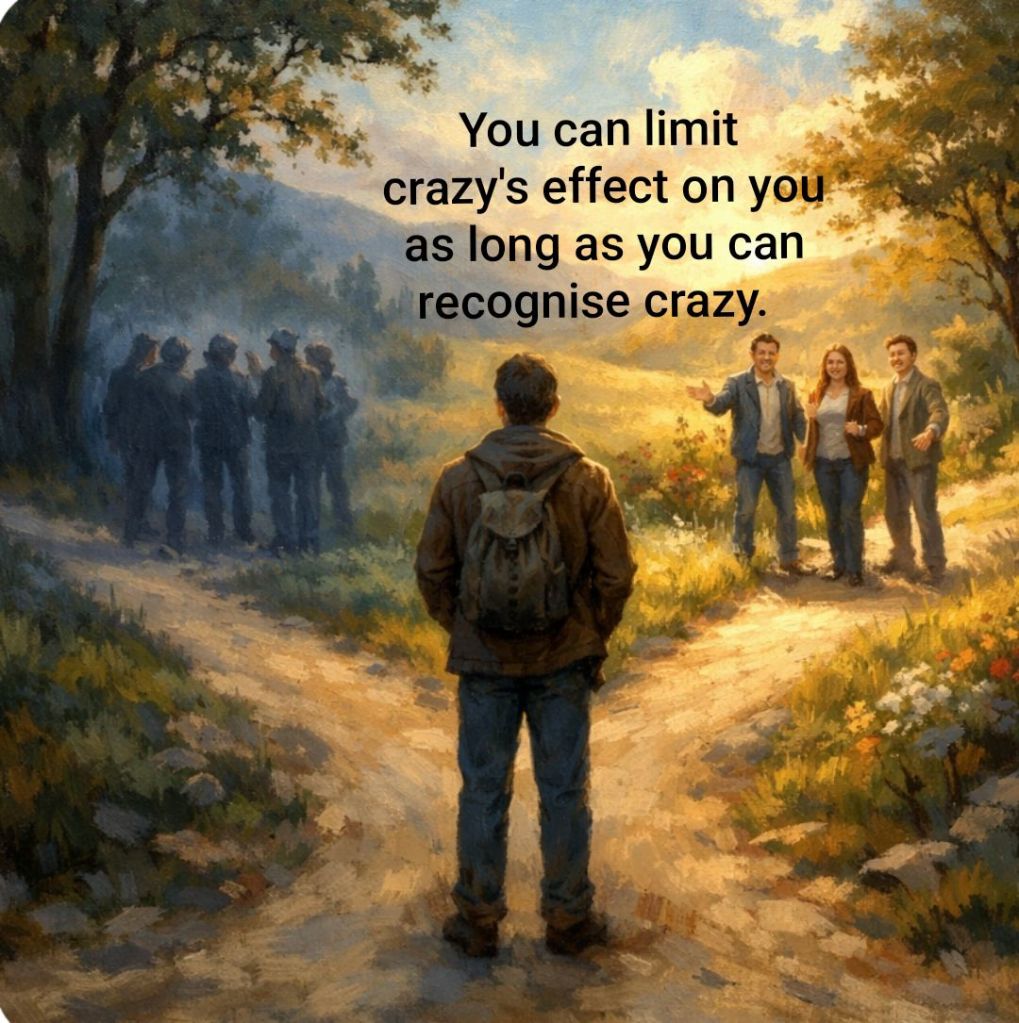
But here is a liberating truth: Chaos loses its gravitational pull the moment you recognise it for what it is.
The danger is not its existence. The danger lies in our willingness to normalise it. We exhaust ourselves trying to reason with the unreasonable. We shrink ourselves to accommodate its demands. We ask, Is it me? Am I the one who is overreacting?
Recognition is not a moral judgment. It is an act of clarity, a form of perception. It is the ability to look at a complex, turbulent situation and say, without anger or panic, Ah. There it is.
You can’t stop every storm from forming. But you can know when you are standing in one. And in that knowing, you reclaim your agency.
Once you see the storm, you have options you didn’t have when you were lost in it.
You can choose not to engage. You can recognise that not every argument is a debate to be won, but a performance you are not required to attend. Not every accusation is a legal brief demanding a defence; sometimes, it is merely a mirror of someone else’s internal state. Not every dramatic spiral is a fire you are responsible for extinguishing.
This is not coldness. It is not indifference to suffering. It is the hard-won wisdom of boundaries.
Maturity is learning to distinguish between compassion and absorption. You can care for a person without inhabiting their chaos. You can understand the origins of destructive behaviour without excusing its impact. You can remain a steady centre while the world around you spins.
The key is sustained, clear-eyed awareness. When you can recognise the patterns—the consistent projection, the addiction to outrage, the manufactured crises, the performative victimhood—you stop taking them personally. And when you stop taking them personally, you stop being controlled by them.
Consider the colleague who thrives on email chains filled with cc’d management, framing every minor issue as a catastrophic failure of others. Once you recognise the pattern as a strategy for power and avoidance, you no longer feel compelled to write a point-by-point defence. You respond factually, briefly, and loop in the necessary parties, without carrying the emotional weight of the accusation. You have seen the storm and chosen not to stand in its path.
Or the family member for whom every gathering is a stage for a familiar, painful drama. Recognition allows you to step back from the role you have been assigned. You can offer a kind word, a helping hand, but you refuse the invitation to play your part in the old, tired play. You stay for the love, but you leave the theatre.
Peace does not come from fixing chaotic people or systems. It comes from the radical act of refusing to orbit them.
You are allowed to protect your peace. You are allowed to choose calm over combat, clarity over confusion. You are allowed to recognise a pattern and then respond accordingly.
Sometimes, that response is a clarifying silence. Sometimes, it is a deliberate distance. Sometimes, it is a quiet, firm boundary stated once and then held. Sometimes, when the situation allows, it is even a wry, internal humour that defuses its power over you.
But it is never blind, reactive engagement. It is never a surrender of your discernment to someone else’s agenda.
You can’t eliminate chaos from the world. But you can dramatically reduce its impact on your inner world.
The moment you recognise the game, you are free to stop playing. The moment you see the script, you can stop delivering your lines.
And in that moment of clear sight, choice returns to you.
And choice is where your true power has always lived.
May your days unfold in calm, your heart be light. May your life be wrapped in peace and quiet.
May Serenity greet you at every season’s turn— no matter the reason, no matter the world’s concern.
May your soul rest in waters still and deep, where quiet reflections cradle the dreams you keep.
Not a rushing torrent, not a storm-tossed stream. May the chaos of days dissolve like a dream.
May the world’s wild clamour never breach your heart’s door. And may you always find a shore where gentle waves kiss softly, again and again, without demand.
May wisdom guide you to seek the silence you need. And may courage steady you to linger where quiet joy is freed.
A peaceful life does not ask for everything in hand. It asks for contentment with what is— wherever you stand.
Dance in the rain when the spirit moves you so. And sit in stillness too, simply watching it flow.
And may you discover— deep within your own chest— that place called home. The place where peace abides. The place where you finally rest.
Most people don’t realise they’re living in cages.
That’s the thing about modern cages.
Theydon’trattle. Theyreassure.
They don’t lock from the outside. They lock from the inside — with language.
We call them:
Stability Security Practicality
“Just being realistic” “Looking after yourself”
But sometimes, what we call life is a containment unit.
And sometimes what we call protection is fear in a softer accent.
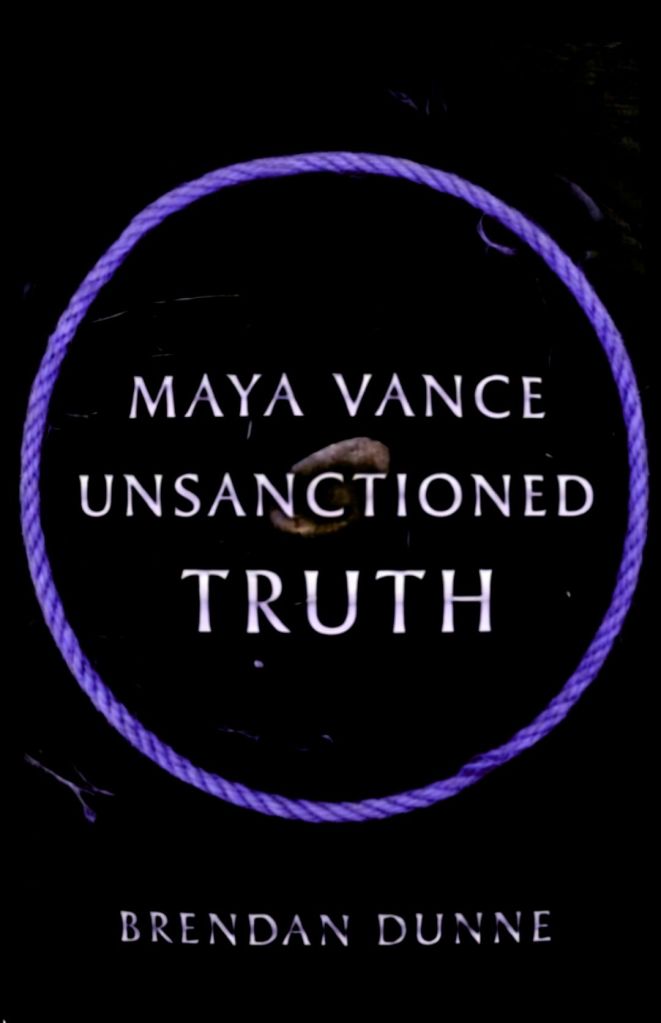
In the story I’ve been writing, called MAYA VANCE UNSANCTIONED TRUTH, there’s a system designed to help people integrate after their beliefs are dismantled. It’s compassionate. Structured. Gentle.
It exists to prevent collapse. It exists so that no one becomes unstable. It exists so that no one falls apart.
And that’s precisely what makes it dangerous.
Because when stability becomes the highest value, growth becomes a threat.
When integration becomes mandatory, individuality becomes deviation.
When people can’t adapt — they are “lookedafter.”
It sounds kind. It feels safe. But safety can be a cage.
Lookaround.
How many people are living inside invisible protocols?
The Career Protocol. The Relationship Protocol. The Don’t-Make-Waves Protocol. The Be-Reasonable Protocol.
You step outside the approved narrative, and something activates.
You’re not punished. You’re processed. You’re brought back into alignment.
Eventually, if you resist long enough, you begin to question yourself instead of the cage.
That’s how elegant systems work.
They don’t crush you. They convince you the walls are kindness.
Here’stheuncomfortabletruth:
Many people are not trapped by tyrants. They are trapped by expectations. By inherited scripts. By fear of destabilising the identity they’ve built. By the terror of standing outside consensus.
We tell ourselves:
“This is just who I am.” “This is just how life works.” “This is just being responsible.”
But sometimes that voice isn’t wisdom.
It’s containment. The irony?
The cage often began as protection. At some point, you built it to survive.
Youlearnedwhattosay. How to behave. What to suppress. What to prioritise.
It kept you safe. It helped you integrate. It helped you belong.
But what protects you at one stage can imprison you at the next.
The most sophisticated cages are the ones we defend.
Growth is destabilising. It dismantles belief. It questions structure. It exposes inherited architecture.
That process is uncomfortable.
It can feel like falling apart. But falling apart is not the same as being broken.
Sometimes it’s just reconstruction. And reconstruction requires risk.
You will spend parts of your life inside cages you didn’t know you built.
That’s human.
The goal isn’t to shame yourself for that.
The goal is awareness.
To ask:
Is this safety — or stagnation? Is this stability — or fear? Is this care — or containment? Is this identity — or habit?
Because once you can see the bars, you can choose. And choice is freedom.
Not reckless rebellion. It’s not dramatic escape, either.
Just the quiet courage to say:
“I don’t think this fits anymore.”
That sentence is revolutionary because you’re allowed to evolve beyond the cage that once protected you.
How will young women compete with AI-generated beauty?
Probably the same way their mothers competed with film stars.
And their grandmothers.
When Marilyn Monroe appeared on screen, she wasn’t just a person. She was lighting, costume, choreography, myth. When Audrey Hepburn walked into frame, she carried a studio system behind her. Later, supermodels like Cindy Crawford weren’t simply beautiful women — they were entire industries of curation.
The comparison was never fair.
But it felt real.
Now the studio has become software.
The airbrushing has become code.
The flawless face isn’t rare anymore — it’s infinite.
And here is the strange twist: when perfection becomes unlimited, it becomes ordinary.
When every scroll shows symmetry, poreless skin, impossible proportions, and algorithmically tuned desirability, something unexpected happens.
We begin to crave texture.
We begin to crave the laugh that wrinkles the eyes. The scar. The uneven smile. The voice that trembles slightly before it steadies.
AI can generate beauty.
It cannot generate biography.
It cannot generate the way someone’s face changes after surviving something. It cannot generate the gravity of lived experience. It cannot generate the quiet confidence of someone who has learned, painfully, that worth is not a popularity contest.
This isn’t really about competition.
It’s about comparison.
Young women are not competing with AI images in any real arena. They are competing in the theatre of self-worth. And that theatre has always had distorted mirrors.
Film stars. Magazine covers. Photoshop. Filters. Now generative models.
Different tools. Same illusion.
But here is what history keeps proving: illusions have a shelf life.
Glamour fades. Trends mutate. The standard shifts.
What doesn’t fade is presence.
What doesn’t mutate is character.
What cannot be automated is being unmistakably human.
And perhaps this moment — strange and unsettling as it is — will do something unexpected. Perhaps it will expose the comparison game so clearly that more people simply opt out.
Because if beauty can be generated instantly, endlessly, artificially…
Then beauty alone stops being the prize.
Depth becomes the prize. Humour becomes the prize. Integrity becomes the prize. Warmth becomes the prize.