When you’re already stressed, your brain goes into hyperdrive looking for threats. You notice the critical email. You zero in on the friend who didn’t text back. You anticipate the worst possible outcome.
It feels like you are just being “realistic” or prepared. But in reality, you are filtering the world through a lens of fear, looking for evidence that things really are as bad as they feel.
This is the trap of the self-fulfilling prophecy.
When you expect things to go wrong, you act guarded. You overlook opportunities. You miss the kindness right in front of you. You create the very reality you were hoping to avoid—not because it was inevitable – but because your focus narrowed so much that you couldn’t see anything else.
If you are in a stressful season, here is your reminder: Do not let your current emotions dictate your permanent reality.
Look for the exception. Look for the win. Look for the person who did show up. What you look for, you will find. So today, try looking for the good—not because the stress isn’t real, but because your focus is too powerful to waste on the negative.
What is one small good thing you’ve noticed today? 👇
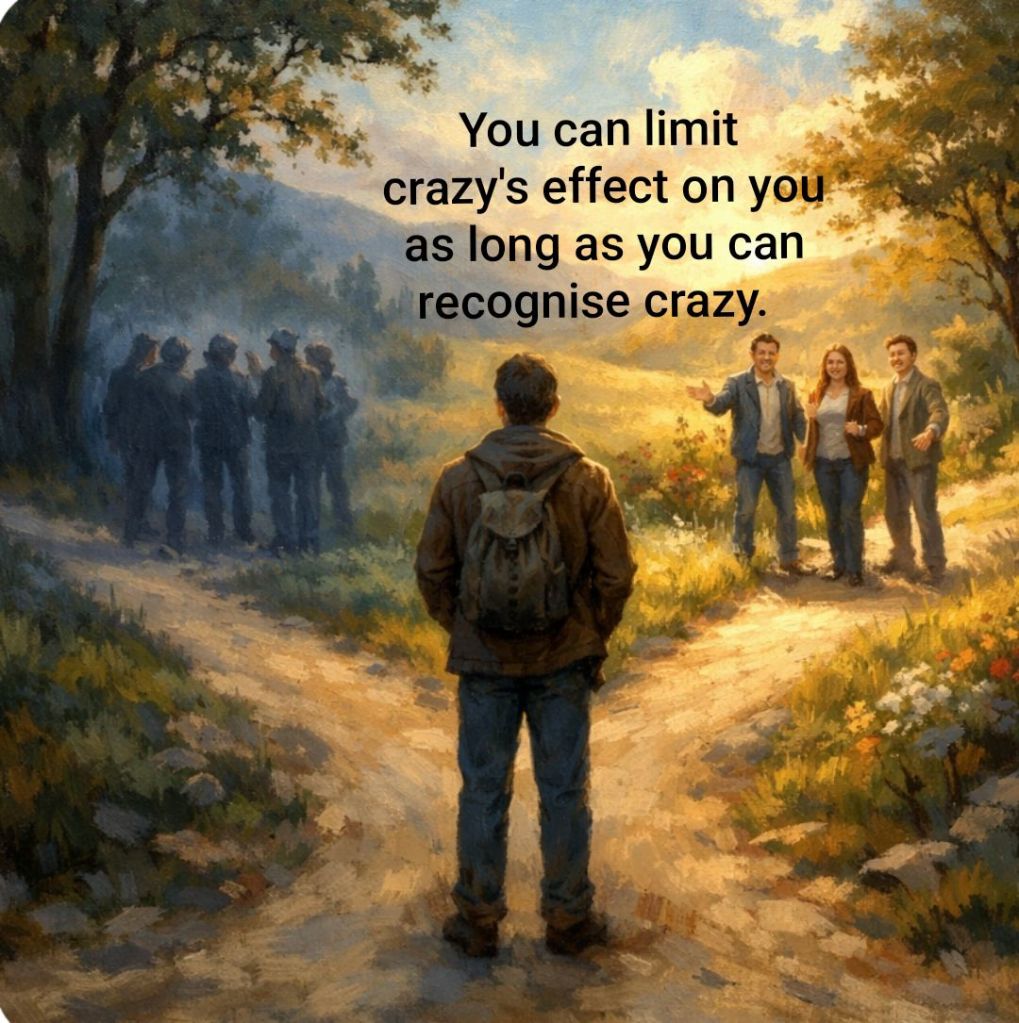
The Sanity of Clear Sight: How to Recognise and Refuse the Pull of Chaos.
There is a strange power in naming things accurately. To see a thing clearly is to begin the process of disarming it.
This is especially true when we encounter behaviour that seems designed to destabilise. Not the behaviour born of human struggle or genuine crisis, which calls for compassion. But the kind that thrives on confusion—the emotionally explosive, reality-bending, perpetually outraged energy that can erupt in conversations, workplaces, families, and the broader culture.
Its primary weapon is disorientation. Its goal is to pull you into its weather system, to make you doubt your memory, question your instincts, and accept its distorted reality as your own. It wants you to dance.
But here is a liberating truth: Chaos loses its gravitational pull the moment you recognise it for what it is.
The danger is not its existence. The danger lies in our willingness to normalise it. We exhaust ourselves trying to reason with the unreasonable. We shrink ourselves to accommodate its demands. We ask, Is it me? Am I the one who is overreacting?
Recognition is not a moral judgment. It is an act of clarity, a form of perception. It is the ability to look at a complex, turbulent situation and say, without anger or panic, Ah. There it is.
You can’t stop every storm from forming. But you can know when you are standing in one. And in that knowing, you reclaim your agency.
Once you see the storm, you have options you didn’t have when you were lost in it.
You can choose not to engage. You can recognise that not every argument is a debate to be won, but a performance you are not required to attend. Not every accusation is a legal brief demanding a defence; sometimes, it is merely a mirror of someone else’s internal state. Not every dramatic spiral is a fire you are responsible for extinguishing.
This is not coldness. It is not indifference to suffering. It is the hard-won wisdom of boundaries.
Maturity is learning to distinguish between compassion and absorption. You can care for a person without inhabiting their chaos. You can understand the origins of destructive behaviour without excusing its impact. You can remain a steady centre while the world around you spins.
The key is sustained, clear-eyed awareness. When you can recognise the patterns—the consistent projection, the addiction to outrage, the manufactured crises, the performative victimhood—you stop taking them personally. And when you stop taking them personally, you stop being controlled by them.
Consider the colleague who thrives on email chains filled with cc’d management, framing every minor issue as a catastrophic failure of others. Once you recognise the pattern as a strategy for power and avoidance, you no longer feel compelled to write a point-by-point defence. You respond factually, briefly, and loop in the necessary parties, without carrying the emotional weight of the accusation. You have seen the storm and chosen not to stand in its path.
Or the family member for whom every gathering is a stage for a familiar, painful drama. Recognition allows you to step back from the role you have been assigned. You can offer a kind word, a helping hand, but you refuse the invitation to play your part in the old, tired play. You stay for the love, but you leave the theatre.
Peace does not come from fixing chaotic people or systems. It comes from the radical act of refusing to orbit them.
You are allowed to protect your peace. You are allowed to choose calm over combat, clarity over confusion. You are allowed to recognise a pattern and then respond accordingly.
Sometimes, that response is a clarifying silence. Sometimes, it is a deliberate distance. Sometimes, it is a quiet, firm boundary stated once and then held. Sometimes, when the situation allows, it is even a wry, internal humour that defuses its power over you.
But it is never blind, reactive engagement. It is never a surrender of your discernment to someone else’s agenda.
You can’t eliminate chaos from the world. But you can dramatically reduce its impact on your inner world.
The moment you recognise the game, you are free to stop playing. The moment you see the script, you can stop delivering your lines.
And in that moment of clear sight, choice returns to you.
And choice is where your true power has always lived.
Are you tired of self-help hacks that leave you more exhausted than empowered? You’ve tried the affirmations, the routines, the “just think positive” advice—but the inner noise just won’t quiet down.
B0G21XDCWB (Copyandpastethelink)
What if real power isn’t about adding more, but about stripping away the chaos to uncover what’s already within you?
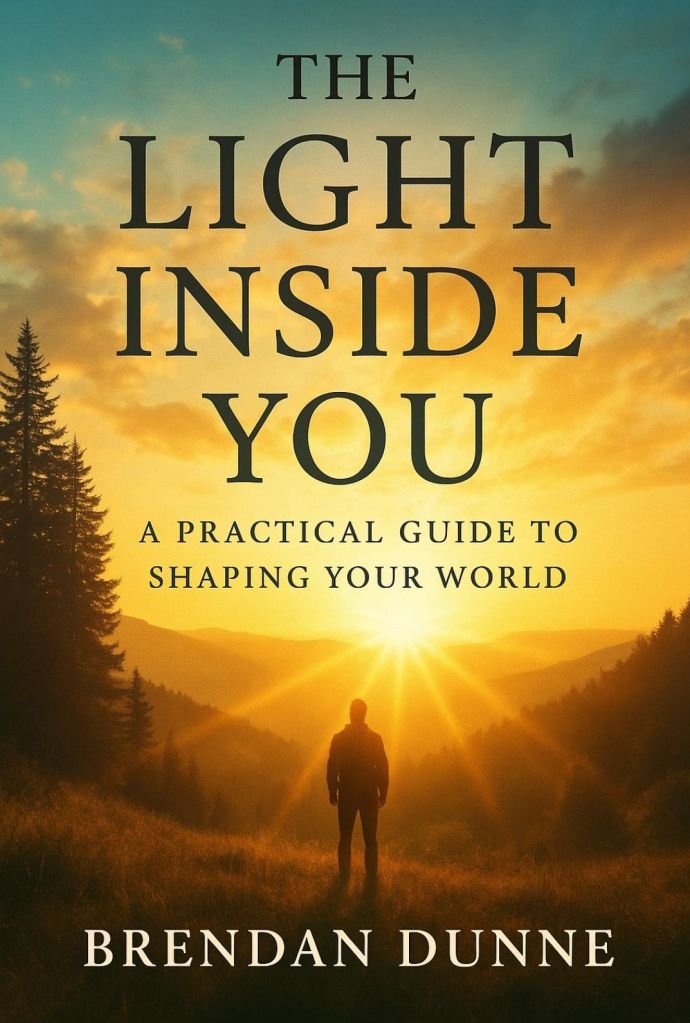
The Light Inside You: A Practical Guide To Shaping Your World offers a refreshing, no-BS path back to your core strength. This isn’t fluffy motivation—it’s a grounded journey to quiet the mental clutter, reclaim your inner light, and shape your reality from within.
Readers call it a game-changer: “Finally, something real.” As Book 1 in The Before the Noise Series, it’s your first step toward lasting clarity and control.
Get it now on Amazon — paperback available, and for today only (29th January), the KindleebookisFREE.
There was a season where action was my only argument. Lifts, pulls, the raw build, and push—proof forged in sweat and callus. The body led absolutely. Motivation meant performance in full view, letting the effort speak in the grammar of strain.
Now, I create. I write these posts. Do not mistake this for something softer; it remains a physical discipline. It’s the act of sitting with ideas instead of fleeing from them. It’s the daily return to the page, faithfully, when no one is watching. It’s choosing clarity over comfort and honesty over approval.
The words that land do not arrive by accident. They are the residue of attention, restraint, and intent.
The method changed. The mission did not.
I still believe in motivating through action—only now. The action is craft. Each post is built evidence. Evidence that reflection is labour. That meaning is constructed, not conjured from wishes. That showing up, day after day, with a considered thought, is its own form of strength.
Some are motivated by instruction. Others by demonstration.
I have always been the latter. I simply trade in language now, instead of iron.
And in a world drowning in noise, I have come to believe this may be the most demanding physical act of all: to stand still—long enough, and with enough discipline—to say one true thing. It’s the quietest form of resistance.
The Invisible Audience: Why You Feel Watched in an Empty Room.
You live with a strange, permanent guest.
They don’t pay rent. They don’t bring wine. They never offer a kind word. Yet they hold immense power over your life, sitting in the front row of your mind with a silent, critical gaze.
This is the Invisible Guest—the internalized spectator who turns your private life into a performance.
They are the reason you rehearse conversations in the car, delete the caption three times, or feel a flush of shame dancing alone in your kitchen. No one is there. No one saw it. Yet the vibe of judgment hangs thick, a phantom audience holding invisible scorecards.
The Solitary Comedy Special
Here’s the tragicomic twist: so many of us are delivering a relentless, polished performance for an empty house.
We edit our thoughts for wit. We choreograph our actions for grace. We time our reactions for maximum impact. We are convinced the lights are on us.
But the truth is stark: theseatsareempty.
No one bought a ticket to this show. The only one critiquing your delivery, your outfit, or your stumble is the spectral critic you’ve installed yourself.
This is self-consciousness distilled to its purest form: the fear of a judgment that exists only in our simulation. We are both the anxious performer and the bored, unforgiving audience. We work exhausting, unpaid shifts for an employer who doesn’t exist.
The Liberating Irony
The prison has an open door. The liberating, almost hilarious, irony is this:
Nearly everyone else is doing the same thing.
They are not thinking about you. They are the stars of their own solitary performances, directed by their own Invisible Guest. They are replaying their own missteps, worrying about their own lines, fretting over the expression they made an hour ago.
We are all, simultaneously, performing solo acts for empty rooms, convinced ours is the only show being judged.
The Quiet Revolution
Freedom begins not with a roar, but with a quiet, internal question. It starts the moment you realize:
You are not on stage. You are simply living.
A powerful shift occurs when you exchange the performance for the practice. When you trade the curated for the authentic. You are allowed to be mundane. You are allowed to be awkward. You are allowed to find your own jokes hilarious, even—especially—if no one else ever hears them.
So, the next time you feel that familiar freeze—the hesitation, the overthink—pause. Ask yourself:
“Who, exactly, am I performing for right now?”
If the answer is a vague, disapproving phantom… you have your cue.
It’s time to politely reclaim your space. To turn off the lights and step out of the theater of your own mind.
Don’t worry about the applause. Or the lack of it.
The most profound peace is found in the silence of an audience that has finally mercifully gone home.