Are good men scarce? The only way to answer that question is to understand what a good man is.
He’s not found in the noise—not in charm, bravado, or performance. Look for him in the quiet.
He is defined by his backbone, not his biography. His strength is in his rootedness.He stands where he stands, not from stubbornness, but from self-respect. He knows that bending his values to soothe another’s chaos doesn’t create peace—it just teaches others he can be used, then left behind when the storm passes.
He has an anchor, not just a compass. He isn’t dragged by every emotional current.He listens, he considers, he cares deeply—but he does not capsize. His emotional maturity allows him to hold space for turmoil without surrendering his own peace. He offers stability, not drama.
He refuses disrespect with clarity, not chaos. His boundaries are quiet, firm, and final. He understands that tolerating poison is a betrayal of the life he’s building. So he steps away, not to punish, but to preserve his integrity. It’s the quiet closing of a door.
His words have weight because he doesn’t make them lightly. He doesn’t deal in flattery.He speaks truth. He offers praise as a genuine witness to what is good, not as currency to buy approval. When he speaks, you listen, because you know it’s real.
Here is the truth, too often missed: Being a good man isn’t about perfection.It’s a direction set by daily intention.
It is choosing integrity when the shortcut is easy. Choosing calm when chaos is the loudest voice in the room. Choosing respect—for himself and others—especiallywhen it costs him something.
A good man doesn’t announce his character. He embodies it. Quietly. Consistently. In the thousand small choices of an ordinary day.
His legacy isn’t carved in stone. It’s felt in the quiet, safe space he leaves in his wake.
* Share this with a good man so that they know they’re appreciated for being a good man.
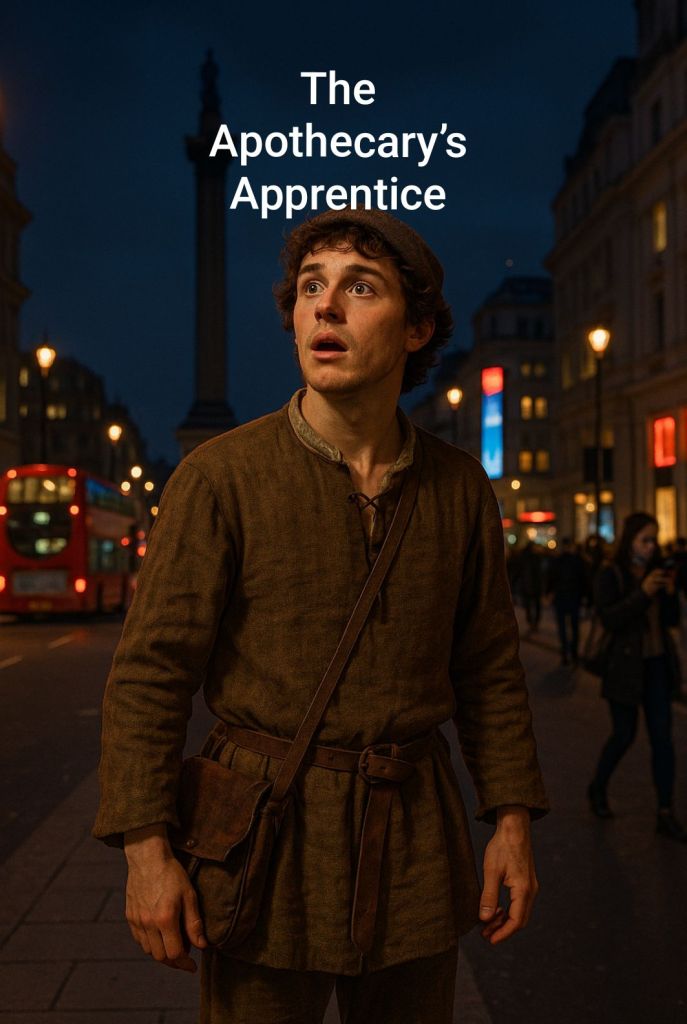
Elias Merton, an apothecary’s apprentice, had always been too curious for his own good. That was why, despite the warnings, he ventured into the ruins of Blackthorn Monastery—a place whispered to be cursed.
The storm came without warning, the sky splitting with veins of lightning. One strike shattered the monastery’s last standing archway, and in a blinding flash, Elias felt the world twist beneath him.
When he awoke, the air smelled of burning metal and something sweet, like rain on hot stone. The ground beneath him was unnaturally smooth. Towering structures of glass and steel pierced the heavens. Horseless carriages roared past, lights flashing and engines humming. People in strange, tight-fitting garments strode by, eyes fixed on glowing tablets in their palms.
A woman in a bright yellow coat noticed him first. “Whoa, dude,” she said, pulling small beads from her ears. “You okay?”
Elias staggered back, his Latin tongue useless here. She frowned, then held out a silver rectangle. “You lose your phone?”
He took it cautiously—and the glass surface flickered to life, moving like a living painting. With a cry, he dropped it.
The woman laughed. “First time in the city, huh?”
The Historian.
For days, Elias wandered, half-starved and disoriented, until an old man named Dr. Lorne found him muttering in Middle English outside a library.
Lorne, a historian specializing in medieval Europe, assumed Elias was just an eccentric reenactor—until he witnessed the boy’s genuine terror at a flushing toilet.
“You’re either the best method actor I’ve ever met,” Lorne muttered, “or something impossible has happened.”
Elias learned fast. He mastered fragments of modern English, though his thick accent drew stares. He marvelled at hospitals where plagues were cured with a pill, at markets bursting with oranges in winter, at books housed inside glowing tablets.
Yet not everything was wonder.
The Dark Side of Miracles.
One evening, Lorne showed Elias a documentary about the 16th century—his century.
The screen displayed famine, war, witch burnings. Elias recoiled. “This is not the world I knew!”
“Isn’t it?” Lorne asked softly.
Elias fell silent. He had heard of these horrors. He had simply chosen not to see them. (That hasn’t changed)
The Artefact.
Lorne grew obsessed with how Elias had arrived. Together, they returned to the ruins of Blackthorn Monastery—now a crumbling tourist site.
Buried beneath a plaque, they uncovered a strange, fist-sized stone, etched with symbols that matched Elias’s tunic clasp.
“This isn’t just a time anomaly,” Lorne breathed. “This was designed.”
The Choice.
One night, Elias stood on a balcony, staring at the neon sky.
Lorne believed the stone could send him back—but it might also be a key to something greater.
The modern world was dazzling, yet it was loud, relentless, and full of screens and strangers who never truly looked at one another.
Elias thought of home—the stench of the streets, yes, but also the warmth of a hearth, the weight of leather-bound books, and nights where the stars belonged to you.
The Return.
In the end, Elias chose the past. Not because it was better—but because it was his.
As lightning cracked over Blackthorn once more, the stone in his hand flared.
Lorne’s last words echoed in his mind: “History isn’t just what happened. It’s what we make of it.”
Elias awoke in the mud, the monastery ruins whole again. In his pocket, the stone still hummed faintly.
He smiled. Perhaps miracles were not so rare after all.
Epilogue – 2024.
Dr. Lorne published a paper based on a “lost” medieval apothecary’s journal describing impossible cures—including one for the plague.
The academic world dismissed it as a forgery.
But hidden in the margins, in Latin, was a single line:
“The future is glass and fire. Remember me there.”
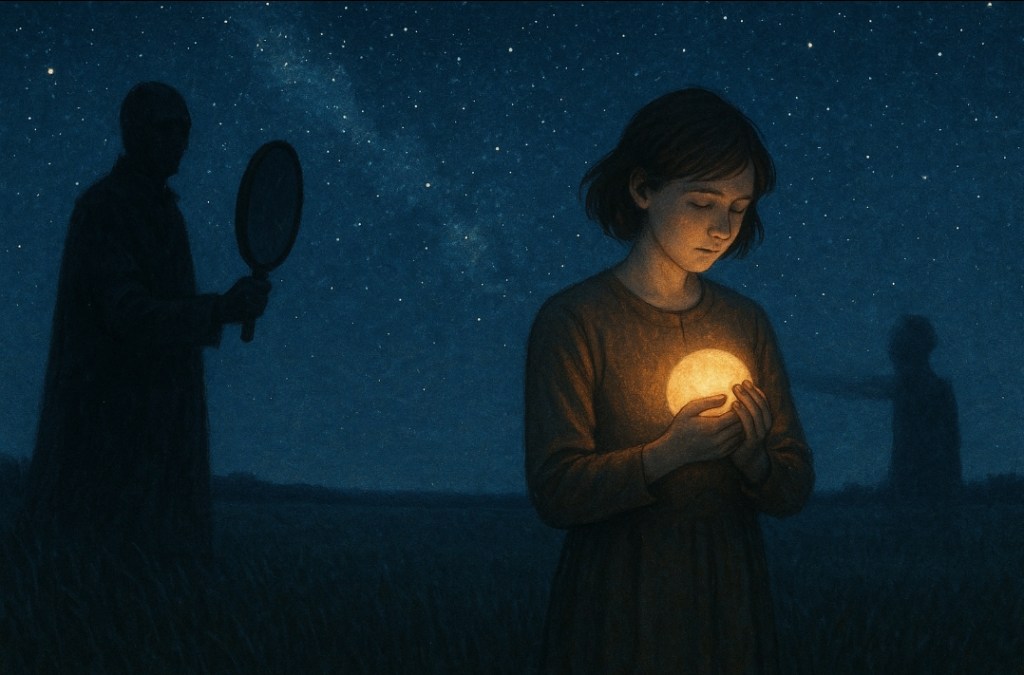
They are not yours to mould. They are not yours to fix. They are not blank slates, waiting for you to write their future.
They are their own person— They have their own minds. Their own dreams. Their own compass.
You are not their sculptor. You are their shepherd.
And the role of a shepherd is not to decide the destination, But to guard the journey. To walk beside. To guide, not drag. To protect, not possess.
You may plant seeds of wisdom, But the soil is theirs. You may shine a light, But the path they choose will not always be the one you expect. Let it be. Let them surprise you.
Do not hand them your fear and call it foresight. Do not give them your regrets and call it tradition. Your job is not to shape them in your image. But to create the space where they can become more fully themselves.
Give them roots—yes. Teach them integrity, kindness, resilience. But do not forget their wings. Let them fall. Let them question. Let them fly where you’ve never flown.
You may not always understand them. You may not always agree. But if they feel safe to tell you the truth— You are doing it right.
And one day, when they look back, They will not thank you for control. They will thank you for trust. For seeing them. For letting go when it mattered most.
Moral:
You were never meant to write their story. You were meant to walk beside them While they learn to hold the pen And write something the world has never seen.
“Not my circus, not my monkeys” isn’t just a meme—it’s a survival strategy. Here’s a couple of examples.
*Your coworker’s third retelling of the office affair they swear is happening. *The group chat erupted over who “started it” at Thanksgiving.
*Someone’s conspiracy theory. *The friend who texts at 2 AM again about the same toxic ex again—but never takes advice.
Here’s the truth: You can care about people without adopting their chaos as your own.
Emotional drama isn’t just exhausting—it’s like a virus without an antidote. And every minute you spend emotionally babysitting someone else’s crisis is a minute stolen from your peace, your focus, or your actual life.
Try these steps the next time someone tries to drag you into their drama.
“Wow, that sounds tough” → (Then change the subject.)
Leave the group chat. (Silently. They’ll live.)
“I’ve gotta be honest—I’m not the best person to help with this.”
Boundaries aren’t cruel. They’re how you stay sane in a world where chaos seems like an orchestra and you’re not sure where the conductor is hiding.
Remember: You’re responsible for the tune you’re playing, so don’t let anyone else tune your guitar.
Enchanting tales about faeries and their etheral magic are at the heart of Irish folklore. If you enjoy that genre, you will enjoy the following story.
TheEnchantmentofCnocFíorúil
In the rolling hills of County Galway, there lay a quiet village named Glenmór, nestled beside the mysterious Cnoc Fíorúil, or the “Hill of the Otherworld.” The hill was shrouded in legend, believed to be a gateway to the mystical realm of the Aos Sí, the fairy folk of Irish lore. Villagers spoke of strange lights and enchanting music drifting from the hilltop on misty nights, but few dared to venture close, probably because parents had been using the reputation of the faeries to make their children do what they were told for generations.
In this village lived a young woman named Maeve, known for her beauty and kindness. She was the daughter of the village blacksmith. Even though she was a good girl, her emerald eyes sparkled with the spirit of adventure. Maeve’s adventurous curiosity often led her to the edge of the forbidden, as she was fascinated by the tales of the faeries and their magic.
One evening, during the Festival of Lughnasadh, Maeve decided to walk up to Cnoc Fíorúil, drawn by an unseen force and the ethereal music she could faintly hear. As she reached the summit, she found herself standing before a ring of mushrooms—an unmistakable faerie ring. The air was thick with enchantment, and the twilight sky seemed to shimmer with an otherworldly light. Against all the warnings she had heard growing up, Maeve stepped into the circle.
The world around her transformed. Maeve found herself in a stunning, vibrant meadow filled with flowers and a crystalline stream that glittered under a sky of perpetual twilight. Before her stood a tall, elegant figure—Fionnuala, Queen of the Aos Sí. She had long, flowing hair that glowed like moonlight and eyes as deep as the ocean.
Fionnuala welcomed Maeve and explained that she had been chosen to receive a rare gift: the ability to see into the true heart of things and people. This gift, the queen explained, would allow Maeve to understand the unspoken truths and hidden emotions of all she encountered. However, there was a condition: she must never reveal the source of her gift, or she would lose it forever and suffer a great loss.
Maeve gratefully accepted the gift and was returned to her world, the vision of the faerie queen and the enchanted meadow lingering in her mind. True to the queen’s words, Maeve soon discovered that she could see the true nature of those around her. She discerned kindness in the most unlikely people and uncovered deceit where there seemed to be only charm. Her newfound insight brought a certain respect from her fellow villagers, who were often baffled by her uncanny understanding and wisdom.
However, Maeve’s gift also brought challenges. She found herself needing to distance herself from people, burdened by their truths she could not share. Because of this, the villagers began to view her with suspicion, whispering that she was in league with dark forces. Her only solace was the company of a young man named Cian, who, like Maeve, was kind-hearted and wise beyond his years.
Cian was a wanderer, a storyteller who had come to Glenmór shortly after Maeve had received her gift. Cian was in great demand by the villagers as he told wondrous tales of distant and mysterious lands. He and Maeve became very close, finding in each other a rare understanding. But Maeve was troubled by a sense that even though there were no untruths in his heart, Cian was hiding something, a sadness that shadowed his bright demeanour.
One night, unable to bear the burden of her secret any longer, Maeve decided to confide in Cian about her gift and the price of revealing it. As she spoke, the air grew still, and Cian’s face turned ashen. He confessed that he, too, had come from the Otherworld, banished by the Aos Sí for choosing a mortal companion. He had been the one to lead Maeve to Cnoc Fíorúil, enchanted by her kindness and courage, hoping she would understand his longing for a human life.
Maeve realised with a start that by revealing her secret, she had fulfilled the condition for losing her gift. As the words left her lips, she felt a sharp pain in her heart. Cian, too, seemed to waver and then, with a sorrowful smile, began to fade from her sight. He revealed that he had given up his immortality to be with her, but now that she had broken the faerie queen’s rule, he was being pulled back to the Otherworld, never to return.
Maeve watched in horror as Cian disappeared, leaving behind only a single silver coin, the token of the faerie realm. Heartbroken and bereft of her gift, Maeve was left with the knowledge of a love she could never fully have. She kept the coin as a reminder of Cian and the world she had glimpsed, a world that now seemed more distant than ever.
In time, Maeve became a revered wise woman in the village, known for her deep understanding and compassion, even though she could no longer see into the hearts of others as before. She often spoke of Cian and the lessons of the Otherworld, reminding the villagers of the beauty and danger of the unseen.
And so, the legend of Maeve and Cian was passed down through generations in Glenmór, a tale of love, sacrifice, and the delicate balance between the magical and the mortal. The faerie ring on Cnoc Fíorúil remained a silent witness to their story, glowing faintly on misty nights, a beacon to those who dare to dream of worlds beyond.