So I took the tests. I read the descriptions. I nodded along when parts fit and quietly ignored the parts that didn’t. For a while, the labels felt comforting. They gave shape to the fog.
But life kept happening.
And with every season lived, something shifted.
I noticed that the person I was at twenty could not be measured by the same questions at forty. The answers changed—not because I was inconsistent, but because I had grown. Travel does that. Loss does that. Love does that. And so, does sitting alone long enough to hear your own thoughts without interruption.
What once felt like personality turned out to be position—where I was standing in life at the time.
The mistake we make is assuming growth should look tidy. Linear. Predictable. As if becoming wiser means becoming more fixed.
In reality, the opposite is true.
The more experience you gather, the harder it becomes to stay contained by simple definitions. You integrate contradictions. You soften sharp edges. You develop empathy without losing clarity. You learn to hold questions instead of rushing toward answers.
This isn’t instability. It’s depth.
Growth is not about discovering who you are once and for all. It’s about learning how to move with who you are becoming.
That’s why rigid labels eventually feel uncomfortable. They freeze a moment that was never meant to be permanent. They describe a snapshot, not the unfolding story.
And maybe that’s the quiet truth beneath it all:
You are not here to be defined. You are here to evolve.
To adapt. To revise. To surprise even yourself.
So if you no longer fit the version of yourself you once understood, that’s not a problem to solve.
That’s life working exactly as it should.
Growth is fluid. And you are allowed to flow.
Click on the link above to read my latest exploration of life and its meaning.
The transatlantic marriage often founders on the oldest rock in the book: You don’t live here. You don’t get it.
It’s the impasse every long-term couple knows—most infamously posed as, “Does this make me look big?” A question where honesty is the first casualty, and diplomacy the second.
Which brings us, inevitably, to the United States and Europe.
One is the dynamic, high-metabolism superpower living the drama in real time. The other is the long-suffering ambassador stationed in the next room, tasked with decoding the moods, soothing the outbursts, and explaining the entire spectacle to a skeptical world—while privately admitting that full comprehension is forever out of reach.
The United States rightly claims her exclusives: perpetual revolutionary fever, the exhausting dream of endless self-reinvention, the eternal hunt for jeans (or policies) that can accommodate both her exceptionalist waistline and her sprawling, contradictory hips. Formidable. Exhausting. Iconic.
But Europe endures a parallel, quieter hell: permanent residency as the live-in envoy to a nation we can never truly join.
Our trials include:
Hostage Negotiation Duty: Fielding inquiries like, “Does this foreign-policy swing make me look… imperial?” Every extraction plan ends in detonation—a trade spat, a summit sulk, or viral meme warfare.
Emotional IT for an OS We Didn’t Code: Providing support for a chaotic system built from Puritan guilt, cowboy optimism, and reality-show spectacle. We can’t Ctrl+Alt+Del it, yet we’re blamed for every global blue screen.
Geopolitical Flinch Response: The five-word thermonuclear alert: “We. Need. To. Talk.” (Transmission source: NATO, Fox/CNN, 3 a.m. hotline.) Fight means a lecture on burden-sharing; flight means tariffs—or a pointed, treaty-shaking silence.
The Fix-It Fallacy: Our brains are hardwired for coalitions and quiet compromise. Yet we’re perpetually informed the real manual is Just Listen—a dialect our archives mysteriously corrupt every four to eight years.
Retroactive Culpability: Being held responsible for American “bloating,” as if the Congress of Vienna secretly ratified supersized portions, suburban sprawl, and the monthly export of existential heartburn.
To summarize, the theatre: America occupies the frontline of constant becoming—a biological and electoral metabolism in permanent overdrive. Europe mans the diplomatic listening post outside the blast doors, parsing signals from an ally whose internal storms obey a rigid two-party hurricane season.
Are the struggles equivalent?Mon dieu, non. Are there casualties? Ambassador, we are all collateral damage.
We share the same alliance mattress, bicker over the thermostat (Paris Accord edition), and keep the UN’s couples-counseling hotline on speed dial. The lights stay on through subsidized agriculture and bureaucratic inertia; the will to continue relies on the faint, desperate hope that tomorrow’s news cycle might feature a different global emergency.
Dispatches from the Old World Embassy. Still standing—by which we mean: leaning perilously, but architecturally significant.
Over.
The United States’ official response was brief:
“I’m not a woman.”
She then turned, swayed her hips, and walked away—confident the conversation was over.
The tiredness of holding opinions you haven’t had time to earn. Of needing clarity before you’ve been allowed confusion. Of believing that a meaningful life requires a finished answer.
What if it doesn’t?
What if a simpler, deeper life begins not with certainty—but with patience?
I’ve come to believe there’s another way of moving through the world. It’s a quieter way. One that trades frenzy for focus and judgment for curiosity.
It doesn’t ask you to know more. It asks you to notice better.
Think of your life not as a puzzle you must solve, but as a collection of small, honest pieces.
* A line from a conversation that lingers. * An article that unsettles something you thought was settled. * A feeling that surprises you by refusing to fit neatly into a category.
Your job is not to explain these pieces away. Only to hold them.
Instead of rushing to conclusions, you gather.
Instead of assuming you already understand, you allow patterns to form slowly—naturally—when enough pieces are present.
And when an understanding does emerge, you treat it as a working compass, not a permanent destination.
You follow it. But you don’t cling to it.
Because you know something essential: this map was drawn with incomplete information.
That isn’t weakness. It’s humility.
This way of living simplifies more than we expect.
In conversation, the need to perform evaporates. You stop listening for openings to speak and start listening to understand. “Tell me more” becomes more powerful than “Here’s what I think.”
In decisions, the fantasy of the perfect choice loosens its grip. You act with the best information you have—calmly, cleanly—knowing you can adjust without self-punishment if new truth arrives.
And with yourself, something tender happens.
You stop treating your inner world like a problem to fix. Contradiction becomes information, not failure. Confusion becomes a signal, not a verdict.
You become less of a project—and more of a presence.
Seen this way, life is no longer a test you must pass.
It is an ongoing collaboration with reality.
The fear of being wrong softens, because being provisionally right is enough to keep moving. The anxiety of not knowing eases, because knowing you don’t know is where all learning begins.
You are not failing to reach a final answer.
You are succeeding at engaging honestly with the mystery.
Sostartsmall.
Pick one question. One relationship. One quiet uncertainty you’ve been trying to force into resolution.
Don’tsolveit.
Just collect a few more pieces. Notice what they suggest. Hold the pattern gently.
And pay attention to how much lighter life feels when you stop demanding clarity on command.
Walk toward what matters.
Let the path reveal itself— piece by patient piece.
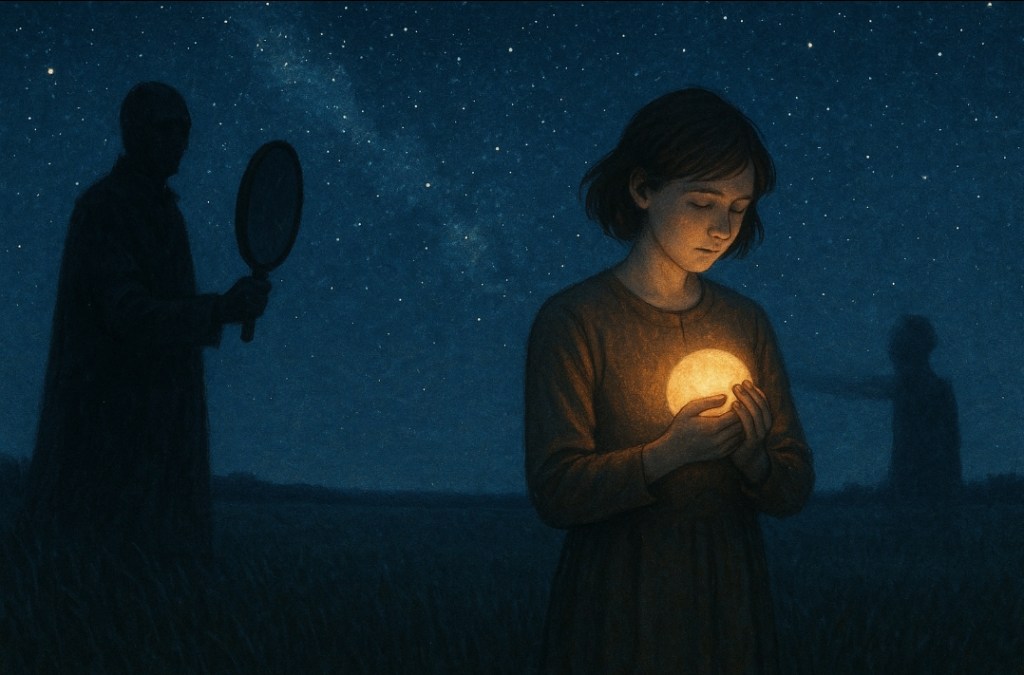
I don’t live in your world, and you don’t live in mine. The landscape of my mind is shaped by memories you’ve never shared, carved by sorrows you haven’t carried, and illuminated by joys uniquely my own. My world is built from private victories and silent struggles, from the books that altered my inner weather and the moments that broke me open just enough to let light in.
And you—you inhabit a universe just as vivid, just as real, yet entirely your own.
Here lies the beautiful, haunting truth of our existence: We are all architects of invisible realms. We walk side by side, exchanging glances and pleasantries, while inhabiting different dimensions of meaning. You may look at the same mountain I see and witness, not stone and snow, but a summer with your grandfather. I may hear the same song as you and be pulled backwards into a decade, a room, a heartbreak you’ll never know.
Our worlds are not merely physical places. They are living interiors—maps of association, memory, and emotion.
And so, you may never fully see my world. I may never fully enter yours.
We will misread each other’s symbols. We will stumble over emotional terrain whose rules were written long before we arrived. At times, we will mistake unfamiliarity for indifference, difference for distance, and silence for lack of care.
This is where things become difficult—and honest.
Because the danger is not that we live in different worlds. The danger is pretending we don’t.
It is easier to flatten another person’s reality than to hold it with care. It’s easier to assume our map is the only map. It’s easier to dismiss what we can’t personally verify. History, relationships, and daily misunderstandings are littered with the wreckage of that refusal.
But what if separation is not a failure of connection, but its beginning?
What if the task is not to see identically but to honour the sanctity of another’s inner world? The bravest bridge we can build is not one that collapses difference, but one that allows a traveller from your universe to visit mine with curiosity—and for me to step into yours with humility.
We are, each of us, lonely planets in the same human cosmos. We spin with our own gravity, orbit private suns, shaped by forces no one else fully feels. We can’t occupy the same space. But we can send signals. We can transmit stories. We can learn to become careful astronomers of each other’s lives—reading the constellations of another’s pain and passion without claiming ownership of the sky.
So let us not fear that we live in different worlds. Let us be awed by it.
Let us meet in the sacred space between realities—the quiet ground of I may not understand, but I am willing to witness. Of I may not have lived it, but I will honor its truth in you.
In the end, our solitary worlds do not isolate us. They make every genuine moment of empathy—every act of careful listening across the divide—a small miracle of cosmic proportions.
You are the sovereign of your universe. I am the keeper of mine.
And in the vast, shimmering space between us, we can choose what to build. Not walls. Not erasures.