Month: May 2026

  • Everyone talks about practice.

    “Just keep practising.” “Put the hours in.” “Repetition is everything.”

    And yes — practice matters.

    But there’s a hidden truth that separates people who improve from people who eventually look effortless.

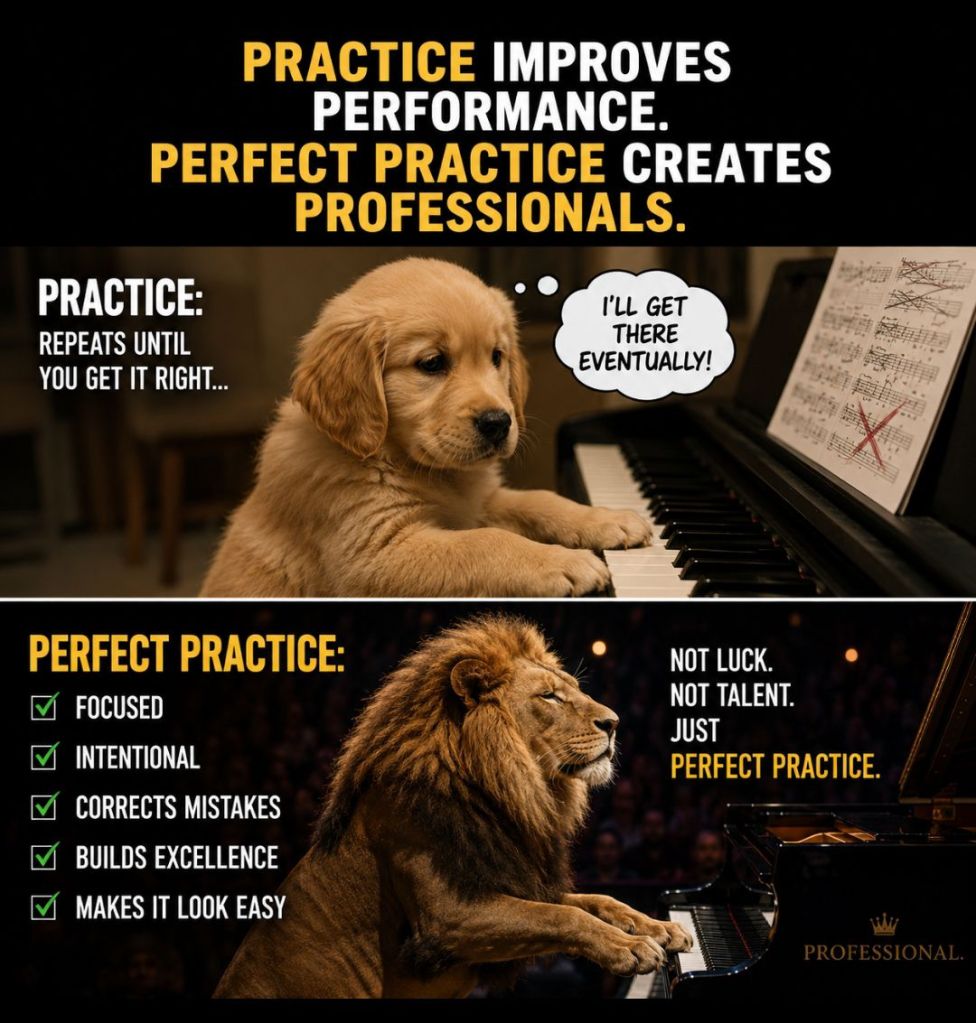
    Practice improves performance.
    Perfect practice creates professionals.

    There’s a difference.

    A person can repeat the same mistake for ten years and call it experience. Another person can spend six months intentionally refining the fundamentals and completely transforming their ability.

    Repetition alone is not mastery.

    Intentional repetition is.

    That applies to almost everything in life.

    Writing.
    Business.
    Relationships.
    Fitness.
    Communication.
    Confidence.
    Emotional control.

    Some people rehearse chaos every day without realising it.

    They practise:

    • distraction,
    • procrastination,
    • self-doubt,
    • reacting emotionally,
    • quitting when things become uncomfortable.

    And eventually those behaviours become automatic.

    Because the human brain does not care whether a habit is useful.
    It only cares whether it is repeated.

    Professionals understand something different.

    They slow down enough to notice what isn’t working.

    They correct mistakes early. They refine technique. They build systems. They repeat the correct behaviours until the behaviour becomes identity.

    That’s why true professionals often look calm.

    It is not because things are easy for them.

    It is because uncertainty has been rehearsed so many times that execution no longer feels chaotic.

    The pianist looks relaxed because the fundamentals became instinct. The athlete looks confident because pressure became familiar. The writer looks effortless because invisible drafts exist behind every polished sentence.

    People call it talent because they never saw the repetitions.

    And maybe that’s one of the most important lessons in life:

    What you repeatedly practise, you eventually become.

    So choose carefully what you rehearse every day.

    Because repetition builds habits.

    But intentional repetition builds mastery.

  • Introduction

    Dysfunctionally Yours Forever is not a love story.

    It is about what happens after the initial impact of falling in love recedes into the daily impact of everyday life. The grand gestures fade. The music stops. Two people who once chose each other wake up in a bedroom that smells like last night’s dinner and this morning’s silence.

    https://amzn.eu/d/086DvL8M

    Ben was never the problem. Naomi was never the problem. They were never threats—only mirrors. They did not break the marriage. They merely illuminated what was already broken: his habit of looking for escape routes before he’s even arrived, her habit of treating trust as a surveillance problem.

    This book is not about infidelity. It is about the thousand small erosions that precede any grand betrayal. The cereal bowl in the sink. The phone left face-up on the counter. The location sharing that feels like safety until it feels like a cage. The photograph taken without permission and kept in a drawer for years.

    The world is full of people performing roles—the good husband, the vigilant wife, the supportive best friend, the mother who stayed and calls it strength. We learn these scripts so early, so thoroughly, that we forget we are reading from a page. Then we marry someone who is reading from their own script, and we wonder why the dialogue does not match.

    Dysfunctionally Yours Forever refuses to judge the performances. It refuses to condemn the compromises. It simply holds them up to the light and says: Look. This is what it costs.

    Some readers will call it slow. Some will call it bleak. Some will recognise themselves in the quiet terror of a marriage held together by unspoken rules and the stubborn, exhausting choice to stay.

    This is not a book about fixing things. It is about staying broken together—and the strange, uncomfortable mercy of that choice.

    Dysfunctionally yours forever is not just a subtitle.

    It is a promise.

  • I was born into a country of storytellers.

    https://amzn.eu/d/0d1d7p3h

    Ireland gave me this: the certain knowledge that the space between a breath and a heartbeat is not empty. It is crowded with whispers. With the almost-remembered. With the ones who walked into a rath (faerie ring) and never came back, or came back wrong, or came back with a fairy’s gift and a faerie’s curse.

    To be Irish is to live in two worlds at once. The world of the clock, the kettle, the cottage range. And the other world—the one behind the green door, the one at the bottom of the lake, the one that opens when you say a name you swore you would forget.

    This is not superstition. It is imagination. And imagination, in Ireland, is a kind of memory.

    We remember the ones who were taken. The ones who followed the music. The ones who stayed too long at the faerie hill and woke up a hundred years later, alone. We remember them not because we believe in faeries the way we believe in gravity but because forgetting would be a smaller country to live in. And we have always chosen the larger country.

    I wrote this book for the ones who wait. For the sisters who keep looking. For the mothers who burn shoes and regret it. For the boys with no names and the fairies who are a bit of idiots. For the electricians who hold onto buttons and the librarians who catalogue love. For everyone who has ever lost something and refused to stop saying its name.

    Being Irish is a privilege. Not because of the green fields or the soft rain or the way we sing sad songs at weddings. Because we were given a heritage of imagination—a permission slip to believe that what is lost is not gone, only moved. That the dead are not silent, only speaking in a language we have forgotten how to hear. That the space between a breath and a heartbeat is wide enough to hold every goodbye that ever ended too soon.

    This book is my small attempt to map that space.

    The Áit Eile is real. It is wherever you put the things you cannot let go. But remember: keeping is not the same as loving. Letting go is not the same as forgetting.

    And somewhere, in a complaints box that no longer exists, a lost button glows blue.

    Go raibh maith agat.

    —Brendan Dunne

    Cill Mór, County Clare
    The year the fair returned

  • Introduction

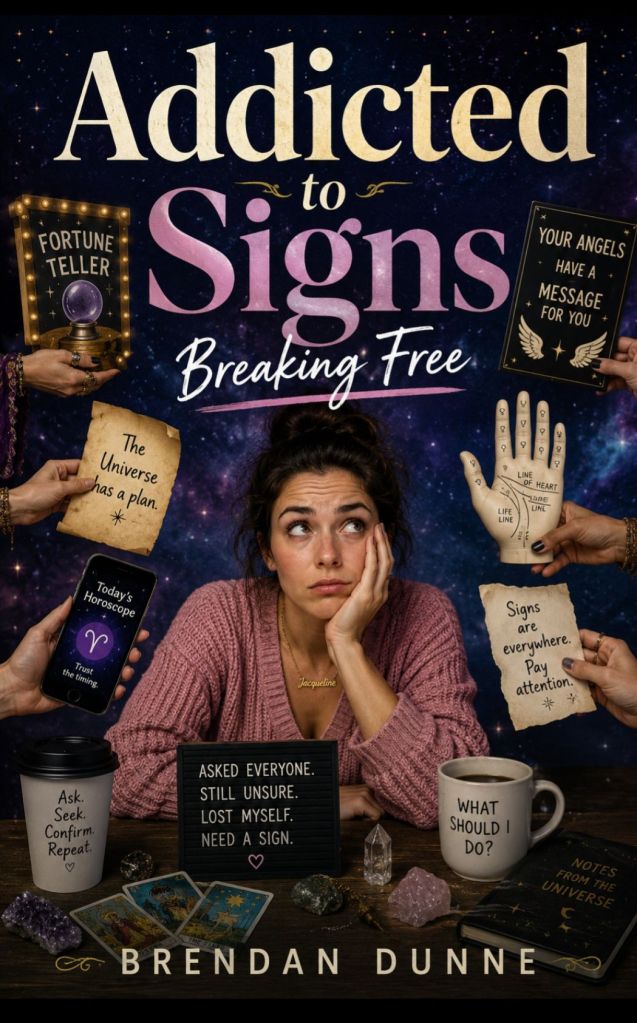
    There is a particular kind of loneliness that comes from asking the universe for answers and hearing nothing back.

    It’s not the loneliness of empty rooms or silent phones. It’s the loneliness of standing in front of a mirror, having done everything you were told—checked the horoscope, consulted the cards, paid the psychic, waited for the sign—and realizing that no one is coming to tell you what comes next.

    This book is for anyone who has ever googled. “Am I happy yet?” at 2 a.m.

    It’s for the people who have rearranged their furniture because someone said having your bed facing north was bad for your health.

    I wrote Addicted to Signs because I believe that escapism is not shallow when the real world feels heavy. I believe that laughter and tears can live in the same sentence. I believe that a story about a woman who breaks three engagements because of a sycamore tree can be both absurd and heartbreaking—and that readers deserve both.

    Jacqueline Prescott is not me. But she is everyone I have known who has ever outsourced their agency to a system, a sign, or a stranger.

    This is not a self-help book disguised as a novel. I have no interest in lecturing anyone about what to believe. That’s their perogative.

    Addicted to Signs is a work of fiction. The psychics are fictional (though the techniques they use are real). The sycamore tree is fictional (though there is one in my neighbourhood that I now cannot look at without smiling). The characters are invented, but their struggles are very real.

    If you have ever asked the universe, “What now?” and hated the silence that followed—this book is for you.

    It will be released in the near future.

    I hope you enjoy reading the story as much as I enjoyed creating it.

    Brendan Dunne